Nirula’s Delhi: Every city has a flavour that becomes part of its identity. Kolkata has puchkas and Park Street. Mumbai has vada pav and Irani cafés. For those of us who grew up in Delhi in the seventies and eighties, that flavour was unmistakably Nirula’s.
This was long before burgers became “gourmet”, pizzas started carrying Italian surnames and cafés began charging ₹600 for coffee while offering free Wi-Fi and attitude. Eating out wasn’t routine. It was an event. Which is precisely why Nirula’s occupied such a special place in our lives. You didn’t drop in because you were hungry. You landed there because something worth celebrating had happened. A birthday. A report card. Relatives visiting from out of town. Father receiving his annual bonus. Or simply because, after weeks of pleading, your parents finally surrendered.
The Connaught Place outlet was the original temple. Later came Chanakya’s basement and the legendary restaurant under the Defence Colony flyover. As the chain expanded, so did its mythology. Every outlet had queues, every queue had stories and every Delhi family seemed to have its own favourite Nirula’s.
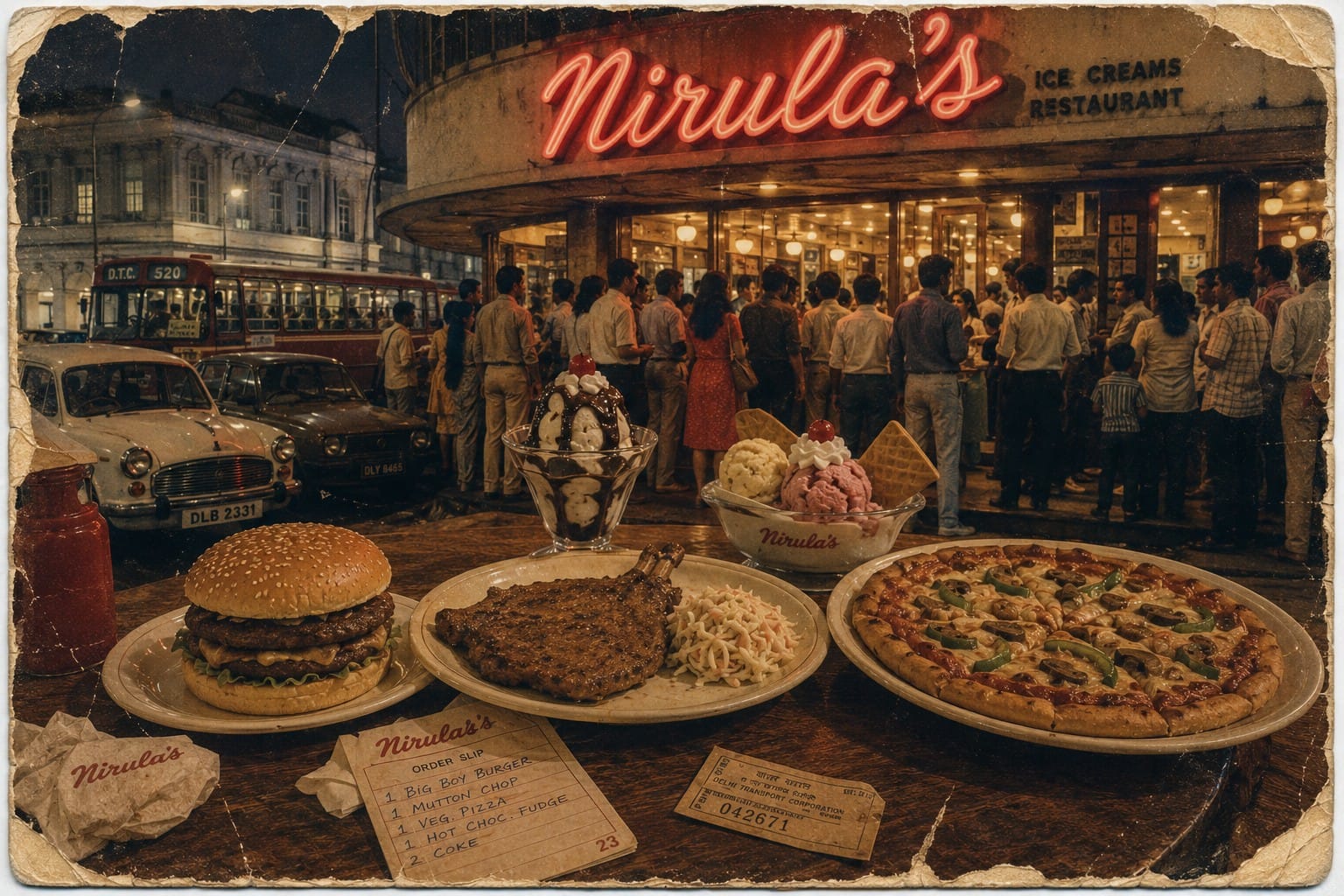
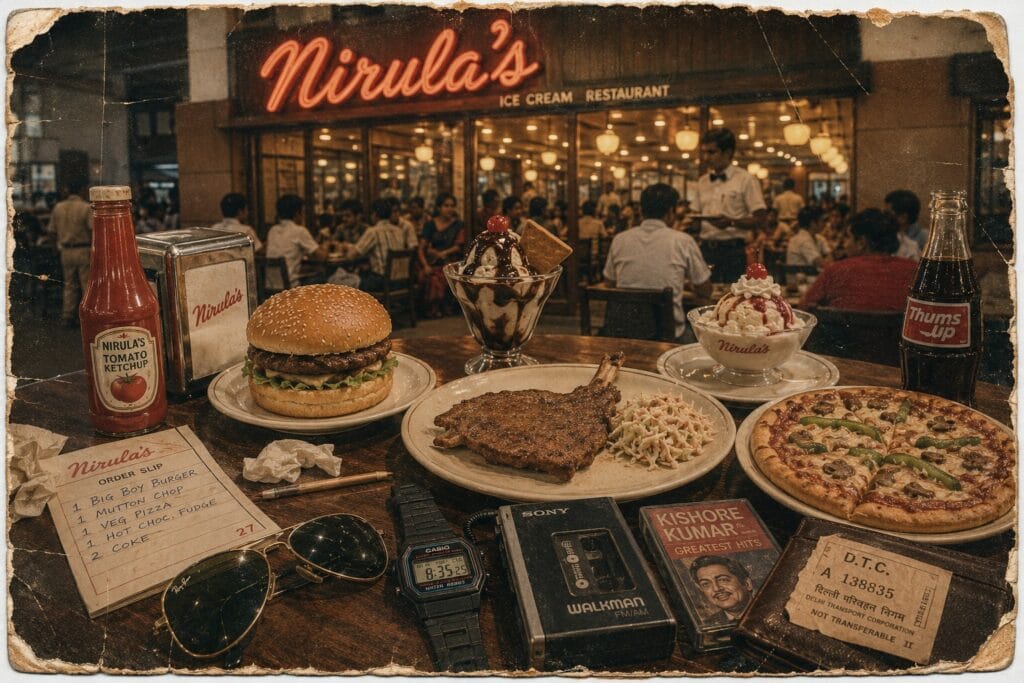
The experience began much before the food arrived. You stood patiently in front of the counter reading the menu painted high on the wall, even though you had already decided what you were going to order before leaving home. The moment the cashier handed over those precious paper slips, the family split into two teams. One hunted for the impossible—an empty table. The other raced to the hot counter before someone else’s order reached the kitchen first. Looking back, those ten or fifteen minutes were an exercise in delayed gratification. Every passing tray carrying a Big Boy Burger or a Hot Chocolate Fudge felt like a personal provocation. Half the pleasure of Nirula’s lay in the waiting.
And then came the Big Boy Burger.
Even today I can remember how it looked before I remember how it tasted. Two thick mutton patties, sauces and relishes threatening to escape from every corner, onions, lettuce and a bun that surrendered somewhere around the third bite. It wasn’t food meant for polite company. Shirts got stained. Fingers became sticky. Napkins lost the battle. Nobody cared because everyone around you was in exactly the same condition.
The mutton chops were another obsession. I honestly couldn’t tell you whether they came from a goat or a lamb and, to be truthful, nobody was interested enough to ask. The accepted way of eating them, at least in my head, was to place a spoonful of Nirula’s creamy coleslaw on top of each bite. That combination remains one of the happiest marriages ever performed in a Delhi kitchen. Add the mutton sausages and the capsicum-mushroom pizza and you had enough reasons to return every month.
The funny thing is that Nirula’s never seemed confused by categories. It sold burgers that people still remember forty years later, but it also served butter chicken, naans, pizzas, Chinese food and desserts with equal confidence. Nobody complained that a burger restaurant shouldn’t be selling butter chicken. Those identity crises belong to today’s consultants. Back then, if the food tasted good, that was qualification enough.
Vegetarians had little reason to feel deprived either. The Veg Burger had a loyal following and those vegetarian pizzas loaded with mushrooms, onions and capsicum were outstanding. In fact, come to think of it, the only other place where capsicum enjoyed such celebrity status was Maggi’s Capsicum Flavour. Nestlé quietly discontinued it years ago in one of the great culinary crimes of modern India. I still insist it was the finest Maggi tastemaker ever invented. The aroma alone could summon hungry children from three streets away. Why it disappeared is beyond me. But Maggi deserves an article of its own, and one day it shall get it.
If Nirula’s was about burgers, Potpourri was about excess.
Long before buffet salads became fashionable, Potpourri at Connaught Place offered an unlimited salad spread that felt almost decadent. The challenge wasn’t how much salad you wanted. The challenge was getting a seat in the first place. Once seated, restraint disappeared. Plates resembled small hills rather than meals.
There was also a little treasure hunt that many of us quietly indulged in. Hidden among the long strips of boiled potatoes were tiny slivers of ham. We all searched for them with the concentration of archaeologists. Nobody admitted it. Everybody did it.
Then there was the wonderfully dimly lit Chinese Room, arriving at a time when Chinese restaurants in Delhi were still rare enough to remember individually. Ginza in Connaught Place, Fujiya in Malcha Marg, Chinese Room, and later Chopsticks after the Asian Games. Golden Dragon, Daichi and Akasaka completed the landscape. Chinese Room, however, had an aura about it. Perhaps it was the lighting. Perhaps it was the décor. Perhaps it simply made us feel worldly. We all began confidently with chopsticks and almost all of us quietly finished with forks.
Dessert was never an afterthought. It was often the reason for coming in the first place. Hot Chocolate Fudge was pure theatre—hot chocolate cascading over cold vanilla ice cream while everyone around the table negotiated who deserved the bigger share. Triple Sundae, Banana Split, Delhi ’66 and Ice Cream Soda completed the ritual. Nobody spoke of calories because calories hadn’t yet become a religion.
Nirula’s also witnessed half of Delhi growing up. First dates happened there. Birthday parties happened there. Families celebrated exam results there. Prospective brides and grooms met over burgers while parents pretended to discuss the weather. College students stretched one burger and one Coke into conversations lasting an entire afternoon because the company mattered more than the food.
Perhaps that’s why every Delhiite of a certain age remembers Nirula’s differently. Mention the name and somebody immediately says Big Boy Burger. Someone else swears by Hot Chocolate Fudge. Another insists the mutton chops have never been equalled. Yet another remembers Potpourri or Chinese Room. The menu changes depending on whom you ask, but the emotion never does.
The food is really just a bookmark.
What we are revisiting is a chapter of our own lives.
Today Nirula’s survives in newer avatars, but like many institutions it belongs as much to memory as to the present. The recipes may be similar, the logo may still be familiar, but time has quietly altered one ingredient that no chef can ever recreate.
Us.
Today’s generation has Michelin stars, celebrity chefs, Korean burgers, truffle fries and food arriving at the door in twelve minutes.
Good luck to them.
We had paper order slips, impossible queues, Big Boy Burgers, mutton chops crowned with coleslaw, mushroom and capsicum pizzas, Potpourri’s salad buffet, Chinese Room’s dim lights and Hot Chocolate Fudge that could silence an entire table for five blissful minutes.
If childhood had a flavour, ours tasted unmistakably of Nirula’s.
Before you go…
If Nirula’s transported you to a Delhi of hot chocolate fudge, family outings and simpler ambitions, continue here:
Puberty, Plaza & the Pause Button;
Nirula’s was owned by our family . My husband Deepak Nirula , deeply interested in food , its chemistry , taste , presentation , took it to a level 3 generations could relate to ….
The article above captures the spirit, emotion and legacy of Nirulas brilliantly .
With regards and thanks .
Ramni Nirula
Dear Ms Nirula,
Thank you so much for your lovely message. It means a great deal coming from someone from the Nirula family.
Like so many Delhiites, I have wonderful memories associated with Nirula’s, and I’m happy the article struck a chord with you.
If I may leave you with one thought—as a lifelong admirer of the brand—I do hope the magic is recreated and the extraordinary legacy your family built continues for future generations. Nirula’s had all the ingredients of an immortal brand, and I genuinely believe it can still be rebuilt to its former glory. Why not give it one more try? I suspect an entire generation of Delhiites would be cheering you on.
Thank you again for your encouragement.
Warm regards,
Sanjay Aggarwal
Dear Ms. Ramani, for people like me who came to Delhi in late 1980s as a bachelor, Nirula’s non veg mini meal for Rs. 18/- was the real saviour. They would give a cutlet with coleslaw, chips and bun. For several years I survived on this until I got married much later.
Also, Nirula’s gave me my first taste of Manhattan Mania, 21 Love, All American Banana Split etc. icecream flavours.
I have very fond memories of Nirula’s Vasant Vihar outlet, near Priya Movie Theatre. It was just across the road from where I lived for 8-10 years. To my dismay, later on this space was given to McDonald’s. But, memories still linger.
On my 75th birthday ( 8 yrs ago ) my son asked me where I would like to go for lunch . He offered me the city . I asked for Nirulas , saying I wanted a Big Boy Burger and Hot Chocolate Fudge . Defence Colony is nearest to our home so off we went . Sadly to find it closed. Biggest disappointment of my life . I continue to look for an equivalent to the Big Boy Burger in Delhi and haven’t yet found it .
So true.I am also searching.