There was a time when you fell ill, you went to a doctor. He put a stethoscope on your chest, tapped your stomach, asked you to stick out your tongue and scribbled something illegible on a piece of paper. You went to the chemist, swallowed the tablets, complained about the doctor’s fees and generally got better. If you didn’t, you went back to the same doctor, who changed the medicine and charged you again. Nobody questioned his wisdom unless the fever refused to go away.
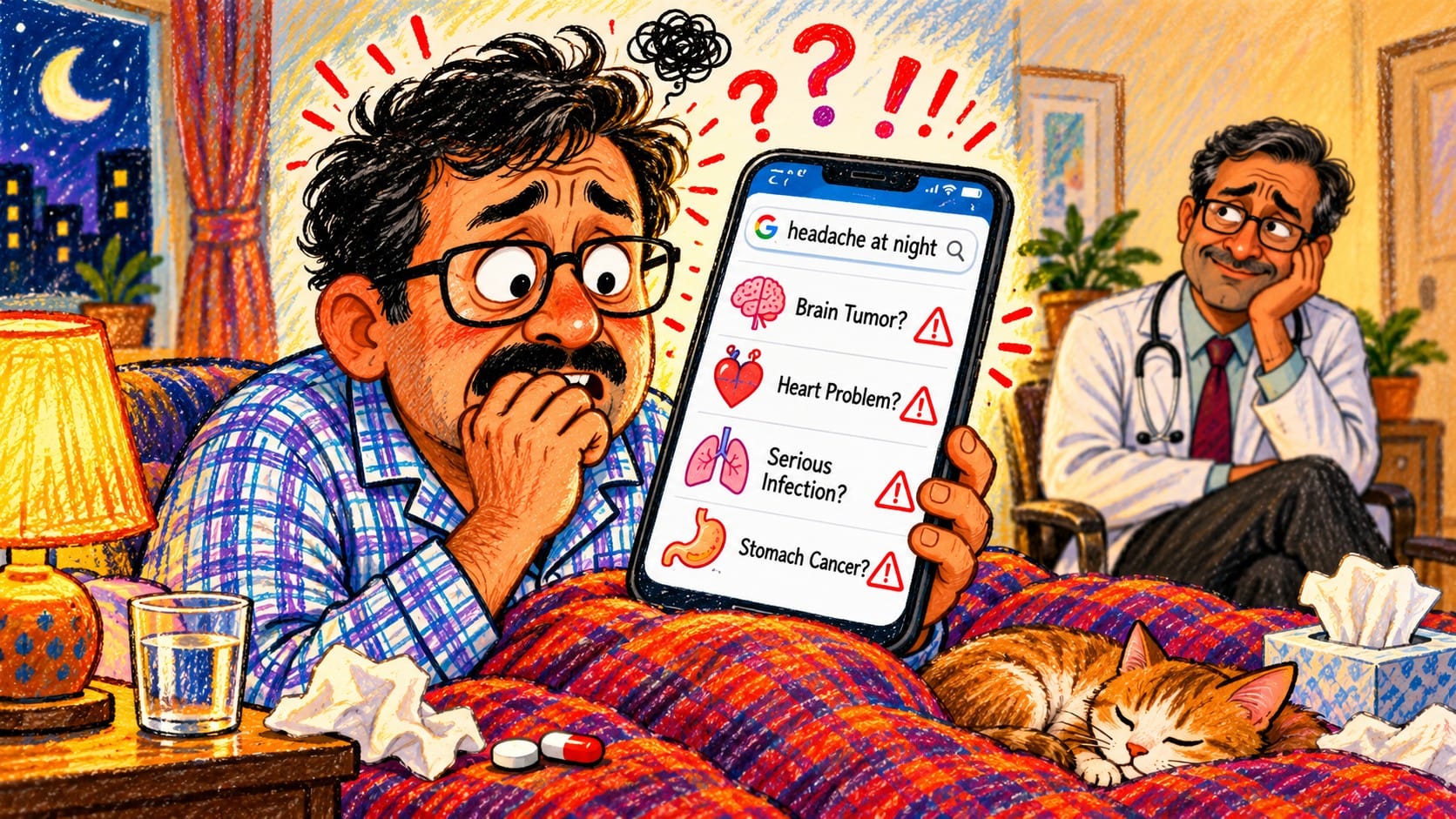
Today, the doctor is usually the second opinion. The first consultation has already happened with Google, free of charge, mostly at two in the morning, while the rest of the family is sleeping peacefully, unaware that someone in the house has diagnosed himself with a potentially terminal illness.
A mild headache, a little dizziness, perhaps some discomfort in the stomach. You type the symptoms into Google and an impressive range of possibilities appears. Dehydration, stress, migraine, neurological disorders and, somewhere towards the bottom, a brain tumour. Naturally, you ignore dehydration. Nobody loses sleep over dehydration. The brain tumour, however, deserves a closer look.
Within fifteen minutes you have moved from headaches to survival rates, treatment options and the best neurological hospitals in the country. Another ten minutes and you are wondering whether the family should be informed. By breakfast the headache has disappeared, but the anxiety is sitting comfortably in your head. Google can diagnose anxiety too, so you get back to work.
The cousin who knows more about cholesterol than your cardiologist has watched three podcasts featuring an American doctor whose name nobody can pronounce. The neighbour has developed considerable expertise in fatty liver after his ultrasound report mentioned Grade 1. Within a fortnight he is advising people with Grade 2 and Grade 3, explaining insulin resistance, triglycerides and metabolic syndrome with the confidence of a professor addressing a medical conference. He has also stopped eating rice and now looks rather miserable.
And there is that indispensable gentleman in every family WhatsApp group who circulates medical discoveries from some mysterious university in America. One morning lemon water cures cancer. The next day turmeric reverses diabetes. By Friday, a particular breathing exercise has apparently cleared blocked arteries in seventeen patients in Japan. The messages invariably arrive with folded hands, red exclamation marks and an earnest request to share this life-saving information with everyone you love. Nobody knows where the information came from, but forwarding is free and carries the satisfaction of having saved a few lives before breakfast.
The medical influencers are another lot. Doctors, nutritionists, wellness coaches, health enthusiasts and people who seem to have acquired their medical knowledge somewhere between the gym and the ring light. They stare intensely into the camera and announce that the food you have been eating for fifty years is silently killing you. Milk is dangerous. Bread is poison. Rice causes inflammation. Fruit contains sugar, sugar causes insulin spikes, insulin spikes cause something else, and before you know it, breakfast has become a complicated biochemical negotiation.
Next week another expert explains why the same food is essential for longevity. Eggs are particularly entertaining. They have been condemned, rehabilitated, condemned again and finally promoted to superfood, depending on which expert the algorithm has selected for the day. Poor eggs. They have suffered more reputational damage than most politicians.
Blood reports have become a favourite pastime. Earlier, the doctor examined the report while you sat patiently across the table. Today, the PDF arrives on WhatsApp before you have even left the diagnostic centre. You open it immediately, enlarge every number printed in red and begin your investigation. A value marginally outside the reference range is enough to send you through five websites, two YouTube videos, a medical journal and a Reddit discussion from 2017.
The reference ranges themselves are a nuisance. One laboratory declares a number perfectly normal while another prints it in bold red. You start wondering whether the first laboratory was incompetent or the second one is trying to frighten you into ordering more tests. Perhaps the technician didn’t calibrate the machine. Maybe the sample was contaminated. The obvious solution is to repeat the test at a third laboratory, which produces a third number. Now you have three reports and no idea which one to believe.
By the time you finally reach the doctor, you haven’t come for a consultation. You have come to examine him.
The poor fellow has spent fifteen years studying medicine, but Google took less than a second to produce seventeen million results. You are naturally inclined to trust the faster one.
The doctor suggests a diagnosis and you inform him that Google has identified four other possibilities. He prescribes a medicine and you immediately ask whether the newer generation of the same drug would be better. He recommends another test and you want to know why he hasn’t ordered the eight additional investigations mentioned in an online discussion. Somewhere during this interrogation, the doctor quietly removes his spectacles, leans back in his chair and probably wonders why he bothered going to medical college.
Of course, if he agrees with Google, he is an excellent doctor. If he disagrees, perhaps it’s time to find another one.
The moment a prescription arrives, the investigation shifts to the medicines. Every tablet is photographed, its composition examined, interactions checked and side effects studied with the seriousness of a criminal inquiry. The manufacturers, in their desire to disclose every conceivable risk, have provided enough material to terrify the healthiest person alive.
A tablet prescribed for acidity may list headache, nausea, dizziness, abdominal discomfort and several other conditions that sound considerably worse than the original acidity. You take the medicine, develop an entirely unrelated itch three hours later and immediately return to Google. The itch may have been there for years, but now it has acquired a pharmaceutical explanation. Some people become so frightened that they abandon the prescribed treatment and return to an unverified herbal concoction recommended by their uncle. At least the uncle doesn’t provide a six-page list of side effects.
The smartwatch has made matters worse. We now have access to heart rates, oxygen saturation, sleep scores, stress levels and colourful graphs throughout the day. Earlier, a man woke up feeling refreshed and assumed he had slept well. Today he wakes up feeling refreshed, checks his watch and discovers that his deep sleep was inadequate. His entire morning is ruined by a device that was asleep on his wrist while he was sleeping.
Heart rates are particularly addictive. You can spend a perfectly pleasant afternoon checking whether your pulse is 62, 67 or 71. A sudden rise is worrying. A sudden fall is equally worrying. Eventually your pulse rises because you are worried about your pulse, which the watch faithfully records, giving you another reason to worry. The watch occasionally advises you to relax, having contributed generously to the problem itself.
This madness isn’t confined to India. Americans have WebMD, Europeans debate clinical studies over dinner and medical influencers from Korea to California dissect the human body in sixty-second videos. One swears by intermittent fasting, another by eating every three hours. Someone recommends cold plunges while another warns against them. The algorithm couldn’t care less whether you are getting healthier. As long as you keep watching, everyone is happy.
There is money in this business. Search for high cholesterol and your phone begins offering supplements, specialised diets, diagnostic packages and advertisements promising to reverse biological ageing. Search for diabetes and you are soon being offered miracle programmes that apparently succeed where generations of endocrinologists have failed. The internet has discovered your medical condition, your anxiety and, more importantly, your wallet.
Artificial intelligence has now joined the consulting room. You can upload entire blood reports, medication lists and discharge summaries and ask a machine to interpret them. It will compare international guidelines, discuss alternative treatments and explain why your doctor might have missed something. If the answer doesn’t suit you, ask the question differently. The family WhatsApp medical expert is facing serious competition. At least artificial intelligence usually manages to spell the disease correctly.
I’m not suggesting we should return to the days of swallowing whatever the doctor prescribed without asking a question. The internet has made medical information accessible, and doctors can certainly get things wrong. But there’s a difference between understanding a disease and deciding you have it after spending an evening reading about it.
I sometimes wonder what happened to the simple business of being unwell. A cold was a cold, a headache was a headache, and an occasional stomach upset was usually blamed on the suspicious chole bhature eaten the previous evening. Now every burp needs an explanation, every meal has a metabolic consequence and every slightly unusual reading requires a family conference.
The other day someone told me his doctor had advised him to stop Googling his symptoms. Sensible advice, I thought.
He went home and Googled whether his doctor was right.