
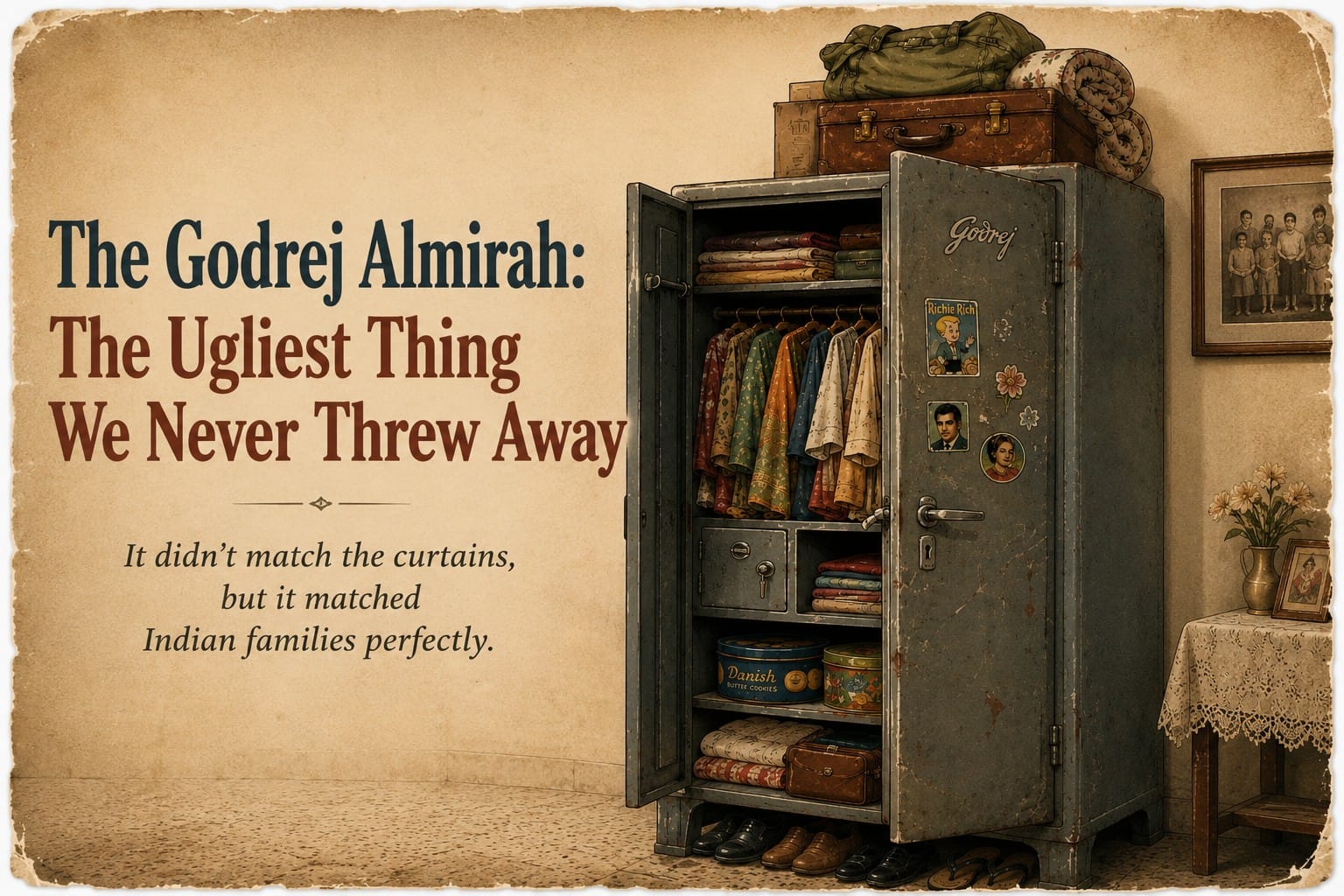
Every few years, someone in the family would look at the old Godrej almirah and say that it had to go. It had become too ugly, too dented and too completely out of place in a house that had otherwise moved on. The almirah, of course, never reacted. It had heard this threat many times and knew that nobody had the courage to carry it out.
It was never a beautiful piece of furniture, even when it was new. It came in those uncertain shades of grey, brown or olive green that made it look less like bedroom furniture and more like something transferred from a government records room. Curtains changed, beds changed, walls were repainted and whole rooms were redesigned, but the Godrej almirah remained where it had always stood, large, stubborn and slightly offended by the idea that it needed to match anything.
Nobody admired it and certainly nobody showed it off to guests. Yet the moment there was cash to hide, jewellery to secure, a property paper to preserve or some important document that absolutely must not be lost, nobody suggested the elegant wooden cabinet. Everything important went into the ugly steel almirah.
That was its strange place in the family. We did not love it, but we trusted it more than almost anything else in the house. It was unattractive, immovable and impossible to replace, which perhaps is why, despite repeated discussions and several renovation plans, it remained exactly where it was.The younger generation simply doesn’t understand the Godrej almirah. To them, it is a crime against interior design. It destroys the carefully curated vibe of a bedroom with its bulky steel body, ungainly chrome handles and unmistakable Lalaji personality. Even the later versions, dressed up with faux teak laminates, couldn’t hide their origins. Underneath all that cosmetic effort, it remained gloriously, stubbornly Godrej.
Yet every respectable middle-class Indian home had one. Many had two. One was usually reserved for the ladies of the house, with rows of neatly hanging saris, carefully folded salwar-kameez sets and winter clothes wrapped in old newspapers. The other belonged to the gentleman, containing safari suits, terrycot trousers, crisply ironed shirts inside transparent plastic covers and perhaps one blazer that emerged only for weddings and formal occasions. These weren’t wardrobes. They were institutions.
The real attraction, of course, was the locker tucked away inside. Long before passwords, OTPs and digital vaults, every family trusted that tiny steel compartment with its stubborn little key. Gold jewellery, fixed deposit receipts, LIC policies, property papers, passports and an emergency stash of cash all found refuge there. It was the closest most Indian families came to owning Fort Knox.
The almirah, however, guarded more than financial assets. Somewhere beneath neatly folded bedsheets and sweaters lay another category of valuables. A well-thumbed Debonair, perhaps a Playboy, sometimes a blue-film VHS cassette tucked discreetly inside an entirely respectable-looking cover. Every teenage boy knew exactly where these treasures were hidden. Every father believed they had concealed them with military precision. Neither side ever acknowledged the obvious, and peace prevailed.
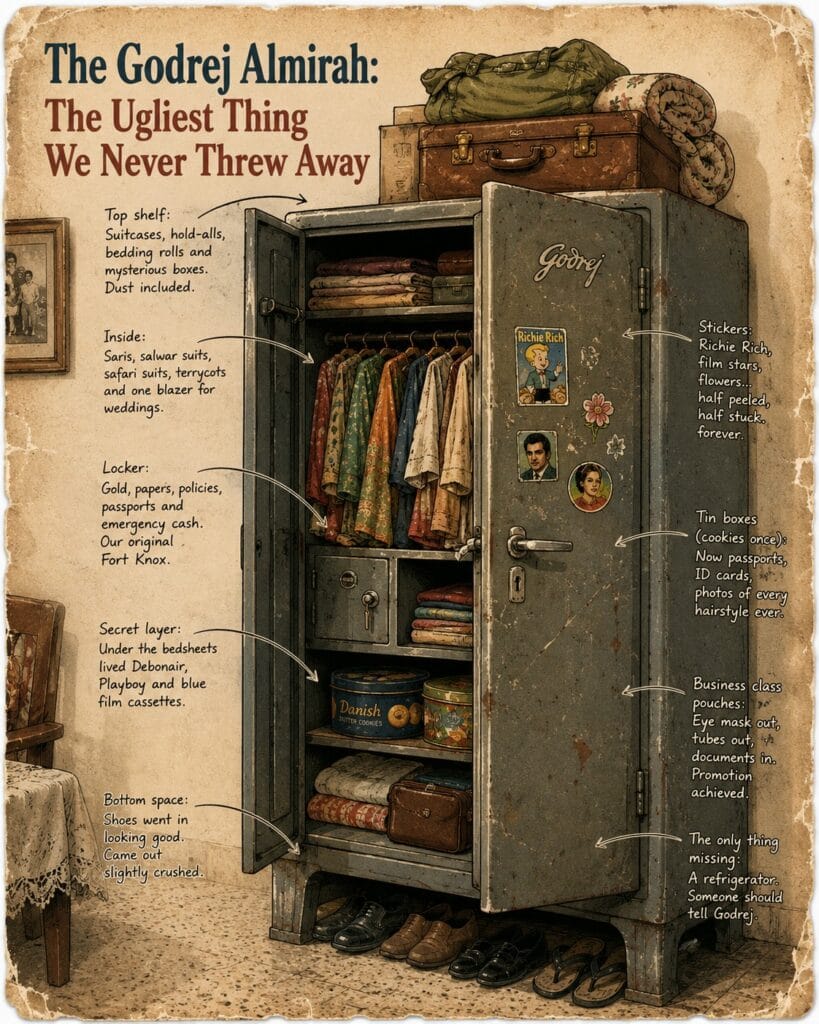
The Godrej almirah also had its own filing system. Hidden inside were those old tin boxes that had once proudly carried Danish butter cookies or imported biscuits. Nobody in India has ever thrown away a perfectly good tin box. Once the last biscuit disappeared, the box simply graduated to a higher purpose. One contained passports. Another held driving licences, PAN cards and assorted identity documents. A third was devoted entirely to passport-size photographs accumulated over decades, faithfully preserving every hairstyle and fashion mistake the family had ever committed.
The tin boxes have become slightly more sophisticated over the years. Frequent travellers now return with those business-class amenity kits that airlines hand out before simultaneously announcing another round of cost-cutting. The eye mask, socks, tiny toothpaste and assorted tubes are removed within minutes and the pouch begins its second innings. Soon it is filled with chargers, medicines, foreign currency, cables or documents. Indians have elevated recycling into an art form. We don’t throw away containers. We simply promote them.
The Godrej almirah was also forced to endure every decorating fad that visited India. There was a glorious phase in the seventies when stickers became the height of sophistication. Richie Rich stickers looked particularly classy to our adolescent minds, although film stars, flowers and colourful designs all found their way onto those steel doors. Years later, when taste improved, the stickers refused to leave. They peeled only halfway, leaving behind stubborn glue marks and sad little fragments that somehow made the almirah look even worse.
Its usefulness wasn’t confined to what lay inside. The flat top served as India’s original storage loft. Suitcases, hold-alls, bedding rolls and mysterious cardboard boxes that nobody had opened for years accumulated there in thick layers of dust. If you wanted an old suitcase, you first had to conduct an archaeological excavation.
The space below the almirah had its own purpose. Resting on two sturdy steel legs, it offered just enough clearance to slide in shoes and sandals. Every family believed this was brilliant space management. It wasn’t. Shoes went in looking perfectly respectable and emerged months later with crushed backs and flattened toes because the height never quite matched. Yet generation after generation repeated the same experiment, convinced that this time the shoes would somehow retain their shape.
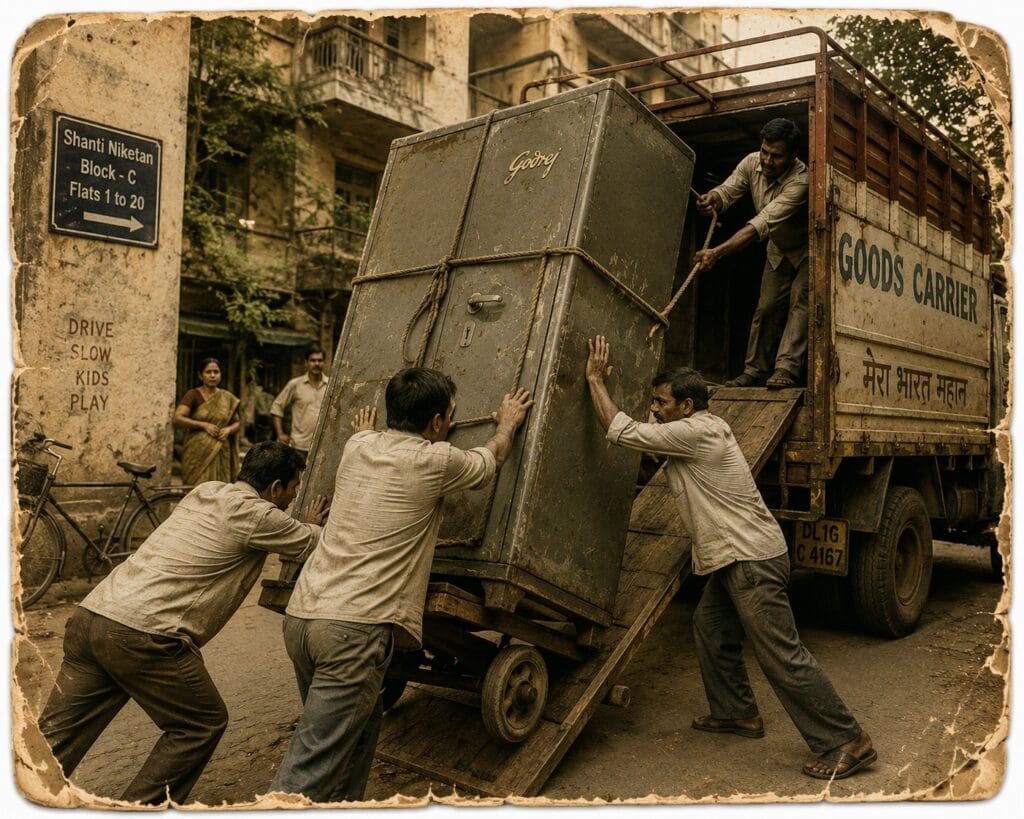
Nothing, however, tested the character of a Godrej almirah more than shifting houses. Modern wardrobes are dismantled and reassembled. The Godrej almirah travelled exactly as it stood. Four movers would wrestle with it through narrow staircases, scrape it against walls, tie it with ropes, balance it precariously on trucks and somehow deliver it to the next address. Every move added another dent and another scratch. The family worried far more than the almirah ever seemed to.
Today’s apartments come fitted with beautiful floor-to-ceiling wardrobes in veneered teak, complete with soft-close hinges and clever lighting. They are elegant, practical and blend seamlessly into the room. Yet ask anyone from our generation whether they would throw away the old Godrej almirah still standing in the corner of the ancestral home, and the answer is usually an embarrassed smile followed by, “Let’s keep it. It still has life left in it.”
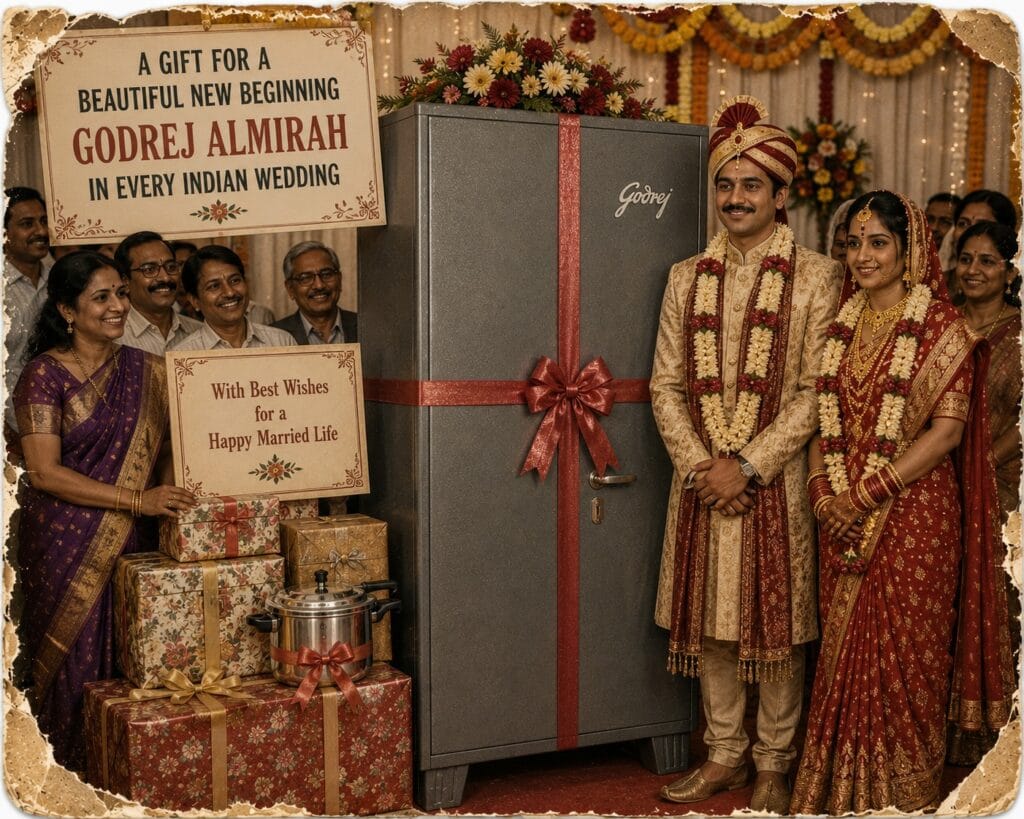
Perhaps that is why the Godrej almirah has survived while so many fashionable pieces of furniture have disappeared. It never matched the curtains, but it matched Indian families perfectly. It watched children grow up, daughters leave after marriage, sons return home with their own children, salaries become pensions and black-and-white photographs become digital albums.
The Godrej almirah’s constant companion was the mandatory double bed from the bride’s side. Indian families somehow agreed that every newly married couple required a bed with storage below, storage behind and enough hidden space to lose a pillow for six months. Retrieving anything from it was an Olympic event. I’ll resist the temptation here because The Great Indian Storage Bed deserves its own essay.
Looking back, the only innovation the Godrej almirah somehow missed was a built-in refrigerator. It already had a locker, shelves, secret compartments, tin boxes, business-class pouches masquerading as document holders and enough family history to fill an archive. Had Godrej managed to squeeze in a tiny fridge, the Indian middle class would probably never have bought another piece of furniture.
Ugly?
Undoubtedly.
Replaceable?
Apparently not.
Before you go…
If the Godrej almirah brought back memories of keys, lockers and clothes that refused to fit, you may also enjoy:





That’s a deeply moving sentiment. A Godrej almirah is often much more than a piece of furniture—it quietly becomes a keeper of a family’s history, preserving documents, jewelry, photographs, letters, and countless memories across generations.oo
My father and mother are no longer with us, but the old Godrej almirah they left behind still stands proudly in our home. It is more than steel and a lock—it is their blessings, their memories, and a silent witness to our family’s journey.
Every time I open it, I am reminded of their love, sacrifices, and the values they passed on to us.
Brilliantly written and magnificently accurate . Loved it
Thanks for liking the post
You said it… We did had one… After some 50 years it is still going strong.. Only thing that has changed is the Owner ship… My sister takes care of it…. Who knows, what the grand children plan to do… 🤪🤪
That’s a deeply moving sentiment. A Godrej almirah is often much more than a piece of furniture—it quietly becomes a keeper of a family’s history, preserving documents, jewelry, photographs, letters, and countless memories across generations.
My father and mother are no longer with us, but the old Godrej almirah they left behind still stands proudly in our home. It is more than steel and a lock—it is their blessings, their memories, and a silent witness to our family’s journey.
Every time I open it, I am reminded of their love, sacrifices, and the values they passed on to us.
Long live Godrej
Will written piece, ours survived may moves as well over the decades.
Last few weeks at a local public school i saw a series of these cupboards bearing the name of its donor and serving as secure storage for class roster, school supplies, teachers laptops, etc.
Thanks for the observation.
Brilliantly delightful! Story of my life 😍
So so true! I have 2 Godrej almirahs .one is almost 80 years old and has a lovely full length mirror..The doors are heavy and strong..The younger one is with us for 55 years and the steel is lighter and not quite as compact! But it also holds all the secrets some jewelry and lots of memories 🌹
Godrej almirah was once upon a time a luxury and over the years has become truly india heritage legacy product across India Rightly said ugly yes ! solid like hell ! GIVES fortnox security feeling ! makes emotional ties with generations Even in our home we have not been able to dispose off this ingenious peice which was bought by my parents in early 50s We have concealed the monster and in a mirror clad wooden case in our bed room
Items tucked inside are age old antique which we rarely see and cannot deal with Hopefully our next generation will deal with it respecfully and carry on the legacy of time tested product
The ugliest thing we never threw away…
Reading this piece on the Godrej almirah brought back a flood of memories. That bulky steel cupboard – dented, mismatched, and stubbornly immovable – was never admired, yet it held our most precious belongings. Jewellery, passports, cash, even secret tin boxes… all trusted to its locker.
It wasn’t just furniture. It was an institution. A silent witness to family milestones, house shifts, and generational change. Ugly? Absolutely. Replaceable? Never.
What struck me most is how something so ordinary became extraordinary in its role – a reminder that trust and utility often outlast beauty and design.
Sometimes the things we don’t show off are the ones that truly hold our lives together.
Godrej almirah used to be an important and most durable furniture for most of the middle class Indian families. Even today we hold one such Godrej almirah.
I love Godrej almirahs.
Best piece of furniture for an Indian home. Other things just don’t compare!
Share your sentiments.
I was inspired enough to put down my ode to the Godrej safe some five years ago … see https://wordotaurus.wordpress.com/2021/11/30/47-a-generic-for-safe/
HI,
Thanks for your comment and I read your blog. Liked it. PLease keep reading other posts and suggesting, commenting, giving feedback.
Godrej Almirah was a must gift for marriage. And there was no equivalent. I remember for my marriage in 1973 my f-in-law had to book for one as there was a queue due to short supply.
Long live Godrej.
Thanks for the reply. As was with everything else in 1973, I guess we had que for Almirah as well. I remember 3-4 years waiting for Bajaj scooters and everyone asking their NRI cousins to book them in NRI quota!!
Infected was called Godrej. Ask anyone where a thing was kept safely and the prompt reply would be – yes it’s in the Godrej. The word Godrej meant safety security and peace of mind.
Godrej became a synonym for a steel cabinet, whatever its size. So much so, that like some asking for Sathe’s Cadbury, many would travel to Ulhasnagar, looking for Arrow’s Godrej, meaning Arrow brand steel cupboard, naturally cheaper. For a little extra, you could get it with Godrej name on it !!!
Nursing a bad flu which refuses to leave despite being threatened by hot steam and antibiotics galore ….the damp weather outside….all gloom until a friend shared this brilliant word to word, nothing spared nor left to imagination piece of literary genius ! What have you not captured here in this little masterpiece ! Kudos ! Bless you and may you keep releasing more of such utterly sweet, engaging and delightful pieces of art👌👌👌
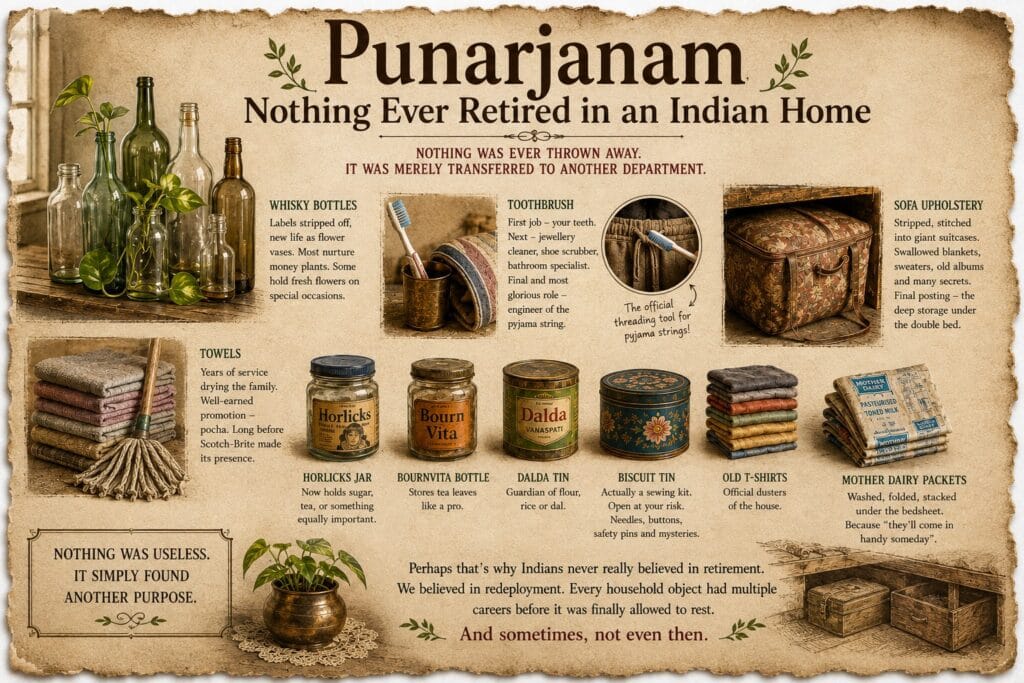
Thanks for the beautiful comment. Please also read Punarjanam & Stepney generation. it might bring back some smile when one is under the weather.
Just loved reading this article! Brought back a whole lot of memories. I am still holding on to one Godrej despite all pressure to get rid of it. Gen next may not appreciate it, but it has its place in Indian cultural history!
Still have one and love it trust it. Amazing piece!! It took me back to childhood days especially the tins/ passport photo/stamps… in fact everything was perfectly described … such a beautiful piece. Will forward it and I am sure our Gen will understand and love it😊
Thanks Madhvi
Brilliant … wonderful article .. beautifully written.. one can immediately connect with it. My mother had a “lohe ki almari” which was a part of our family for decades.. family heirloom!!
Thanks Seema for your response.
I still have a Godrej almirah (military olive green) from the 1970s that came with wife (no, not new … I mean, the Godrej)!
It has moved from Lucknow to Kolkata to Patna to now Delhi.
It is become a storehouse of documents (once upon a time clothes that have found inbuilt cupboards), which mysteriously become untraceable when needed urgently.
Only once I saw it dance. That was in the wee hours in 1988 when the earth shook — and setting this intrepid journo off to Ground Zero near the Nepal border, casting aside the planned Sunday lunch party for which I had assidously plucked, till past midnight, the dainty plaintain flowers for the delectable mocha-r chop and charchari.
Thanks Abhijit for the wonderful description. Please read thru my post on Kolkata : Amar Prem…. and Sharmila. I love mochar chop…..
A group with ethics, values & customer centricity in all its operations !
I am more than 70 years.Got connected right away with your amazing and beautiful write up.
It was as if someone has mirrored all that happened in our house and caricatured it to the smallest detail.
The beautiful Godrej Sturdy Steel Almirah found a place of pride in our small home and still continues to occupy a place though we have moved into a bigger home with more Pricey and sophisticated furniture with the changing times and trend; yet this invaluable piece still stands tall as it carries the wonderful memories of my parents and our growing up years! Kudos to you for reviving and jogging the wonderful memories which was deep down in the hard disc and to be frank made me emotional too!!
We had 2 in our home..
After parents left us , I don’t know where the Almirahs went.
If anyone knows where I can buy one..I would love to acquire one.
I bought a midsize Godrej cupboard for Rs 600/- in early sixtees raising a bank loan and it still serves me good. Nothing to replace it. I have not even repainted it.
Hi, Thanks for the comment.
Some of you may recall, the Godrej had an equivalent – it was the Atlas cupboards. Equally sturdy and similarly cherished.
Delite was another brand that was sturdier at times. Kirti Nagar special in Delhi.
Every boarding school kid had one half-size Godrej that got passed on from one Gen too the next.
That unmistakable sound of shutting and opening will live on.
Must try the sound to awaken those in comma. May just work…
What a lovely read – spot on.
It opened up a ton of memories and brought a smile to my face.
Thank you!
Yes, the ‘military’ green giant in the room. Almost a living thing. No, certainly a living thing. An old faithful servant. A go-to object that somehow hands you that long-lost document or photograph. A Manna Dey song that never gets old. Imitators were many. But for Godrej they were water on a duck’s back.
Thanks for giving life to an object. strange how it was always there that it became family.
Wow!!
Words can’t perhaps express how it felt while reading through this beautifully scripted article! Every sentence took me back to our childhood and resonated so much more – the Godrej Almirah was more than a piece of furniture to us – clothes, books, pens, toys and the naughty raunchy magazines too went in – as if it had limitless space to accommodate everyone’s special or usual requirements!
And the locker – the keys of which were only with Maa and Baba – as they had all the essential documents and petty cash too.
Truly overwhelmed with nostalgia and memories!
Keep writing and posting!
Thanks for the lovely comment
I am new to your Tadka Life. Absolutely loved the post on Godrej Almairah. Brought back happy memories of my mother and her obsessive fondness for her two almairahs. You have captured the sentiments so very well. Thank you for this lovely post.
Hi, Thanks for your beautiful comment.
Excellent article, beautifully written. Enjoyed thoroughly and brought back good old memories of those days!.
This is for Vivian Verma— I have 3 godrej – 2 big and one small. I can give one to you if you really mean to have one.
Today’s digital world may have made many things virtual, but it has not made the humble Godrej almirah irrelevant. A digital locker may store documents, photographs and memories in the cloud, but a Godrej almirah stores something more tangible—our clothes, certificates, letters, old photographs, family treasures and, above all, memories.
For generations, it has stood quietly in our homes, surviving moves, changing fashions and changing times. In a way, the Godrej almirah is not merely a piece of furniture; it is a silent witness to family life. Some things may become digital, but the need to preserve what is precious will never disappear.
I am Manjunath , and I arrived into this world in 1956. But our Godrej almirah arrived in 1954. A 5 foot petite piece that still exists without a dent despite 15 transfers.
When booked by my father it’s cost was 106 Rs. When it arrived price was increased to 110. That’s what my father told me. Probably he was bitter to pay an extra 4 rupees.
Both my parents left.
But this is one item that reminds us everyday till my end.
Next generation cannot understand the sentiments packed in this Godrej.
I might have opened it few thousand times in childhood.
Lay on the top of 5 feet was account book. All 4 of us are free to use money but note in account book.
When I knew and could understand life by 1966 , my father’s salary was 400 rs as an assistant engineer.
An imported BSA bicycle was his great asset . It was lost after 22 years of excellent service.