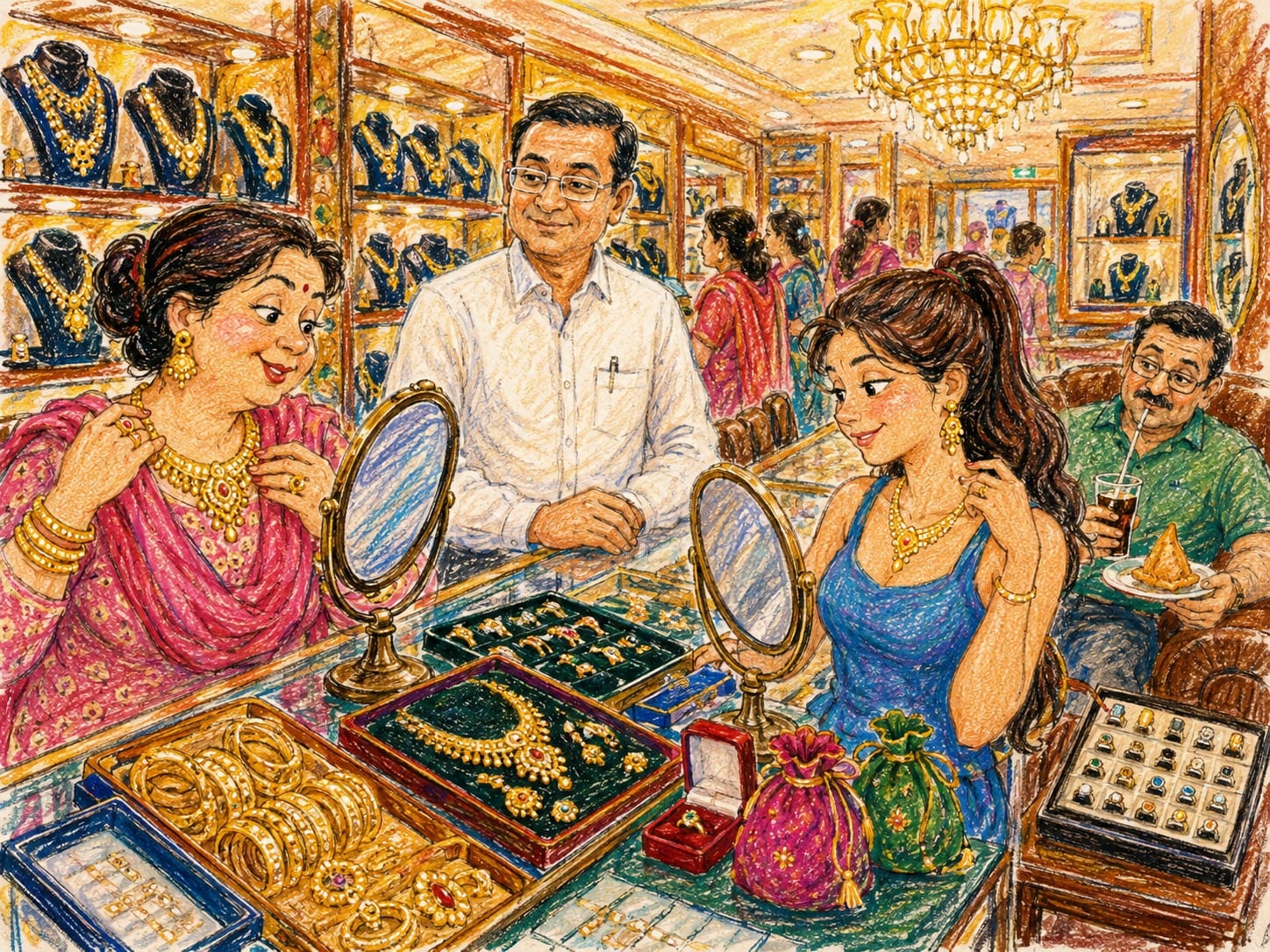
Your friendly neighbourhood jeweller always appears strangely unruffled. Crisp white shirt, preferably linen, ₹50,000 Silhouette spectacles resting over his ears, perhaps with platinum supports for all you know. His face has that peculiar jeweller glow which I have never understood. Why do jewellers have such Korean-glass skin? Maybe they do a facial every morning before opening the shop, or perhaps generations of desi ghee and kaju are finally doing what every dermatologist promises and making the skin shine and look translucent.
The shop itself is another matter. Italian marble, large glass doors, chandeliers, security guards and showcases lit as if some royal treasury is inside. All this grandeur completely belies the actual business model because inside, Bhatia aunty is negotiating making charges for her daughter’s wedding jewellery.
Our desi-ghee jeweller listens patiently, scribbles something on a small notepad, tears off the sheet and slides it towards her. For some reason jewellery prices have to be negotiated like secret defence deals and are rarely spoken aloud.
Bhatia aunty is no stranger to these miss-if-you-blink negotiations.
“Kya baat kar di aapne. Itna zyada? Hamare poore khandaan ne aapse jewellery banwayi hai. Aapke pitaji Bhagwan Dasji hamesha adjust karte the.”
Bhagwan Dasji continues to participate in the business long after retirement.
Another number is written, another chit moves across the counter and Bhatia aunty is still not convinced. Gold rates are discussed, old relationships are recalled, family loyalty is invoked and references to how Bhagwan Dasji used to deal with people keep coming back. This can go on for a while.
Meanwhile Geetanjali is looking at designs.
And there lies the basic problem of wedding jewellery. Geetanjali is looking at design while Bhatia aunty is looking at weight.
Geetanjali wants something elegant, delicate and contemporary. Bhatia aunty looks at exactly the same necklace and sees very little gold.
“Isme hai hi kya?”
Geetanjali tries explaining that this is precisely why she likes it.
But better design usually means more workmanship and more workmanship means higher making charges, which Bhatia aunty has spent the last forty-five minutes trying to reduce. So both are effectively shopping for different things. Aunty wants a stone; Geetanjali wants a delicate pebble.
Mr Bhatia, meanwhile, is sitting slightly behind them sipping Coke. Nobody has consulted him yet because his role has not arrived. Bholaji knows this and keeps the Coke coming while mother and daughter struggle with design, weight, stones and making charges.
By now the assistant has practically emptied the shop in front of them. Necklaces, earrings, rings, sets and velvet trays are spread across the showcase. The original purpose was to buy jewellery for Geetanjali, but somewhere along the way Bhatia aunty has also started trying things on.
Aunty, you really don’t need more jewellery. It is your daughter getting married.
That, of course, is beside the point.
Now both are peering into those small mirrors kept on stands over the glass counter, sometimes three mirrors joined together so that you can inspect yourself from different angles. Bhatia aunty tries on a pair of earrings, turns her face slightly left, then right, looks at herself once more and is clearly warming to them.
Then she turns towards Mr Bhatia for that small nod of approval which really means: please loosen the wallet now.
Unfortunately, Mr Bhatia is not following the jewellery discussion at all. He is immersed in his investment app, checking the latest portfolio returns as the Iran war heats up and his holdings gyrate royally. While Bhatia aunty is deciding whether the earrings suit her face, he is watching several lakhs disappear and reappear on the screen every few minutes.
“Haanji?” she asks.
He looks up briefly, gives the vague nod of a man who has absolutely no idea what he has just approved, and goes back to the portfolio.
Only then does Bhatia aunty notice something else.
“Yeh dheela hai.”
“Ho jayega,” says White Shirt.
“Isko theek karwana padega.”
“Bilkul.”
“How much time?”
“One week.”
“One week?”
The marriage is still two months away, which White Shirt mildly points out, but this does not help. In wedding shopping, two months is very little time and one week sounds like an unreasonable delay.
By now Mr Bhatia has graduated from Coke to a samosa. He is eating quietly when White Shirt casually mentions that men’s rings are coming back in fashion.
Mr Bhatia looks towards him.
A tray is brought out.
There are plain bands, heavier rings, stones, no stones, different finishes. White Shirt mentions that a proper stone can also be fitted and he happens to know a very good gems guy whose recent predictions have all gone right.
Within a few minutes Mr Bhatia, who had entered the shop purely as the financing arm of the family, is trying on a ring with half a samosa still in his hand.
The whole scene gets even better when the customers happen to be NRIs.
Then the calculator comes out.
Prices start moving between rupees and dollars while mineral water is being sipped and the accent has become just a little more visible. White Shirt has also quietly registered that the return flight is in a couple of days.
Arora aunty still has half the trousseau to buy from Kinari Bazaar in Chandni Chowk. Suits are yet to be collected, blouses need alteration, some gota work has still not arrived and someone suddenly remembers that the gifts for the groom’s bua are still pending.
Everything in rupees looks expensive, but somehow the moment it is divided by eighty-something and converted into dollars, it begins to look reasonable.
“Only twelve hundred dollars?”
A necklace costing around a lakh suddenly starts sounding like something one could pick up at the airport.
The NRI couple is rarely alone. There is usually an Indian niece, nephew, cousin, sister or another aunty accompanying them to help with bargaining, local knowledge and currency conversion. They begin with great seriousness, punching numbers into the calculator and explaining exchange rates, but after some time the niece is looking at earrings for herself and the accompanying aunty has also found a pair she likes.
Somewhere during all this, the dhokla arrives.
After hours of negotiation, trying, removing, checking, calculating, eating and consulting gemstone people, the elephant finally enters the room.
Elephant in a jewellery shop? No, no. Mode of payment.
That itself is a separate story and can run into several pages, so best left for another day.
But there is still one final matter to be settled.
The box.
One has just become poorer by several lakhs, but the packaging now has to be top class. White Shirt lines up boxes and potlis which look like designer accessories in their own right. Velvet, satin, embossed logos, ribbons and magnetic flaps. The jewellery is carefully placed inside while Bhatia aunty inspects the presentation.
Never mind that once the jewellery reaches home, hardly anyone remembers the box.
The pieces eventually go into the locker, often wrapped in that familiar red wrapper or put into a small potli because it is far easier to store. The elaborate box with that satin mound rising in the middle occupies half the locker, refuses to stack properly and becomes an irritation almost immediately.
Still, at the shop, the box is very important.
“Achha box dena.”
The jewellery is finally packed. Geetanjali has what she wanted, Bhatia aunty has managed some reduction in making charges, Mr Bhatia has finished his samosa and nearly acquired an astrologically recommended ring, while White Shirt still looks exactly as fresh and unruffled as he did when they entered.
But the afternoon is not over because gol gappas are still pending.
“We’ll pick everything up after we come back from the chaat counter,” says Bhatia aunty, gathering her handbag and stepping out in her Birkenstock chappals, sensible footwear for an afternoon of roaming around the market.
After all, jewellery can wait in the shop for another half an hour.
Gol gappas cannot.
Come walk with me to my gym and look inside……..