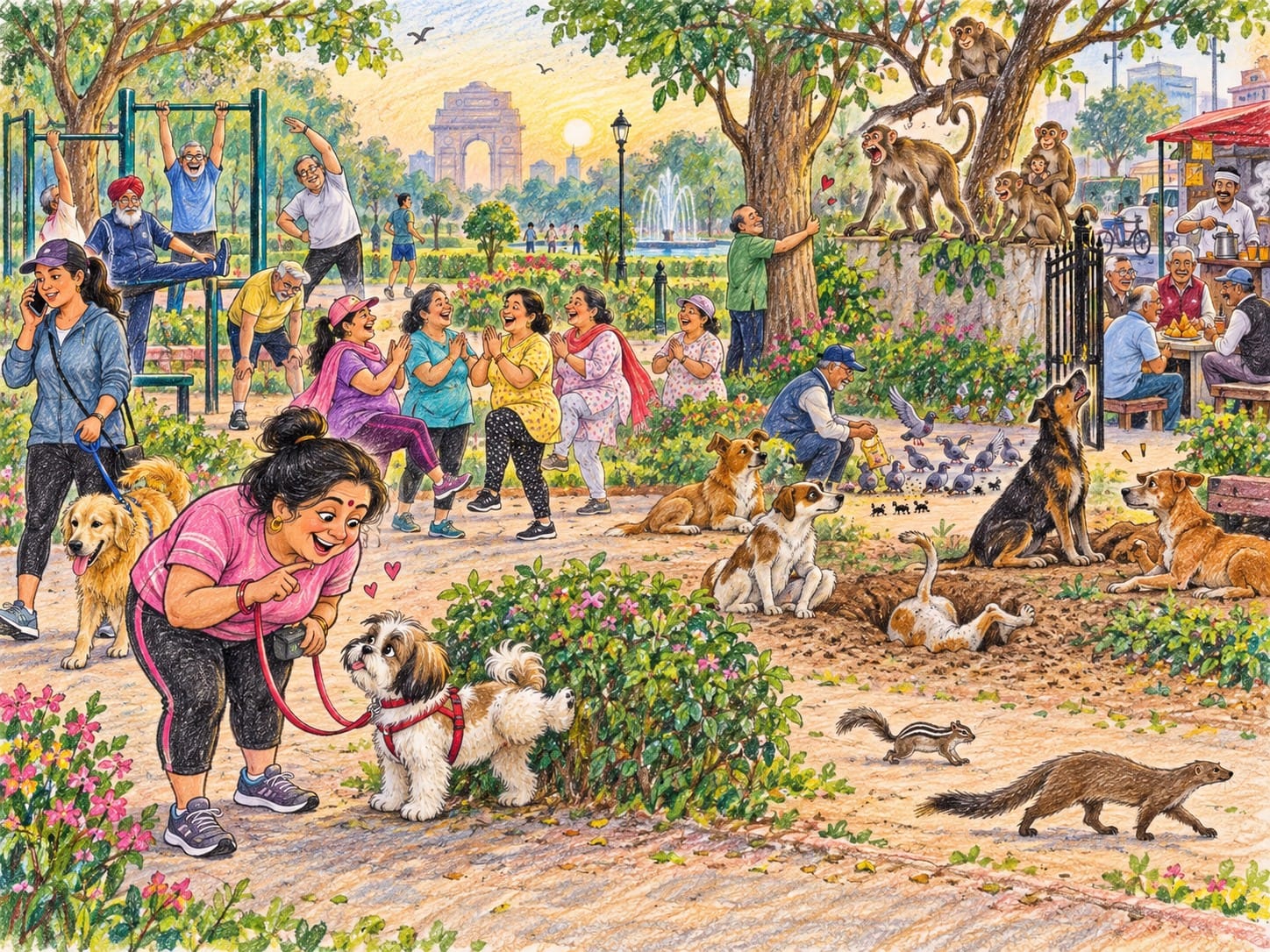
Auntie is talking to her tiny dog as I walk past.
I have never quite understood how this works. The distance between Auntie’s mouth and the tiny dog’s ears is considerable, yet she talks to him as if every word is being carefully processed.
“Chintu, idhar aao. Chintu, don’t do that. Chintu, good boy.”
Whether Chintu understands a word of it is anybody’s guess, but Auntie is in complete conversation with him. Not the sort of conversation one has with a pet either. This is closer to talking to a child who happens to be four inches above the ground and covered in fur.
And, in a way, it is very cute.
You are walking past, trying to complete whatever number of steps your watch has decided is necessary for your survival, while Auntie and Chintu are in their own little world. Auntie is in total bliss. Chintu, meanwhile, usually has other things on his mind — an interesting bush, a suspicious smell or an urgent need to lift one of his hind legs against something.
But Chintu needs to be careful.
Because it is a jungle out there.
Every park has another population which doesn’t arrive on a leash, doesn’t wear a little jacket in winter and certainly doesn’t answer to Chintu.
The resident dogs.
There is usually an entire gang of them, lying around the park like extras from Reservoir Dogs. One stretched flat across the pathway, another curled into an impossible angle under a bench, a third sleeping upside down with all four legs pointing in directions that would concern an orthopaedic surgeon.
Some of them dig shallow holes in the earth with their paws and settle inside, presumably because ordinary ground is not comfortable enough. They spend the morning looking completely unemployed and remarkably content.
Until their breakfast Auntie arrives.
She comes every morning carrying food for them and suddenly the entire gang springs to life. Tails wag, bodies straighten and expressions change. Breakfast has arrived.
She knows them individually too. There is always a Kaalu, a Sheru, perhaps a Moti who is neither particularly fat nor particularly pearl-like. She speaks to them with the same affection with which Chintu’s Auntie talks to Chintu.
For a few minutes, peace prevails.
Then another dog enters the park.
And everything changes.
The same creatures who were lying five minutes earlier in positions suggesting complete surrender to life suddenly become territorial commandos. One bark is answered by another, the whole gang gets up and the unfortunate visiting dog realises that municipal parks apparently have invisible international borders.
Chintu, of course, has no idea.
He is still sniffing a hedge while Auntie continues explaining life to him.
And then there is Whisky.
Not the single malt or blended variety that appears in glasses later in the evening. This Whisky has four legs and saunters around the park with extreme confidence.
Whisky walks with his owner but doesn’t appear to believe much in the concept of walking with anyone. He wanders away, inspects something under a tree, disappears towards a hedge, gets distracted by another dog and then, after a while, casually returns to his owner.
No panic. No apology.
Just complete confidence that the chap will still be there.
Then off he goes again.
There is something wonderfully independent about Whisky. Chintu seems to need continuous conversation and reassurance. Whisky appears to have concluded that relationships require space.
He keeps straying and coming back, straying and coming back, while his owner continues walking with the relaxed confidence of someone who knows Whisky eventually will.
Perhaps that is their arrangement.
Then there are the dog walkers.
They move around the park in a world entirely of their own, usually talking to someone back home in some eastern or western corner of the country. A few adventurous ones have the video on as well, so while the dog is trying to examine a very important patch of grass, the walker is discussing breakfast, family politics and somebody’s wedding with a face appearing on the phone screen.
It is seven in the morning, the air is crisp, and the dog at the other end of the leash is probably having an existential crisis.
Where the hell is my owner?
The same person who lovingly pets me in the evening, scratches behind my ears, calls me baby and occasionally lets me occupy half the sofa is now either sleeping, reading the newspaper or drinking tea somewhere upstairs.
And I have been outsourced.
Instead, I am walking with this fellow who has barely looked at me since we left home.
He has earphones on. Some raunchy song is playing loudly enough for me to hear it too. Strangely, I think I heard the same song yesterday from the security guard’s phone.
Who exactly am I?
In the evening I am family. I am hugged, kissed, photographed and introduced to guests with considerable pride. In the morning I am a logistical assignment attached to a leash.
The music keeps gyrating. The walker keeps talking. I stop.
Nothing happens.
I stop more firmly.
Still nothing.
Finally, I jam all four paws into the ground and refuse to move another inch. That gets his attention.
Because, boss, it is potty time.
For the first time since we left home, he looks at me.
And perhaps, for one brief moment, we understand each other perfectly.
What a dog’s life.
Except that even that expression now seems unfair to dogs.
And then, occasionally, the monkey family arrives.
Bloody hell.
You can almost feel the mood of the park change.
The Reservoir Dogs notice them first. The monkeys notice the dogs. Both sides become cagey. Nobody really knows who is stronger, but neither side is willing to admit that little uncertainty.
Suddenly the park becomes The Jungle Book.
The monkeys become the Bandar-log, shrieking from branches and walls, while the dogs below behave like the wolf pack guarding their territory. Every now and then one side makes a little advance and the other responds with enough noise to suggest that a full-scale jungle war is about to begin.
The dogs growl and bark. The monkeys bare their teeth and shout from above. One monkey sits on a wall looking as if the entire park belongs to his grandfather. A large dog below looks back with exactly the same expression.
Neither is going anywhere.
The whole park gets disturbed.
Sparrows disappear from the bushes. Birds fly off from the trees. Walkers slow down but maintain a respectable distance. Even the aunties temporarily stop their conversations. Chintu is hopefully picked up before he decides that this is the morning to discover his inner Shere Khan.
For ten minutes, a perfectly bright Delhi morning turns into a neighbourhood version of The Jungle Book.
There is barking, screeching, growling, branches shaking and considerable posturing from both sides. Nobody actually seems interested in starting a proper fight. The objective is simply to convince the other party that, should matters escalate, terrible consequences will follow.
Eventually the monkeys move on.
Nobody knows where they go. They simply arrive like visiting relatives, disrupt the entire household and then disappear.
Peace returns.
The Reservoir Dogs go back to their holes in the ground. The sparrows return. Auntie puts Chintu down. Whisky wanders off again. The dog walker resumes his phone call and whatever song he was listening to.
And then there is the morning human population.
At around six-thirty, a club of joyous and boisterous aunties takes over one corner of the park. Full of life, they clap away to glory in perfect rhythm. It must be some exercise. Or perhaps laughter therapy. Every now and then a collective “ha ha ha ha” rises into the morning air with such force that even the birds must wonder what exactly happened.
The uncles are around too.
Some are attempting yoga with great seriousness. Others are stretching, rotating shoulders, bending knees or using those colourful contraptions that municipal parks optimistically call gym equipment. There are bars, wheels, swings and assorted moving parts designed, I assume, to keep ageing joints in negotiation with the rest of the body.
Everyone is trying to keep something moving.
A shoulder. A knee. A waistline. Blood circulation. Conversation.
Life at seven in the morning is one hell of a surprise.
And then there are beliefs.
Someone is feeding the pigeons. Someone else carries a little white powder and is remarkably focused. He walks along, spots some ants, bends down, sprinkles a little of it and moves on.
I have no idea what the powder is or what exactly the ritual means.
A little further away, someone stands with folded hands, quietly praying to the morning sun. Another person hugs a tree.
Nobody asks anybody why.
At that hour of the morning, everyone seems to have arrived with their own little understanding of the universe.
The pigeons certainly have no objection to any belief system that involves breakfast.
The trees stand patiently through the hugging. Somewhere in between, a man is doing pranayama, another is walking backwards, while the sun receives its own silent morning greeting.
It is a fascinating display of life just as the machinery of the day is beginning to crank up.
And the park has its permanent residents too.
Several mongoose families live somewhere inside the bushes and occasionally shoot across the walking path with such urgency that you wonder what appointment they are late for. Squirrels are everywhere, running up trees, down trees, across branches and occasionally stopping midway to look at us as though we are the strange species.
Which, considering what is happening around them, may not be an unreasonable conclusion.
There are dogs of every possible description. Huge ones walking beside owners who appear half their size. Ferocious-looking ones who turn out to be complete softies. Tiny fluffy things wearing harnesses more elaborate than my walking shoes. Labradors carrying a little more weight than perhaps the vet would approve of. Indies moving around with the confidence of people who actually own the place.
Some are loved ridiculously. Some are professionally walked. Some belong to nobody and everybody. And Whisky, of course, appears to belong entirely to himself.
And all of them somehow meet every morning in the same few acres of Delhi.
By now the park is fully alive.
Dogs are barking. Monkeys are threatening dogs. Aunties are clapping. Uncles are stretching aching joints. Pigeons are being fed. Trees are being hugged. Chintu is examining a bush. Whisky has disappeared again. A mongoose is running across the path as if late for office.
And then comes Sunday.
Just opposite the park is the chai wala, and that changes the post-walk programme completely.
The same gang of uncles who have spent the morning discussing cholesterol, blood pressure, steps and the importance of regular exercise can now be seen standing around the stall, emptying copious quantities of chai along with bread pakodas and samosas.
The logic is impeccable.
Sunday morning walk was exhausting, my dear.
Let’s have a samosa.
One uncle tears a bread pakoda into two as if that reduces the calories. Another asks for tea without sugar and then reaches for the green chutney. Someone announces that he walked five kilometres today and therefore deserves one more.
Meanwhile the aunties are still laughing, Chintu is probably being taken home, Whisky has eventually found his owner, the Reservoir Dogs have finished breakfast and the monkey family has hopefully decided to terrorise another neighbourhood.
The city is now beginning to wake up properly. Cars appear, horns start, phones begin ringing and everyone will soon return to whatever serious business occupies the rest of their day.
But for an hour or so every morning, this little park has already lived an entire life.
Love, territorial disputes, exercise, beliefs, breakfast, outsourced childcare, wildlife, friendship, ageing joints, existential crises and, on Sundays, samosas.
All before eight.
The morning walk, I have finally realised, has very little to do with walking.