
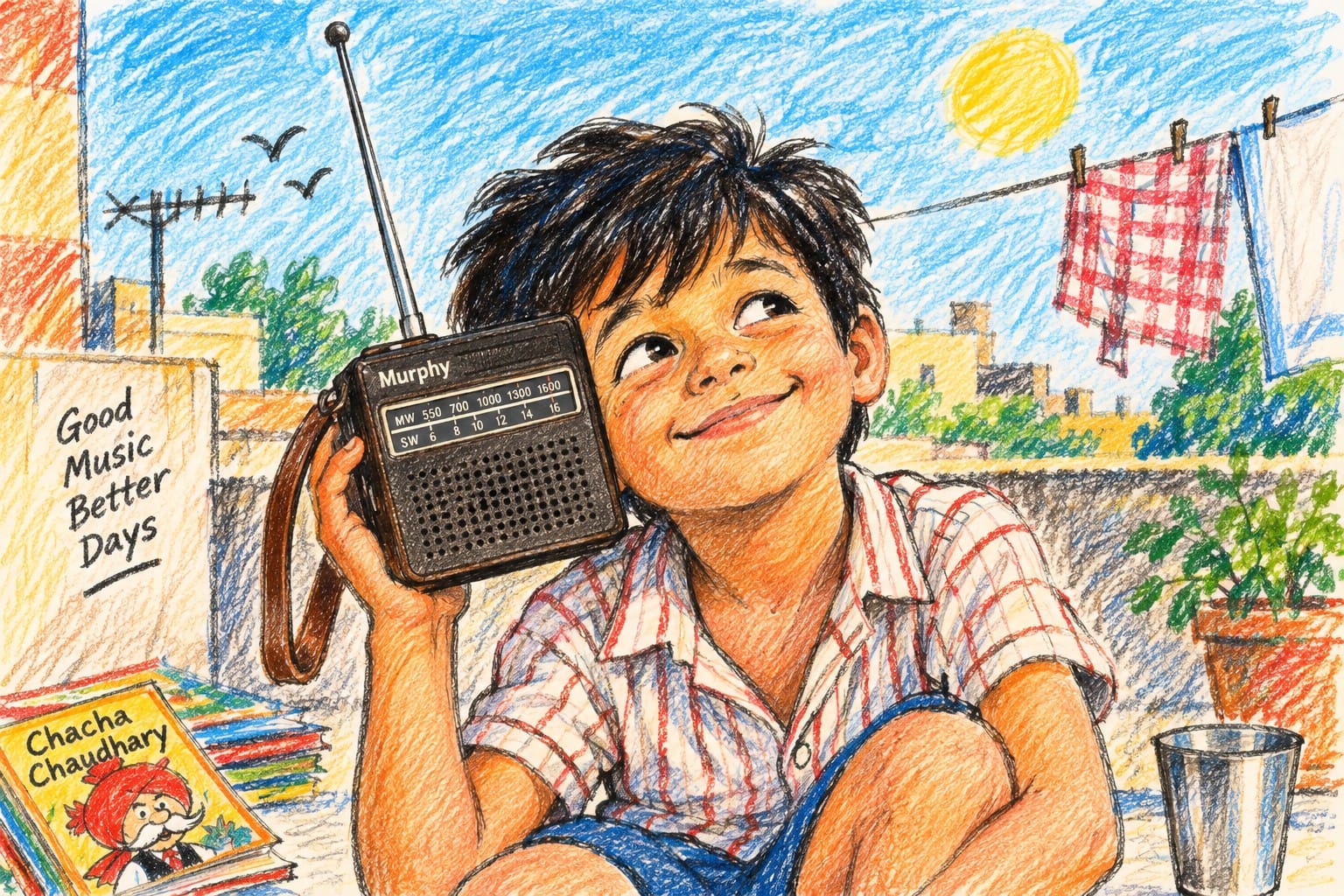
“Transistor” was probably one of the first physics words that entered our homes before physics itself did. Nobody thought of semiconductors, junctions or current flow. A transistor simply meant the chhotu radio, the small fellow that could leave the drawing room, travel to the terrace, sit in a shop, go on a train and generally behave with far more freedom than the big radio at home.
Murphy made that chhotu famous. That cherubic baby with the finger near the lips stared at us from advertisements with the confidence of someone who knew the entire country was listening. You may forget the model, the price and even who bought the set, but not that face. Murphy was less a brand and more a permanent character in the visual memory of the time.
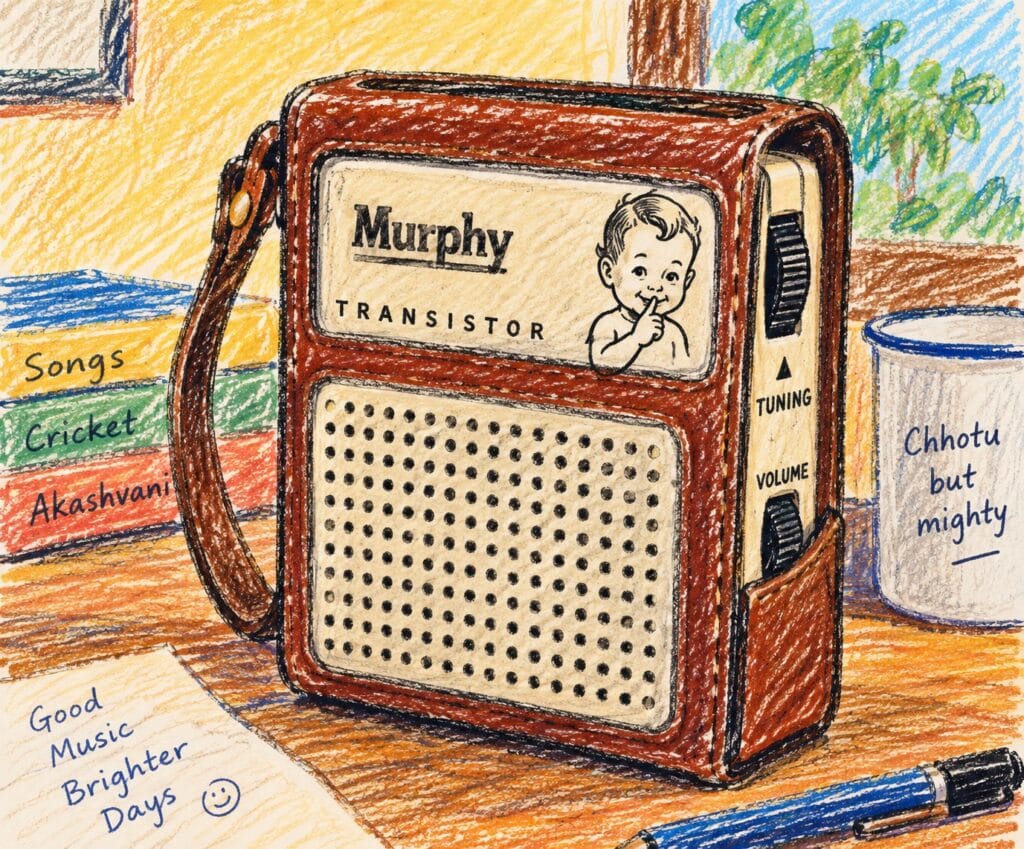
Most transistors wore leather jackets. Brown, black, slightly stiff when new and increasingly battered with age. There were cut-outs for the speaker, little openings for the controls and often a strap so the whole thing could be carried around like a tiny handbag. Many had small dial wheels on the side or top, and you rolled one with your thumb while the station came and went. A little left, too much, back again, static, half a song, gone again, and then finally the voice settled.
The leather cover developed its own personality. The corners curled, the stitching loosened, the surface got scratched and shiny with use, and yet nobody removed it. In fact, a transistor without its leather cover looked slightly undressed.
The early ones also had an antenna, a thin metal rod tucked into the body which had to be pulled out and pointed upwards when reception became temperamental. Sometimes you moved it left, then right, tilted the whole transistor a little and waited for the crackle to settle. Later models somehow managed without this ritual, but in those days pointing the antenna towards the sky seemed perfectly logical. After all, what else would you do when you were trying to catch Akashvani, the voice from the sky? God bless whoever coined that word. Even now, it sounds far more magical than “radio broadcasting” ever could.
And when the transistor stopped working, we had our own repair system. First shake it. Vigorously. If something rattled inside, that was somehow reassuring. At least something was happening. If that failed, there was always the thappad. One firm slap on the side and, with surprising frequency, the set crackled back to life. Electronics in those days seemed to respond to a mixture of persuasion and violence.
The big radio was treated no better. That one was a proper bulky contraption, with a large speaker sitting above and a long glass window below crowded with station names. Behind the glass, a thin needle moved from one end to the other as you turned the knobs.
The names themselves were fascinating. Delhi, Bombay, Calcutta, Madras, Colombo, London and other places that sounded very far away. You could sit in one room and see the world printed on a glass panel.
Tuning was half the entertainment. You moved through whistles, crackles, strange noises and sudden bursts of voices. Sometimes you caught half a sentence, turned back a little and lost it completely. Then somebody standing next to you would say, “Bas, bas, wahin,” as though you were landing an aircraft.
If the radio refused to cooperate, somebody would twist the knob, tap the cabinet, give it a shake and announce with complete confidence, “Contact loose hai.” Nobody knew which contact or where it lived, but the diagnosis sounded sufficiently technical and the family accepted it.
Vividh Bharati had its own morning signature tune and that tune was infectious. It floated out of houses, shops and open windows, bounced through the lanes and somehow announced that the day had begun. Long before phones started buzzing with notifications, that little piece of music told you India was awake.
After that, Vividh Bharati simply became part of the air. Songs came, dramas came, dedications came, advertisements came, Ameen Sayani came, and Hawa Mahal brought its own little world with it. Nobody needed a schedule on the wall. People simply knew when certain programmes came.
There was also something wonderfully undemocratic about radio. You did not choose every song. Somebody somewhere chose it for you and you listened. If you liked it, great. If not, you waited. Another one would come. Today we skip a song in seven seconds because apparently even three minutes is too much commitment.
Ameen Sayani had a voice made for radio, and Binaca Geetmala turned film songs into rankings and rankings into national suspense. The same song you had already heard many times suddenly became more important because it had climbed two places.
And Binaca, of course, was toothpaste. Imagine sponsoring a radio programme so successfully that the programme outlived the product in public memory. Binaca the toothpaste slowly disappeared from our bathrooms, but Binaca Geetmala refused to disappear from our heads. That is either brilliant advertising or a slightly cruel joke on the advertiser.
At night, radio could change character completely. Modi Ke Matwale Rahi had Balwan Singh and Lalit Singh getting into mysteries and adventures. A door creaked, footsteps came closer, somebody whispered, maybe a car stopped in the distance, and your mind did the rest. By then you had already built the bungalow, the dark road, the villain, the servant who probably knew too much and a dog barking somewhere that the programme may never have mentioned.
That was the great thing about radio. It never gave you everything. It left enough empty space for your imagination to misbehave.
Sunday afternoons were lazy in a very specific Indian way. Lunch was over, nobody wanted to move too much, and the radio fitted perfectly into that level of ambition. There was the Bournvita Quiz Contest, where we sat safely at home answering questions and feeling superior to children who were actually on air and under pressure. If you knew an answer that a contestant missed, you felt absurdly pleased with yourself.
Then came programmes like S. Kumar’s Ka Filmi Muqadma, along with snippets of film dialogue, songs and promos that could make an upcoming release sound far more exciting than it eventually turned out to be. The promotion itself was often better than the film, but by then nobody was asking for refunds.
Sunday afternoon radio did not require everyone to sit in silence and listen. Somebody read the newspaper, somebody dozed, somebody wandered in and out, and the radio kept going. It was part of the room rather than the centre of the room.
Sunday night had a different purpose altogether. There was an English-song request programme where young men sent dedications to girls who, in all probability, had no idea these young men were emotionally active. You waited for the announcer to read out her name and that alone was enough to make the evening worthwhile. The song could be excellent, average or completely forgettable. By then, who cared?
There were no blue ticks, no heart emojis, no “seen at 11:42 pm” and no carefully curated playlists sent at midnight. Just her name coming out of the radio and an unreasonable amount of happiness.
And then there was cricket, where the transistor probably reached the height of its social importance.
Ball-by-ball commentary was killer. One man held the set close to his ear while everyone around him pretended not to be listening, yet reacted to the same sentence at exactly the same time. A boundary could lift a whole shop. A wicket could stop conversation.
The paan shop had a transistor hanging somewhere near the counter. The barber shop usually had a radio perched high on a little wooden support, almost like part of the establishment. In front of it lay the assorted scissors, combs, brushes and shaving gear, and the radio sat above all of them supplying the soundtrack to the barber’s daily drama. Hair was being cut, somebody waited with foam on his face, another customer gave unsolicited advice on the match, and the commentator carried on as if all of this was perfectly normal.
The tailor had one too, usually perched near the sewing machine while his foot kept the pedal moving and his ears followed the score.
You could leave home knowing nothing about the match, stop for a paan, get a haircut, alter a trouser and return fully briefed on the score, the bowling changes, the captain’s stupidity and probably two neighbourhood scandals as well.
I still remember the shock of Sudhir Naik being dismissed first ball against the West Indies at Eden Gardens in 1974. Somewhere a paan must have stopped halfway to the mouth, a barber’s scissors must have paused above somebody’s head and a man with shaving foam on one cheek must have waited for the commentator to explain what on earth had happened.
That was radio cricket. The commentator saw the field and somehow transferred it into your head. You could almost see the bowler running in, the batsman shaping for the shot, the ball going through cover and the fielder chasing it, all while staring at a brown box sitting on a shelf.
The transistor went everywhere because it could. Terrace, park, train, roadside, shop, verandah. One person could be listening and three others would slowly drift closer without asking permission. There was something wonderfully public about private listening.
Then there was the world beyond India.
The BBC came through with static, whistles and fading voices, which somehow made it sound even more serious. You moved the knob a fraction, lost London completely, found it again and felt quite pleased with yourself. If the signal stayed clear for a few seconds, it felt like a personal achievement.
Radio Australia was even more fun. Catching it felt like pulling a voice out of another continent through sheer patience. There was no app, no preset, no guarantee and no friendly screen telling you what had gone wrong. Just the needle, the crackle and your own stubbornness.
And when Australia finally came through, there was a small thrill in it. A voice from thousands of kilometres away had somehow entered your room through that box. We did not call it connectivity. We just thought it was amazing.
Now the needle has disappeared and frequencies arrive as neat digits on a screen. Radio Mirchi and its many cousins chatter away while we drive or are driven, mixed with songs, traffic updates, contests, callers, jokes and whatever else can fit between two red lights. Everything is cleaner and easier now, but nobody shakes the set, nobody gives it a thappad, and nobody feels mildly heroic because London has suddenly emerged from the static. Somewhere in all that convenience, a little fun went missing..



Proud to have sold Murphy Radios and Transistors in 1972. My first job!!! Great Memories