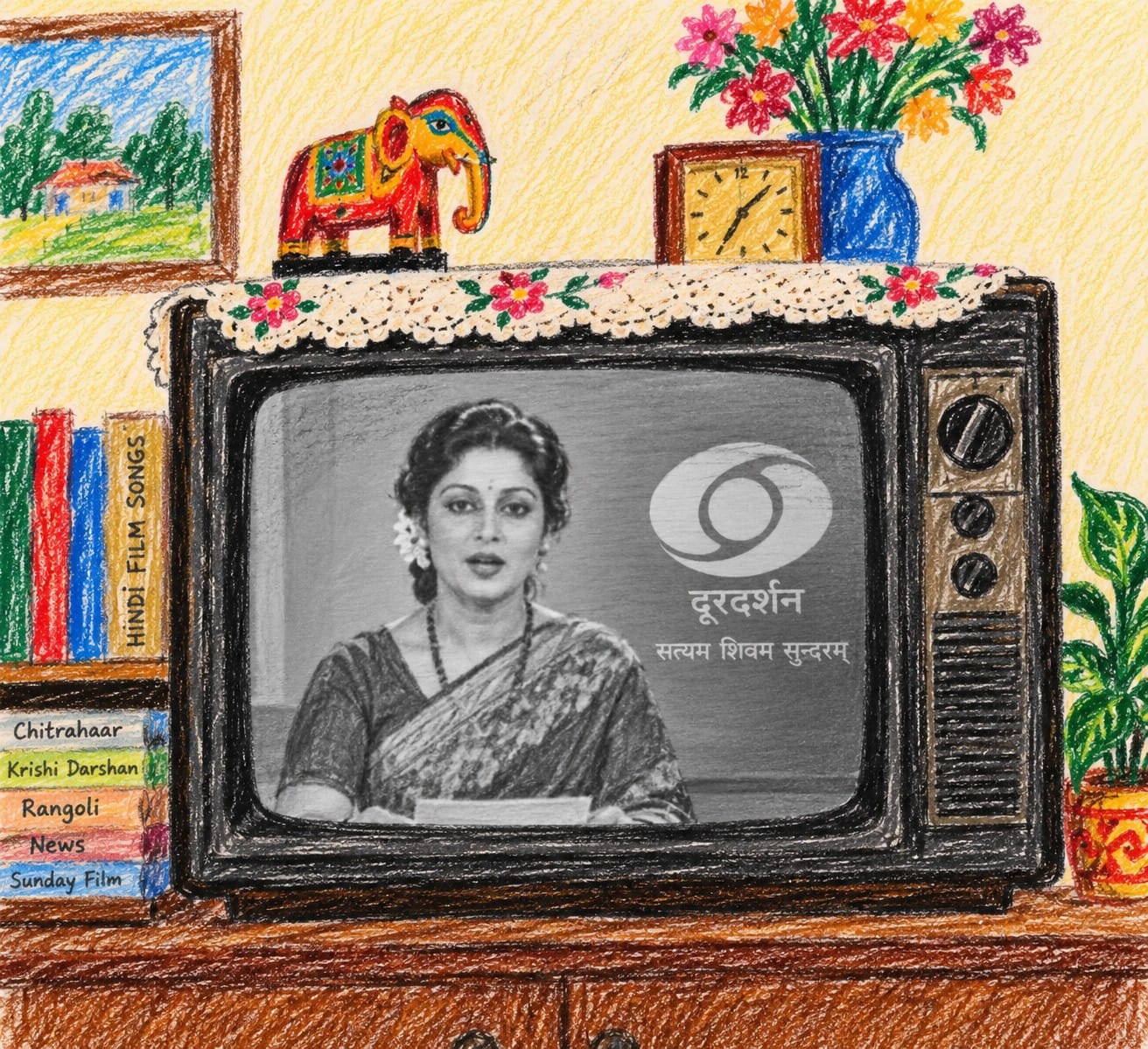
Thoda Left. Bas! Hilana Mat.
From Doordarshan and rooftop antennas to streaming, Wi-Fi and fifty years in front of the television.
I guess nothing has really changed, although technology has kept marching forward. Nearly half a century ago, we stood on terraces adjusting television antennas while someone shouted instructions from the drawing room below. Satellite television would later sulk whenever the monsoon became serious. Smart TVs were supposed to solve all that, but now a storm comes, a lineman accidentally cuts a cable, the Wi-Fi goes kaput and the entire household discovers how dependent it has become on one blinking router. Airtel lines get jammed with urgent requests, somebody switches the router off and on again, somebody checks the cable, somebody announces that the problem must be outside, and tempers rise with the buffering circle.
The climax of Musafir Cafe was one blink away when the Wi-Fi died.
Television, in those days, was not just another appliance in the house. It was a member of the family, a piece of furniture, a source of entertainment and occasionally a minor engineering project. The early sets were large wooden cabinets, occupying enough space to establish their importance. Many had embroidered covers that were ceremoniously removed before viewing and put back afterwards, almost as if the television needed its own nightdress.
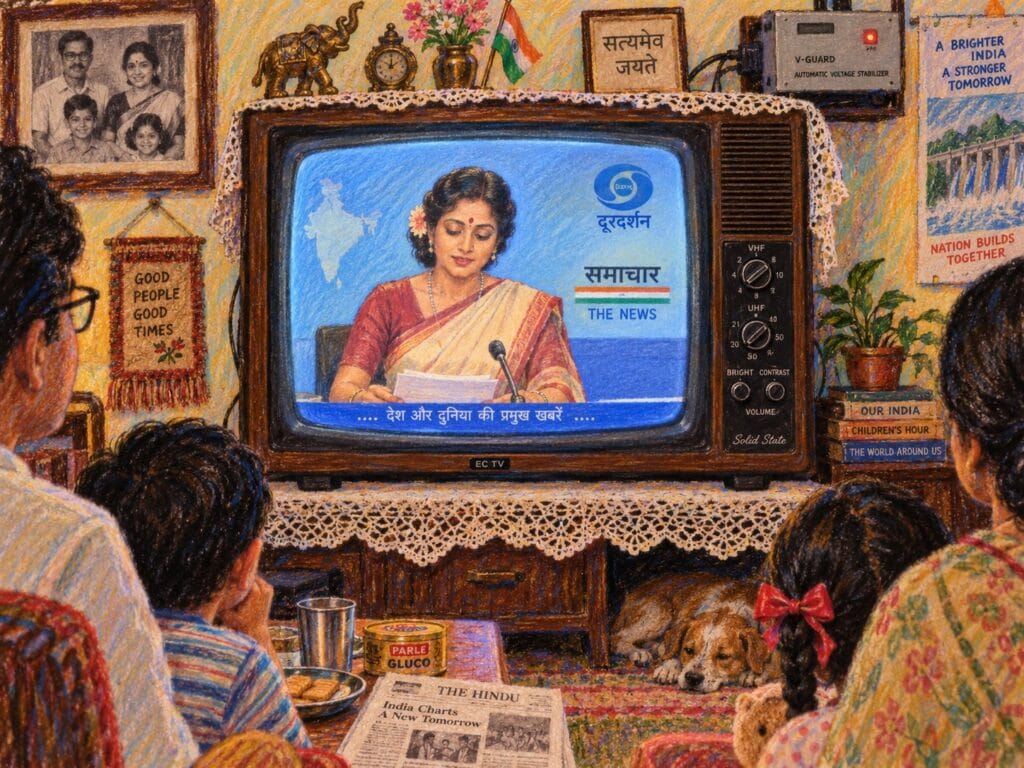
And beside the television sat the stabiliser, another serious-looking box whose importance nobody questioned. Before switching on the TV, you pressed Input, watched the needle carefully, pressed Output, checked where the needle had moved, and only then did the television earn permission to come alive. It was a tiny pre-flight check performed with enormous concentration. If the needle looked suspicious, viewing was postponed until electricity decided to behave itself.
The tubes at the back became red hot and scalded many adventurous fingers, handkerchief or no handkerchief. Yet that never stopped us from venturing behind the set when the picture misbehaved, fiddling with things we barely understood and occasionally emerging convinced that we had repaired the television. Parents had theories about how long the set should remain switched on, partly because it would spoil our eyes and partly, I suspect, because they feared the thing might eventually cook itself.
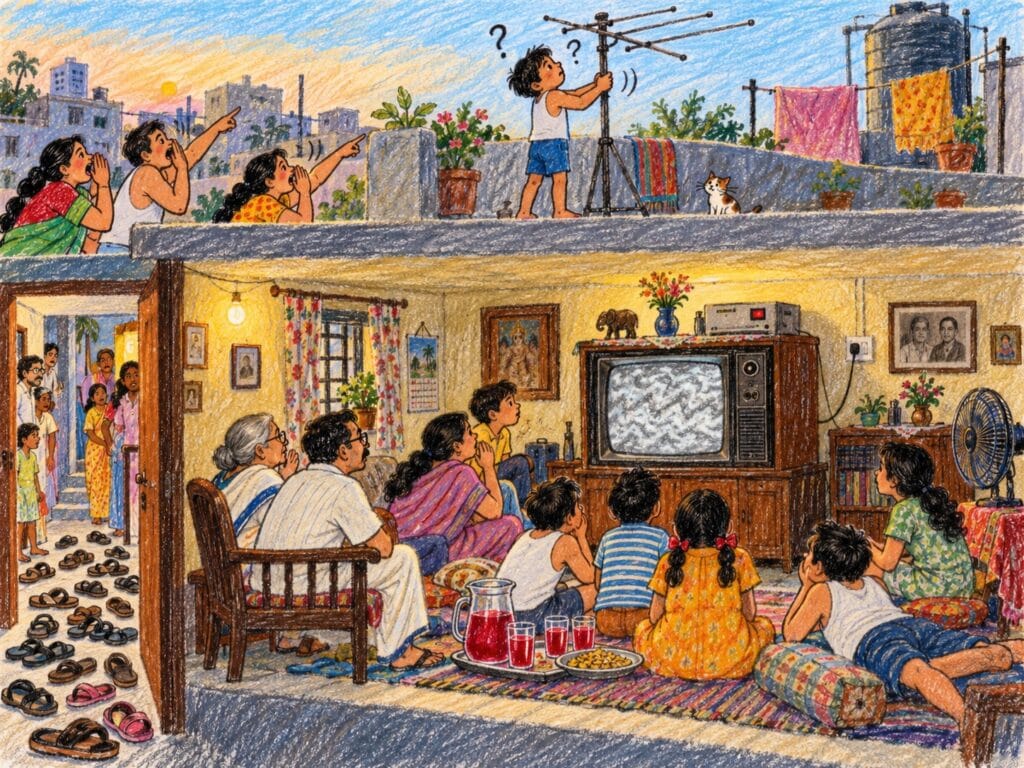
Reception required teamwork. Somebody went to the terrace and turned the antenna while someone downstairs became air-traffic control.
“Thoda left.”
“Bas!”
“Arre, wapas.”
“Wahin. Hilana mat.”
There were no mobile phones to coordinate this operation. Instructions travelled through windows, balconies and staircases, occasionally assisted by a younger sibling positioned halfway between floors. By the time the picture became reasonably stable, half the neighbourhood knew what was happening.
Outside, cinema halls were packed for very different reasons. Sholay had Gabbar Singh taking over the country, while Jai Santoshi Maa had audiences turning the theatre into something close to a place of worship. Inside our homes, meanwhile, we were still glued to Krishi Darshan, waiting patiently for Tabassum and the evening news. One India was roaring “Kitne aadmi the?”, another was bowing before Santoshi Maa, and television was calmly teaching us about crops and irrigation.
But television had its own magic. Salma Sultan appeared for the news, the rose in her hair becoming almost as familiar as the news itself. Tabassum chatted her way through Phool Khile Hain Gulshan Gulshan. There was Fireball XL5, taking us into space long before most of us had been inside an aeroplane, and Here’s Lucy bringing an America that seemed impossibly distant into Indian drawing rooms.
Memory does not arrange any of this properly. Fireball XL5 somehow becomes Star Trek. Spock raises that eyebrow and before you have worked out which decade you are in, He-Man and the Masters of the Universe has arrived. Then suddenly Salma Sultan is back. Television history in our heads is not a timeline. It is more like an old cupboard into which everything has been stuffed, and opening one door causes three unrelated things to fall out.
The advertisements are mixed up in there too. There was the Liril girl under the waterfall, apparently experiencing a degree of happiness that nobody before her had thought possible from a bar of soap. Years later, the Cadbury girl would be unable to contain herself after a six, running onto the cricket field with such spontaneous joy that the chocolate became almost incidental.
Kapil Dev stood around India Gate assuring us that “Boost ka jawab nahin.” The line became even better in hindsight because in 1983, Boost really did come. Kapil lifted the World Cup at Lord’s and cricket on television changed forever. India did not just win a tournament; it created one of the great national television memories. Families sat together, neighbours drifted in and every wicket seemed to belong to the entire room. Long before giant screens and fan parks, the drawing room had already become one.
A year earlier, colour itself had been the excitement. The 1982 Asian Games in Delhi pushed colour television into Indian homes in a way nothing else had. Families upgraded sets, neighbours gathered in houses lucky enough to have one, and Doordarshan suddenly looked transformed. For a generation raised on shades of grey, green fields, coloured tracksuits and bright stadiums felt almost futuristic.
Kabir Bedi, still carrying the swagger of Sandokan, strides through another corner of memory telling us it is Only Vimal. Around him float Bournvita, Rasna, Campa and Garden Vareli. None of them stay in the right year anymore, and perhaps that is the point. Television memories are not filed chronologically. They arrive in clusters — a jingle, a cricket match, a newsreader, a Sunday morning, a coloured screen.
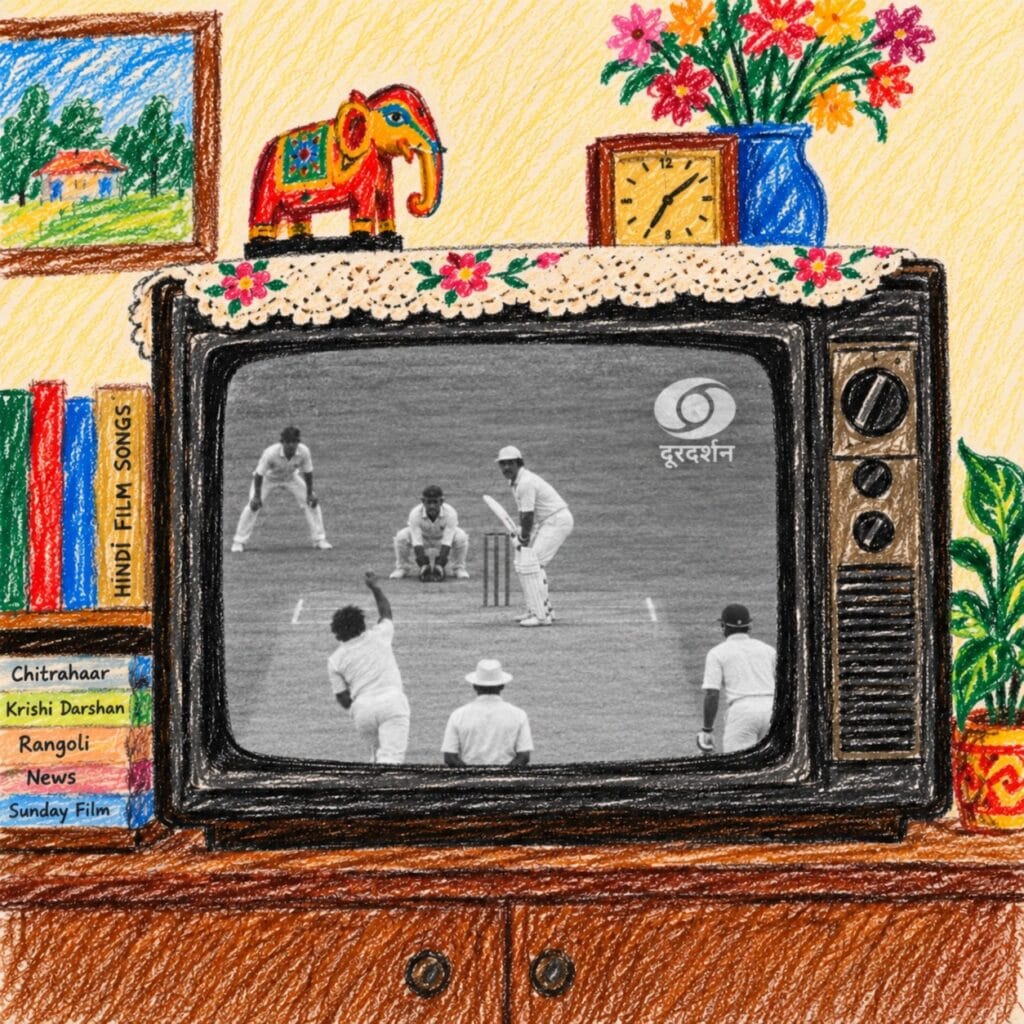
Cricket probably shows the journey better than anything else. In the black-and-white days there were no wagon wheels on the screen, only the occasional cartwheel by a boisterous fielder who had just taken the catch of his lifetime. Whether his fingers had actually touched the grass was another matter. No camera knew, no replay could prove it, and everybody in the drawing room had already delivered a verdict.
Today there are ultra-motion cameras, ball tracking, spidercams, speed guns, heat maps and statistics for things we never knew needed measuring. The IPL added music, flashing lights and pom-pom girls, and cricket became as much television spectacle as sport.
The technology around the set kept changing, but every generation invented its own home remedy for when things went wrong. With the old television, we thumped the side, fiddled with knobs and peered behind those hot tubes with far more confidence than knowledge. A strategically delivered slap to the cabinet sometimes restored the picture and gave the family member responsible an undeserved reputation as an electronics engineer.
The set-top-box era invented another ritual. The card would be taken out, wiped carefully on a shirt or handkerchief, inspected as though it contained some secret code and pushed back in. If the picture returned, we felt technically accomplished. Today the same instinct survives in router CPR: switch it off, count to ten, switch it on again and stare at the lights until one of them agrees to cooperate.
The television itself also began acquiring friends. First came the VCR, that magical machine which allowed us to watch a film when we wanted rather than when Doordarshan permitted it. It also, rather mysteriously, brought the colour blue into our lives.
Nintendo followed. Mario jumped, ducked under fireballs, disappeared into pipes and kept going in search of his princess. Years later, PlayStation would bring warriors with frightening arsenals, spectacular graphics and entire worlds to conquer. Xbox would make those worlds even bigger. Yet poor old Mario, armed largely with his jumps, mushrooms and an extraordinary ability to survive, remained a match for all of them. The graphics became more sophisticated; apparently our need to rescue somebody never did.
Somewhere along the way, the television had stopped being something you merely watched. You could now enter it, race cars, fight wars, play football and eventually lose badly to your own children on the same screen where Salma Sultan had once read the evening news.
Television also learnt how thoroughly it could interfere with our emotions. Hum Log and Buniyaad showed us that fictional families could become almost indistinguishable from people we actually knew. Their problems were discussed over dinner as though somebody in the extended family had got into trouble.
Ramayan and Mahabharat briefly turned television into something close to a national appointment. Sunday mornings changed. Roads emptied, shops opened late, neighbours adjusted their plans and whole families sat in front of the set together.
And Mahabharat had that unmistakable opening — “Main Samay Hoon.” The chakra appeared, that voice filled the room, and for the next half hour or so philosophy, spirituality, mythology, family feuds, politics and war were somehow packed into one television capsule. We may not have understood all the wisdom being dispensed, but we listened with remarkable seriousness. Time itself was speaking; who were we to argue?
For those hours on a Sunday, television was not competing with anything outside because practically everybody outside was indoors watching the same thing.
Years later, when Mihir died in Kyunki Saas Bhi Kabhi Bahu Thi, a large part of the country seemed genuinely bereaved. The houses had become bigger, the clothes grander and the background music considerably more dramatic, but our willingness to worry about people who did not actually exist remained reassuringly unchanged.
Western pop had already begun slipping into our lives in the early eighties. Michael Jackson, Bruce Springsteen, Stevie Wonder, Madonna and Whitney Houston made the world outside feel much closer. Cable television eventually blew open the carefully controlled windows of Doordarshan. Suddenly there was Star Plus, endless choice and imported serials such as The Bold and the Beautiful, with houses, clothes, relationships and problems that seemed to belong to another planet. Much later, the same television brought us Billions and Succession, where family drama had moved from drawing rooms to boardrooms but remained just as vicious.
Somewhere in this journey, scarcity disappeared. Earlier, if something interesting came on television, you watched it because there was no guarantee it would ever return. Missing a programme actually meant missing it. There was no rewind, no catch-up and no streaming platform politely asking whether you wanted to continue watching.
Perhaps that scarcity was also what made television communal. There was usually one set in the house and everybody negotiated around it. Someone wanted cricket, someone wanted a film, somebody wanted the news and the youngest member of the family generally had the weakest negotiating position.
Television has even acquired a new morning congregation. At 9:15 sharp, stock-market punters across the country are glued to business channels, watching red and green numbers flash across the screen as if Warren Buffett might personally call for advice before lunch. Every tick becomes a signal, every expert a guru and every two-percent move proof that somebody had “seen it coming.” The old family waited for Ramayan on Sunday morning. The new tribe waits for the market to open on Monday.
Now every person in the house can watch something different on a different device at the same time. The television itself has become thinner, sharper and smarter, with more channels, apps and choices than we once imagined possible. It remembers what we watched, recommends what we may like and waits patiently while we spend ten minutes deciding what to see.
Perhaps that is the biggest change of all. Earlier, television gave us very little and we watched almost everything together. Today it gives us almost everything, and we often watch alone.
Somewhere between Krishi Darshan, Salma Sultan, the 1983 World Cup, Ramayan, Mario, the VCR, The Bold and the Beautiful, IPL, business channels and Succession, television stopped being the centre of the room and became one screen among many.
It became smarter.
We became harder to gather.
Lets go on a train journey now>>>>>