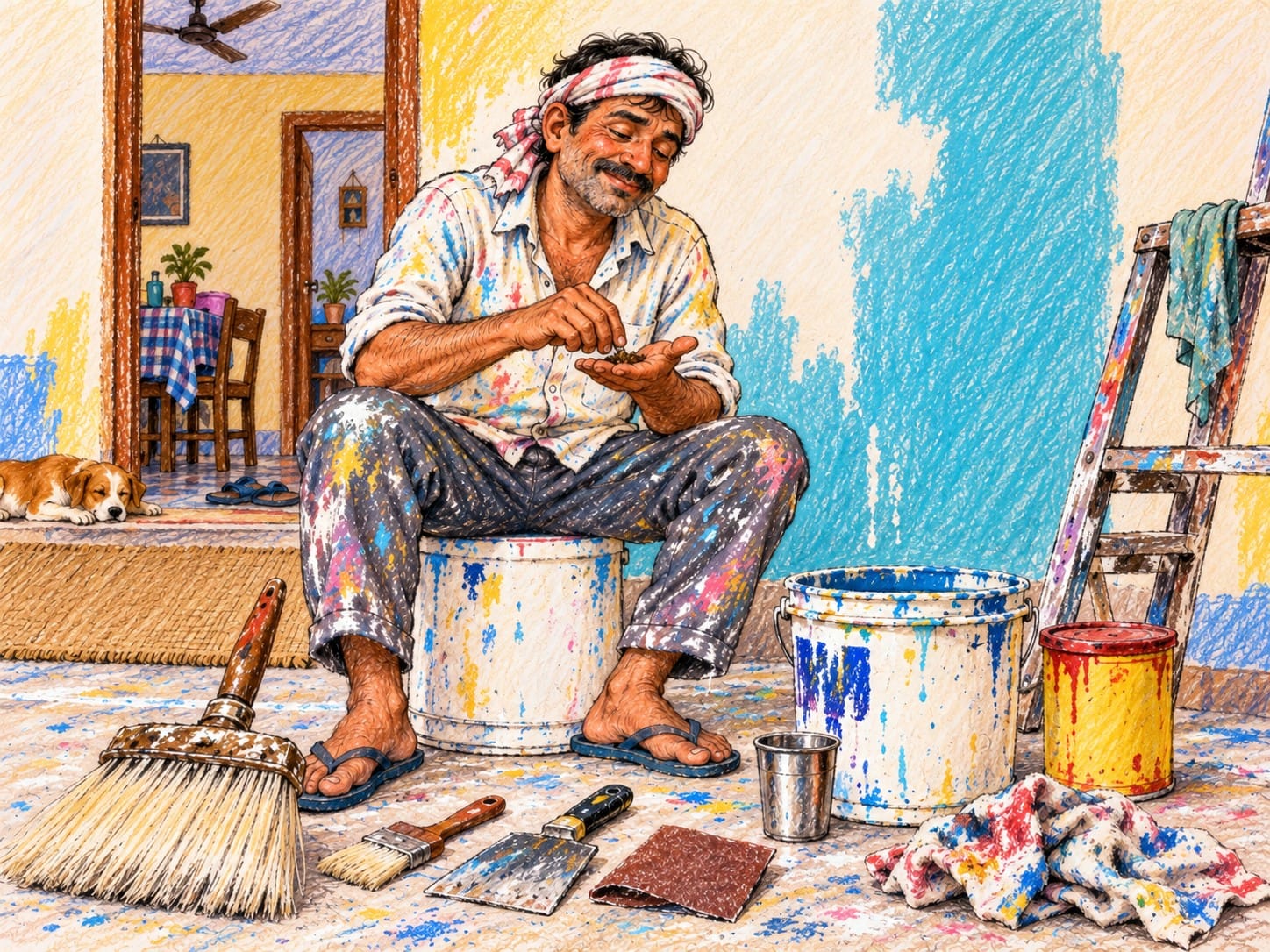
Decades back, whitewashing really meant whitewashing. It started with a bucket, a thick lime paste and a brush which looked more like a small broom than anything a modern painter would recognise. Painter Bhaiya would dip the whole thing into the bucket and slather it enthusiastically over the wall. Half of it went where it was supposed to go, the rest landed on the floor, his hands, the nearby furniture and occasionally on some unfortunate child who had been standing too close and had not yet understood the dangers of home improvement.
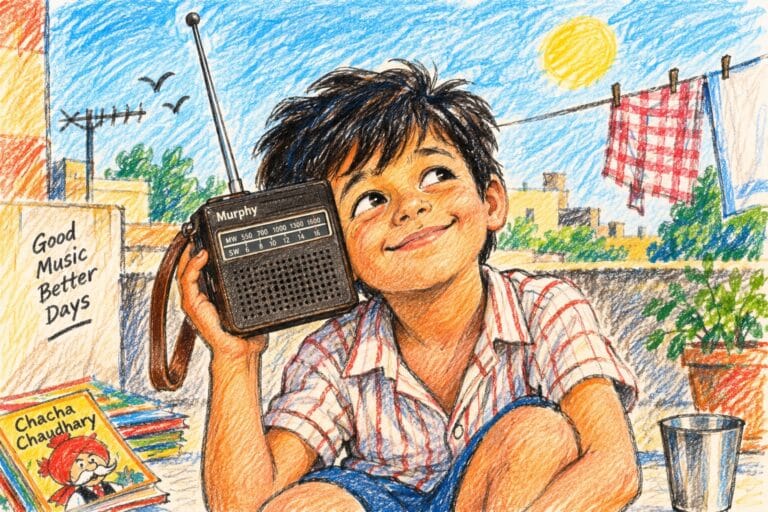
Somewhere in the background the Murphy radio would be playing, with Ameen Sayani announcing the latest crooner in town. The radio crackled, the painter worked, the room smelled of wet lime and nobody was discussing texture, finish, palettes, accent walls or whether the beige had warm undertones. The instruction was simple: “Ghar mein safedi karwani hai.”
Some kid in the house would suddenly decide that plain white was boring and demand colour. Painter Bhaiya, who was always called Bhaiya and never contractor, would drop in some blue, green, pink or whatever pigment happened to be available, stir it with a stick and continue with the same broom-like brush. There was no roller, no masking tape, no machine and certainly no consultant standing there with a colour wheel. Splash it, spread it and move on.
The preparation was also uncomplicated. Old newspapers appeared on the floor, beds were pushed into corners, furniture was covered with whatever bedsheet had already retired from respectable use and switchboards were treated with a confidence that would horrify an electrician today. Somehow a bit of paint always managed to find its way onto the fan regulator, window latch or door handle and then stayed there for years. Nobody regarded this as a defect. It was simply evidence that the house had recently had safedi.
What is amusing is that after nearly forty years of becoming very sophisticated about our walls, we seem to be travelling backwards. We went through emulsions, plastic paints, velvet finishes, pearl finishes, washable finishes and those enormous shade cards where twelve colours looked exactly the same until somebody from the paint company explained that one was “morning mist”, another was “quiet pebble” and a third was some variation of Scandinavian silence. There were advertisements showing pearls sliding elegantly down walls to prove something about the paint which nobody really understood.
Now suddenly lime wash is fashionable again. The unevenness which Painter Bhaiya produced without making any effort is called earthy, organic or artisanal. People actually pay extra for a slightly blotchy finish which thirty years ago would have earned Bhaiya a lecture from the lady of the house. It is a little like millet. We stopped eating it because it looked too old-fashioned, spent decades discovering everything else and then brought it back as a superfood. The wall has gone through roughly the same journey.
The trouble is that while the paint may have evolved, the trauma of getting the house painted has not.
Even the discussion of whitewashing produces anxiety because everybody knows what follows. Negotiating with the contractor, painter or Bhaiya is only a small part of it. The real problem is the whole shabang of moving from room to room, shifting beds, dragging sofas, unplugging computers, untangling wires, moving televisions and discovering things behind furniture which probably belong to another geological era. You find an old slipper, three pens, a charging cable for a phone nobody owns anymore and enough dust to raise uncomfortable questions about your housekeeping.
Bhaiya will inspect the house very seriously, make a few thoughtful sounds, look at the ceiling as if consulting higher powers and finally say, “Sir, dus din.” You know this is fiction but somehow you still want to believe him. Ten days later two rooms are half done, one flower pot has broken, a suitcase has acquired permanent white freckles and somebody has left a paint bucket exactly where you normally place your foot while walking in the dark. By the third week nobody in the family even asks when the work will finish because hope is exhausting.
Then comes the furniture strategy. Do you empty the storage beds and create another mountain of bags somewhere else, or do you use that latest contraption ordered online with little wheels which are supposed to let you move a double bed without emptying it? Four people gather around the bed, insert the wheels underneath and push valiantly. One wheel immediately escapes and rolls under the cupboard, another tilts at an angle and the bed moves just enough to trap somebody’s foot. Eventually everyone agrees that the old method of lifting and abusing each other verbally was probably more efficient.
The kitchen is another headache. Everything there is either fixed, greasy, fragile or essential and once Bhaiya starts his antics inside, cooking becomes nearly impossible. Earlier people survived on bread, biscuits and whatever could be made on one functioning burner. Today Zomato comes to the rescue. For three days nobody knows where the pressure cooker is, half the utensils are sealed inside newspaper bundles and the gas stove has disappeared behind a plastic sheet, but butter chicken arrives in thirty-two minutes, so civilisation somehow continues.
Then there is the smell. Paint, putty, thinner, wet wall, dust; all of it gets into the entire house and settles into curtains, clothes and your lungs. Somebody should seriously try mixing a little hash into the paint. At least then you may get some benefit from inhaling the stuff all day instead of merely developing a headache by four in the afternoon.
Bhaiya and his goons meanwhile are perfectly comfortable. After applying putty to half a wall they settle down for a break, gently rubbing tobacco or khaini on their palms before swiftly tucking it into their gums. There is tea, some discussion, a phone call, another tea and then a detailed explanation of why the wall is not drying because the weather has changed. You begin to realise that meteorology plays a much bigger role in painting than anybody had previously told you.
The entire project also turns out to be dependent on one person called Chhotu. Nobody had mentioned Chhotu when the ten-day completion promise was made, but apparently he alone knows how to sand one particular wall, operate some machine or finish one complicated corner. The day Chhotu takes leave, the project schedule goes completely haywire. “Sir, Chhotu gaon gaya hai,” Bhaiya says with such finality that there is nothing left to discuss. You are not even told which gaon, when he went or when he intends to return. Chhotu has become less of a worker and more of a force of nature.
Then somebody in the family gets another brilliant idea. Since the house is already upside down, why not get the marble polished as well? This is how whitewashing quietly turns into a civil engineering project without anybody consciously taking that decision.
The diamond-polish fellow arrives with a machine and a collection of finishing plates underneath which, to the untrained eye, all look fairly similar. He adds water, rubs the floor, changes the plate, adds more water and rubs again. The marble slowly begins to shine while dirty grey water splashes onto the legs of sofas, beds and anything else within range. By then you are too tired to complain because the floor does admittedly look better and beauty makes people forgive many things.
Then comes the billing surprise. The marble floor was one rate, but the strip running along the wall is apparently something completely different. “Sir, cutting alag hoti hai.” Nobody had mentioned this earlier. Every part of the house seems to develop its own tariff once the work begins, rather like airline baggage or hospital billing.
And don’t even get me started on wooden floors. That brings another man, another machine and a mechanised wood scraper which makes enough noise to suggest that somebody is dismantling the building from inside. Fine wood dust travels into cupboards which were never opened and somehow reaches rooms where no wooden floor exists.
By now you have forgotten whether the original idea was to whitewash the house, polish the marble or rebuild the entire place. Everyone is sleeping in whichever room is least damaged that evening, bags have migrated from one corner to another, chargers cannot be found and somebody has been wearing the same pair of slippers for a week because all the others are inside a covered cupboard.
Eventually, after weeks of dust, paint, putty, khaini, missing Chhotu, broken flower pots, marble machines, displaced furniture and Zomato dinners, Bhaiya announces that the work is over. You walk around the house slowly. There is one patch behind a curtain which could probably do with another coat and a faint paint mark on the door frame, but by now you have acquired wisdom. You say nothing.
The walls look fresh, the marble shines, the house suddenly appears larger and cleaner and, strangely enough, the pain begins to fade much faster than you expected. Within a few days the furniture is back, the curtains are up and normal life returns.
Five years later somebody will stand near the drawing room window, look thoughtfully at one slightly tired patch and say, “Lagta hai safedi karwa leni chahiye.”
And somehow, despite knowing exactly what this means, the discussion will begin again.