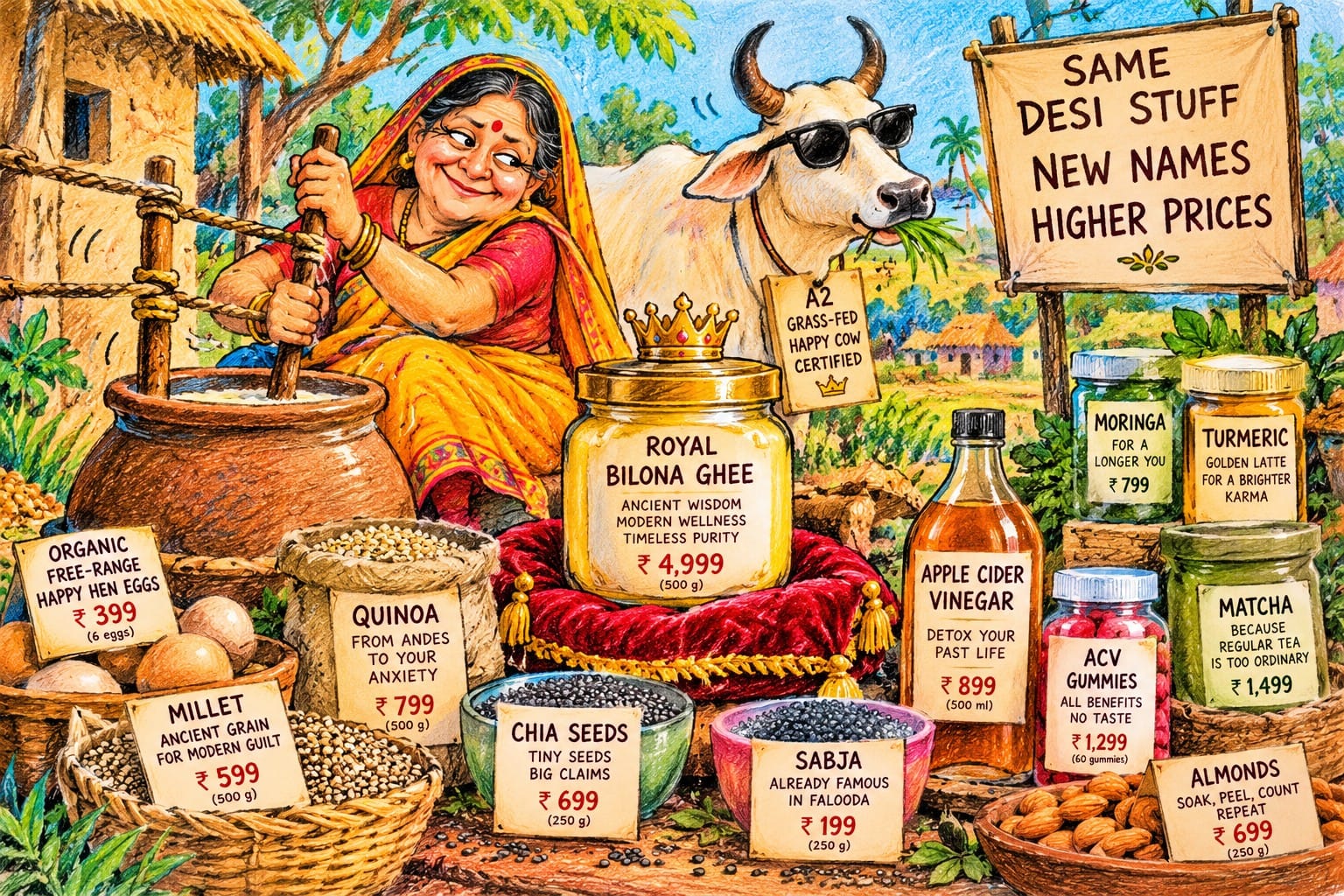
The village auntie is pulling the ropes tied to a matka, rhythmically churning away as though the future of Indian civilisation depends on her wrists. In the background, an A2 cow is grazing on impossibly green grass, occasionally letting out a gentle moo, presumably to certify the purity of the product. There is a mud house, a charpoy, a brass pot and perhaps a flute playing somewhere. The entire village seems to have been assembled for the occasion. Welcome to the world of bilona ghee, where the story is almost as expensive as the product. By the time you finish watching the advertisement, the little jar of ghee is competing in price with a bottle of Black Label whisky.
And to think that our grandmothers poured the stuff over hot rotis without giving it a second thought.
Ghee itself has had a remarkable career. For years it was treated like a dangerous chemical. Doctors warned against saturated fat, families scraped it off chapatis and people proudly announced that they had stopped eating ghee altogether. Now it is back in business. A2 ghee, grass-fed ghee, organic ghee and ghee made from cows with family histories that would put a thoroughbred racehorse to shame. Some enthusiasts even put it in their morning coffee. What a waste of perfectly good coffee.
The poor egg has had an equally miserable time. One day it is the perfect food, packed with protein, and the next day a cholesterol bomb waiting to explode in your arteries. The yolk was declared the villain and millions started eating those pale, miserable egg-white omelettes. Then the experts changed their minds. The yolk was back, though not without conditions. Two eggs a day, three eggs a week, six whites and one yolk. Boiled, scrambled, poached, but perhaps not fried. Every expert had a different number.
Now there are organic eggs, free-range eggs, cage-free eggs, brown eggs and eggs from hens who presumably enjoy better living conditions than most of us. An egg used to be an egg. You boiled it, fried it or made an omelette and got on with your life. These days breakfast resembles a medical conference.
Take millets. Bajra, jowar and ragi were what people ate long before supermarkets discovered healthy living. They were inexpensive, filling and available everywhere. Our grandparents ate them without discussing antioxidants, fibre or glycaemic indices. Then someone decided they were ancient supergrains and the whole business took off. Millets appeared in expensive packets with rustic-looking farmers printed on them. Millet cookies, millet noodles, millet pasta and millet breakfast cereals. Some generously loaded with sugar, salt or fat, but never mind. They contained millet, and that apparently settled the matter.
Rice, meanwhile, has been sent to the naughty corner. White rice is treated almost like a criminal substance, while brown rice has acquired the moral superiority of a school prefect. People who happily ate rice for fifty years now look nervously at their plates, wondering whether each spoonful is shortening their lives.
And what about quinoa, or keen-wah, as we were repeatedly instructed to pronounce it?
A seed from South America, it arrived with the confidence of an international consultant charging by the hour. Suddenly everyone wanted quinoa salads, quinoa bowls and quinoa pulao. Restaurants discovered that a small helping of quinoa with three pieces of cucumber and a cherry tomato could command an astonishing price. Our dal-chawal, which had been feeding generations without demanding applause, suddenly looked terribly ordinary.
Every time I see quinoa, I picture myself as an Inca warrior with a little pouch of the precious seeds tied around my waist, marching across the Andes, roaring to go through the day with such extraordinary vigour that even my fellow warriors are mesmerised. The Inca civilisation might have disappeared centuries ago, but its quinoa has found a comfortable second life in expensive urban cafés.
Chia seeds are another marvel. Tiny black things that swell up when soaked in water, acquiring the appearance of frog eggs floating in a pond. You are told they absorb several times their weight in water, and immediately the imagination runs wild. You can almost picture them puffing up to enormous sizes inside your stomach, while the poor organ contracts rhythmically, churning away like an old washing machine trying to digest hundreds of little water balloons. After a glass of chia water, you begin to wonder whether the seeds are keeping you full or preparing to take over the available real estate inside.
Our sabja seeds must be wondering what went wrong.
Sabja has been sitting in falooda for decades, quietly swelling in rose syrup and milk without making grand claims about longevity or gut health. Nobody ever photographed a falooda and announced that they were improving their digestive microbiome. It was simply something you drank on a hot afternoon, preferably with a generous scoop of ice cream. Now sabja is being rediscovered too. Give it another year and somebody will launch premium Himalayan sabja, harvested under the full moon and priced accordingly.
Turmeric has probably pulled off the greatest international trick. For generations, haldi sat in a little steel container in every Indian kitchen. It went into dal, sabzi and practically everything else, staining our fingers and occasionally our clothes. If you had a sore throat, your mother produced haldi doodh, which you drank reluctantly before going to bed.
Then somebody in California discovered turmeric.
Haldi doodh became a golden latte, moved into an elegant ceramic cup and acquired an extraordinary price tag. Add a pinch of black pepper and you could almost hear the cash registers ringing. What our mothers had been serving without ceremony was now being discussed at wellness retreats by people wearing expensive yoga clothes.
Apple cider vinegar is another fascinating success story. You take a sip of the stuff and can almost feel the enamel on your teeth dissolving under the assault of acidity. God knows what it is doing to the lining of your oesophagus on its way down, before it finally lands in the stomach and meets the resident acids waiting to welcome it. The entire journey feels like a chemical warfare exercise being conducted inside your body, all in the noble pursuit of good health.
Yet people faithfully consume it every morning, usually diluted in water, convinced that something wonderful is happening inside. Weight loss, blood sugar, digestion, appetite control. There is some research suggesting modest benefits in certain situations, but modest benefits don’t sell very well. Miracles do.
And now there are apple cider vinegar gummies. We took vinegar, persuaded people to drink it for their health, then converted it into something resembling candy so they could consume it without suffering the taste of vinegar.
Seeds have become a separate department in the wellness industry. Flaxseed for omega-3, pumpkin seed for zinc, sunflower seed for vitamin E and sesame for whatever the other seeds have not already claimed. Some must be soaked, others roasted, a few ground and apparently certain seeds should be consumed at precisely the right time. The poor digestive system must be wondering why its owner has suddenly become so bureaucratic.
Our old til laddoo sits quietly in the corner. Too much jaggery, apparently. Not sufficiently sophisticated.
Even almonds have become complicated. Soak them overnight, remove the skin, don’t remove the skin, eat five, eat seven. Apparently, simply picking one up and eating it is no longer acceptable.
And there is the growing army of powders and juices. Moringa, wheatgrass, amla, beetroot, matcha, spirulina and various green concoctions that look like water drained from a garden after heavy rain. Better skin, cleaner gut, stronger immunity, less inflammation, more energy, slower ageing. There is something for every anxiety and a powder to go with it.
Detox is particularly popular. Apparently, our liver and kidneys, which have been doing the job for a lifetime, now require assistance from a green drink sold on Instagram. One wonders what these organs were doing before the wellness industry came along.
The real genius is the marketing. Put an ordinary ingredient in a plastic bag and nobody cares. Put the same thing in a glass jar with a beige label, write ancient wisdom, gut-friendly, cold-pressed or superfood across it, and the price multiplies. Add a story about Himalayan farmers or forgotten tribal traditions and you have a premium brand.
The internet has made everything worse. Watch one video about chia seeds and the algorithm decides you are terminally interested in nutrition. Within minutes your feed is overflowing with advice on insulin spikes, inflammation, gut bacteria, intermittent fasting and the dangers of eating fruit at the wrong time.
Breakfast is essential. Breakfast should be skipped. Eat six small meals. Eat only twice. Never eat carbohydrates at night. Eat carbohydrates to sleep better. Coffee will kill you. Coffee will save you. Eggs are dangerous. Eggs are wonderful.
And every expert speaks with absolute confidence, sometimes wearing a white coat to remove any lingering doubts. The influencers are even better. A spoonful of powder held close to the camera, an earnest expression, a dramatic account of how it changed their lives and, naturally, a link in the bio. Sometimes the only thing visibly transformed is their bank balance.
Somewhere between sensible nutrition and an expensive jar of bilona ghee, we seem to have lost our minds. Food is no longer just food. It must detoxify, rejuvenate, repair, reverse ageing and preferably add another twenty years to our lives. All this while we sit on the sofa watching videos about what to eat.
My money is on methi dana as the next miracle.
Once it becomes Fenugreek Longevity Pearls, packed in a frosted glass jar for ₹1,999, we will all be queuing up to buy it.
And somewhere in a village, an auntie will be soaking methi seeds in an old steel bowl, completely unaware that she is sitting on the next billion-dollar wellness revolution.