
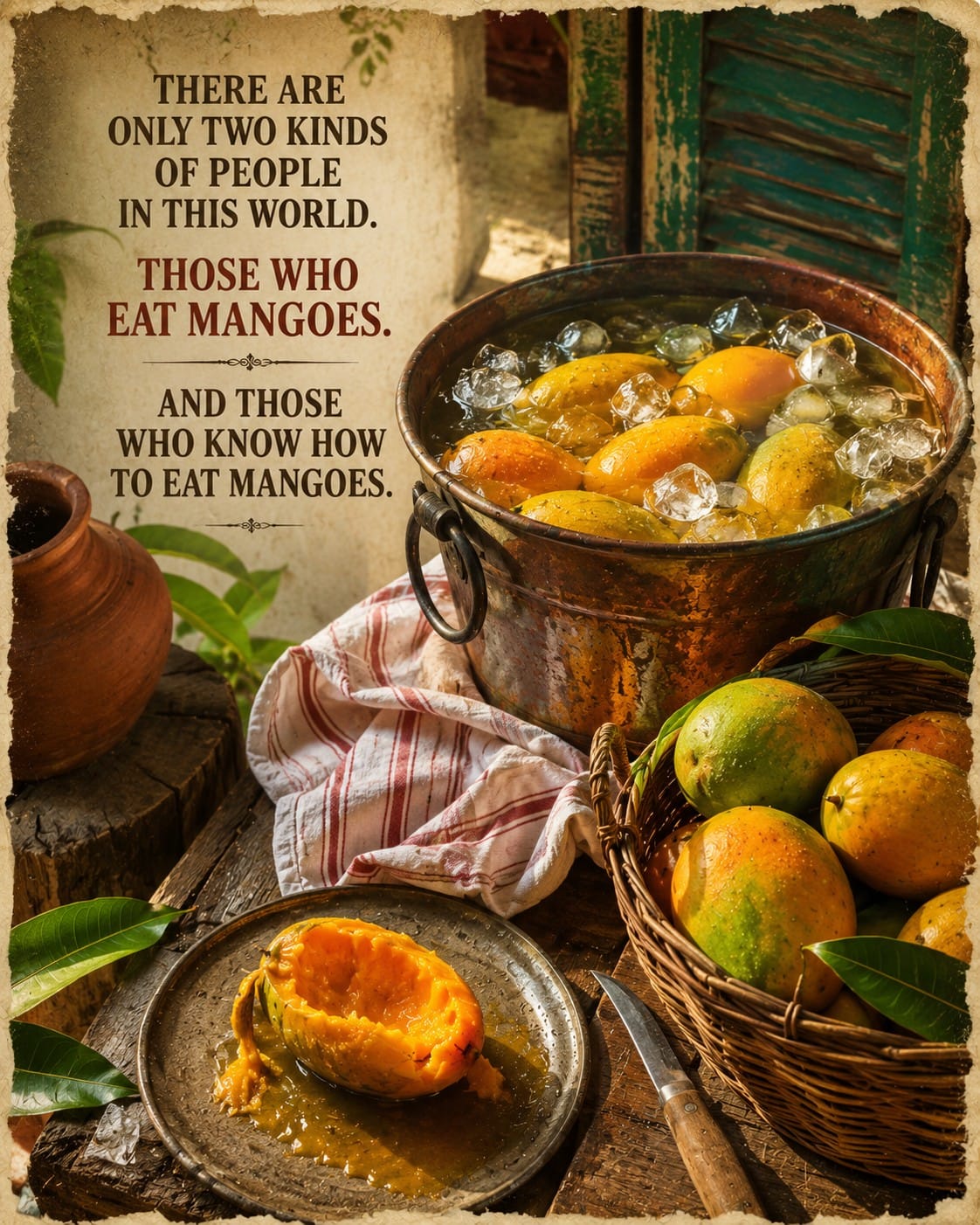
There are only two kinds of people in this world. Those who eat mangoes. And those who know how to eat mangoes. The difference is enormous.
The modern world has reduced the mango to a fruit. It isn’t. It is a season. It is a ritual. It is an annual festival that quietly arrives every summer, occupies your entire afternoon and disappears before you’ve had enough.
Every year I watch perfectly sensible people commit unspeakable crimes against mangoes. They refrigerate them, peel them, cut them into neat little cubes, spear them with forks and, to complete the assault, sprinkle chaat masala over them. Others imprison them inside fruit salads or convert them into smoothies.
Civilisation, I fear, is in decline.
Allow me, therefore, to explain the correct procedure.
The mango must first be chosen with care. Dussehri. Langda. The variety is your choice. What matters is respect. Pick it up gently. Caress it. Smell it. Wipe it lovingly with a soft muslin cloth. Then smell it again. A mango knows when it is being admired.
Now find a large bucket. Better still, an old wrought-iron tub that has survived many summers. Fill it with water and generous blocks of ice. Let every mango disappear beneath the water. Then wait.
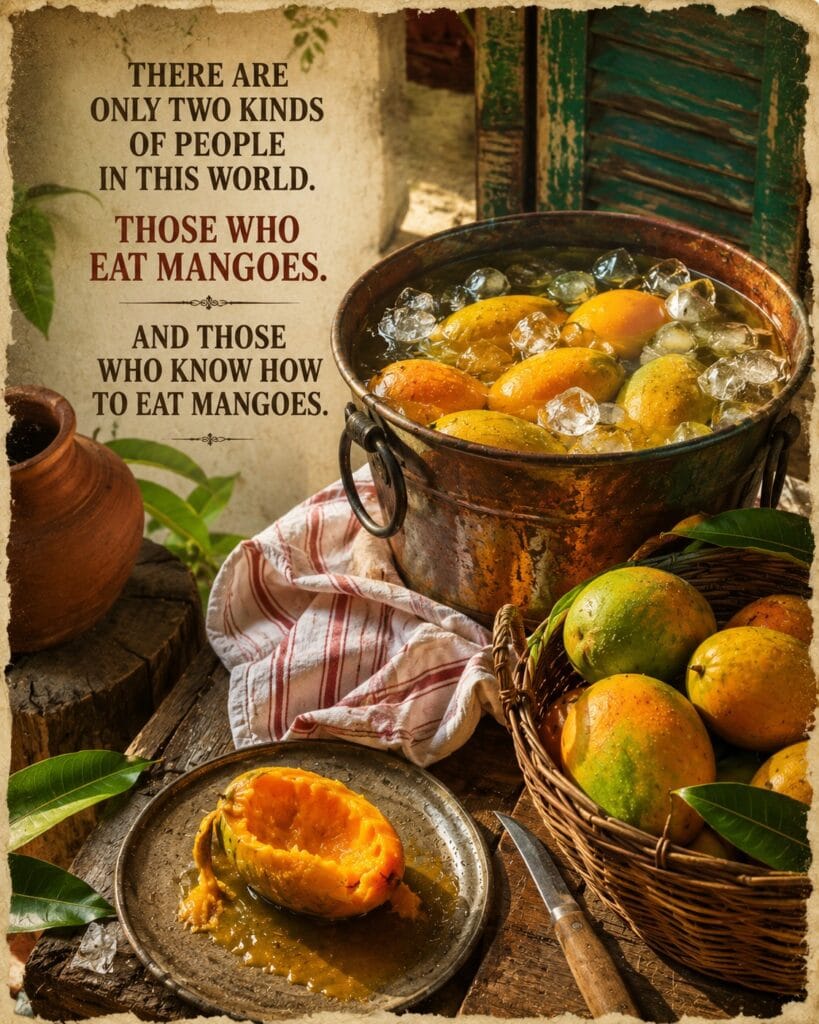
This is where character is built.
The ritual begins in the morning. The reward comes in the afternoon.
When the summer sun is at its fiercest, walk slowly towards the bucket. Bend down until the tip of your nose almost touches the icy water. Close your eyes and breathe deeply. No perfume company has yet managed to bottle that fragrance. If they ever do, I shall gladly stop buying perfume.
Now remove your shirt.
This is important.
Mangoes have absolutely no respect for freshly ironed clothes. There is a theory—entirely unsupported by evidence—that half-sleeved shirts were invented because nobody could eat rasam properly in full sleeves. I have chosen to believe it because it sounds too delightful to be false.
The same principle applies to mangoes.
Shirts and mangoes were never meant to coexist.
Pick up one mango and make a tiny hole near the stem. Old folklore says the sourness escapes through that little opening. Science disagrees. Science also insists tomatoes are fruits, so I have decided not to involve science in matters concerning mangoes.
Hold the mango firmly in one hand and massage it gently until the flesh inside becomes silky smooth. Then squeeze.
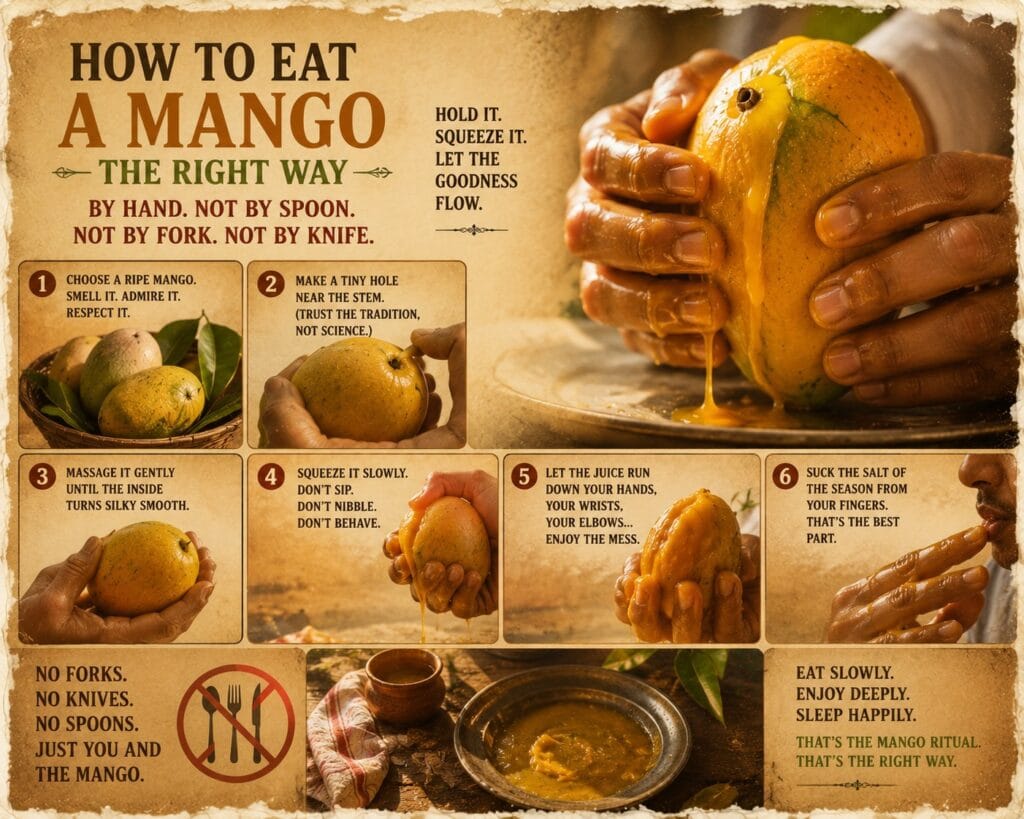
Don’t sip.
Don’t nibble.
Don’t behave.
Let the juice run down your wrists, your elbows and, if necessary, onto your baniyan. If your vest acquires a bright yellow abstract painting, congratulate yourself. You are finally eating a mango the way it was intended to be eaten.
Repeat the process. One mango is merely an introduction. Two is good manners. Three is commitment. Four is where philosophy begins. Beyond that, arithmetic loses all meaning.
Then comes the most important part of the ritual. Take a long bath, draw the curtains and sleep. Nobody should work after eating mangoes. Eating mangoes is work.
There is a delightful sequence in Border that captures this lazy summer ritual far better than any cookbook ever could. Every time I watch it, I become convinced that afternoons were invented solely so that people could eat mangoes and then surrender to sleep.
People often ask me which mango is the greatest. I refuse to answer. Every region has its loyalties. Alphonso has its admirers. Kesar has its devotees. Himsagar has its evangelists. Banganapalli has generations willing to defend it with their lives. Every one of them has a convincing argument.
As for me, a Dussehri is a mango. A Langda is a mango. The others are distinguished members of the extended family.
Unfortunately, age has an irritating habit of interfering with romance.
The four or five mangoes I could effortlessly demolish as a teenager have now become part of family folklore. These days, before every mango, there is a quiet negotiation between my tongue, my conscience and my endocrinologist.
Mangoes, delightful though they are, are not exactly blood sugar’s closest friends. They contain fibre, vitamins and everything nutritionists like to mention. They also contain enough natural sugar to make a glucometer earn its keep.

So the man who once counted mangoes now counts cubes instead. Six, perhaps seven—roughly a hundred grams. Just enough to satisfy the heart without upsetting the pancreas or alarming the endocrinologist.
The real drama begins two hours later. You prick your finger, insert the strip into the glucometer and stare at it as though it were announcing the civil services results. Those five seconds while it counts down are among the longest known to mankind.
If the number behaves itself, you silently congratulate your self-control and mentally reward yourself with another six cubes tomorrow. If it doesn’t, you immediately blame the mango, never the second helping of dinner. Human beings have always possessed a remarkable talent for identifying the wrong culprit.
These days I also have a weakness for Safeda, particularly when it is just short of being fully ripe—still firm, with a gentle bite and not embarrassingly sweet. Whether it genuinely contains less sugar or merely tastes that way, I have no idea. I have wisely avoided conducting the experiment. Some beliefs are better left untested.
Growing older, I have realised, doesn’t stop you from loving mangoes. It merely teaches you moderation—reluctantly, grudgingly and with enormous emotional resistance. Somewhere between demolishing four Dussehris as a teenager and carefully counting six mango cubes in middle age lies the entire story of growing up.
The mango hasn’t changed.
I have.
Every summer, however, when I lower a basket of mangoes into a bucket of ice-cold water and that unmistakable aroma rises from the surface, I become sixteen again. For a few glorious minutes the glucometer, the endocrinologist and the HbA1c all disappear.
Summer, after all, isn’t measured in degrees Celsius.
It is measured in mangoes.
Raw mango, of course, has its own journey.
Some are destined for a trip to the martaban, that magnificent pickle pitcher which seemed to exist in every household. The raw mangoes were cut, sometimes dried a little in the sun, then packed with spices and drowned rather generously in mustard oil. After that, into the martaban they went for the next couple of months, left quietly to pickle while the family got on with life.
Every family had its own recipe and, therefore, every mango pickle tasted different. Some were fiercely spicy, some more sour, some had a faint sweetness and some could make your eyes water before the second bite. Copious quantities were exchanged after family dinners, carried back home in little containers with the solemn assurance, “Hamara wala try karna.” That tradition, thankfully, still survives.
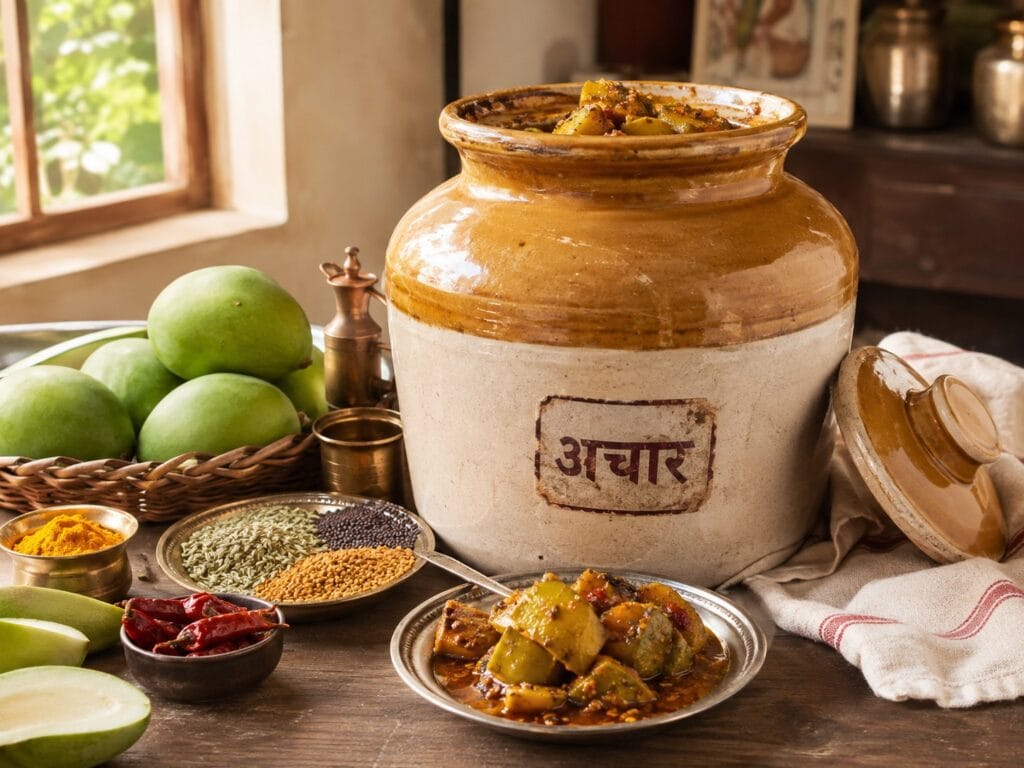
And mango pickle has never been particularly fussy about company. Roti, parantha, mathri, bread, puri, even a hurriedly assembled meal when nothing else looked exciting—it worked with almost everything.
Then there was aam panna, summer’s own air-conditioner in a glass. Raw mangoes were roasted, grilled or smoked until soft, the pulp scooped out and mixed with black salt, sugar, assorted spices and water. Every house again had its own interpretation. Served chilled, it was less a drink and more a rescue operation after an afternoon spent fighting the Indian summer.
Once the mango ripened, of course, the story changed completely.
Aamras, mango shake and shrikhand deserve their own little temples. Shrikhand with hot puris remains one of those combinations where all ideas about restraint quietly leave the room. And mango shakes during childhood were serious family business. Thick, cold, sweet, with little slivers of mango floating around the glass, they were invariably distributed in quantities that appeared unfair to at least one child.
The last half-inch at the bottom of somebody else’s glass could start a diplomatic crisis.
But when you finally got your share, cold glass in hand and mango pieces slipping through the froth, it was pure jannat.
Before you go…
If you believe mangoes should be eaten with both hands and no dignity, there is more food philosophy here:





Awwww…..you just nailed it. Images and visions of Mangoes and the fragrance that permeated the room when it came in a raw wooden peti lined in layers of dried hay….mmmmm…. As Kids, we would scrape off every last bit of the yellow nectar from the seed until it looked like a white haired fossil….
Yes, Yes we are Mango people here.
Such a brilliantly laid out article….devoured every word and hoping my sugar reading won’t spike due to the gastronomical visions,😂
Thanks. Its a delight that you loved the post. I am only writing experiences that I have lived thru. Probably thats the reason they sound believable and not fiction. Your request on Biscuits and their assorted cousins o innumerable candies would come soon. Thanks once again.
Thanks for your response to my comments…. Most writers lap up all the feedback and choose to remain quiet and unreachable ! You are such a welcome change to all that.
Now ,me just 2 comments old and if I may continue….. Just stumbled into your blog 24 hours back….. And hence quite sure have not put any requests yet… Biscuits and their cousins. Case of mistaken identity or am I the only privileged one to know what is in the pipeline next. Hahaha….Dil maange more !
Lived thru memories. Its strange that they resonate.