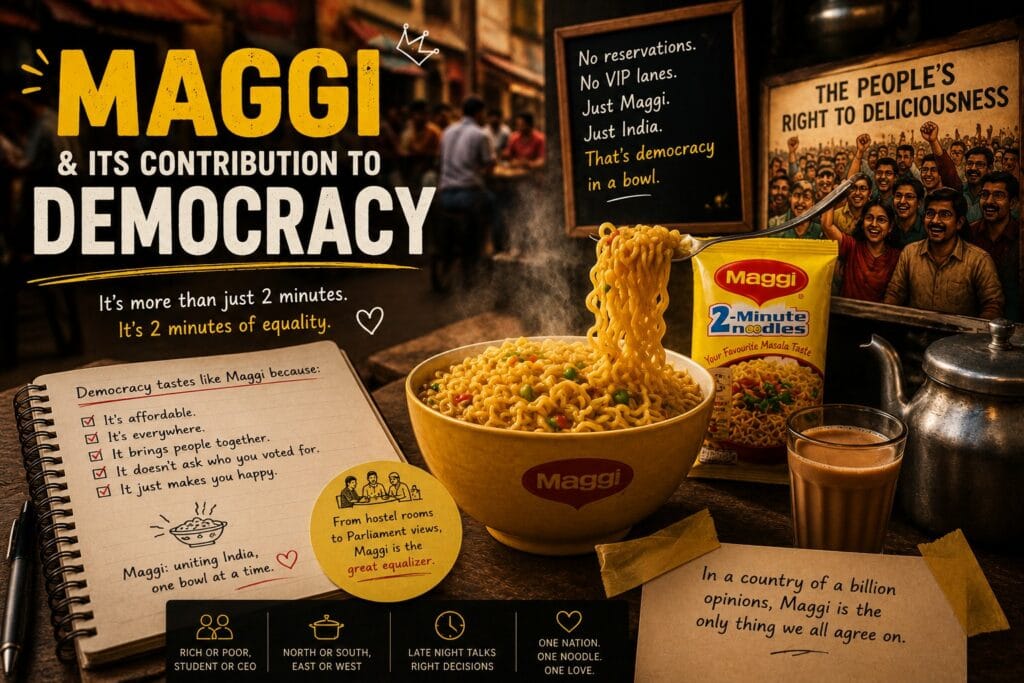
I have often wondered why our Constitution forgot to mention Maggi. It speaks eloquently about justice, liberty, equality and fraternity, but somewhere between the Fundamental Rights and the Directive Principles, somebody should have quietly inserted one more sentence: “Every citizen shall have the right to two-minute noodles.” No food in modern India has done more for democracy than Maggi.
Think about it. A billionaire’s son and a hostel student have both eaten Maggi straight from the saucepan. The IIT topper. The engineering backbencher. The investment banker returning home at midnight. The newly married couple who have just discovered that romance doesn’t automatically produce dinner. The homesick student in Boston. The software engineer in Bengaluru. The bachelor who proudly declares, “I cook,” and then proceeds to boil water. Maggi has judged none of them. Unlike fine dining, it has never asked who you are. It has only asked whether you remembered to switch off the gas.
Every Indian has a Maggi story. It appears during hostel nights, mountain holidays, train delays, examination weeks, heartbreaks, rainy evenings and those mysterious Sundays when the refrigerator contains precisely half an onion, one tomato and limitless optimism. Maggi never complains. It simply adjusts. In that sense, it is probably more Indian than many Indians.
Curiously, Maggi also possesses a remarkable ability to improve with poverty. A hostel Maggi invariably tastes better than a five-star Maggi. Nobody has ever explained this scientifically. Perhaps hunger is the greatest seasoning ever invented. Or perhaps dented aluminium saucepans retain memories that expensive stainless steel never can.
The recipe printed on the packet is merely a suggestion. Every Indian household believes it knows better. Some insist on onions. Others swear by tomatoes. North Indians refuse to proceed without green chillies. Somebody inevitably adds peas to reduce guilt. Cheese barges in like an overenthusiastic relative. Butter improves everything. And then there are the enlightened souls who crack an egg into Maggi. They deserve our respect. Others add leftover chicken, paneer, mushrooms or vegetables and proudly announce that they have “made a meal.” No. You have merely made expensive Maggi.
Then there is the greatest marketing fiction ever written—“Two-Minute Noodles.” Has anybody, anywhere in the history of civilisation, actually cooked Maggi in two minutes? Finding the saucepan takes two minutes. Waiting for the water to boil takes another three. Locating the masala sachet after accidentally throwing it into the dustbin with the wrapper consumes one more. Then comes the stirring, the tasting and the inevitable decision that it needs “just a little more water.” By the time you finally sit down to eat, democracy has aged considerably.
But Maggi truly comes into its own in the mountains. There is something almost magical about eating a steaming bowl of Maggi while looking at clouds drifting across the valleys of Himachal or Uttarakhand. Every viewpoint, every roadside shack and every tea stall seems to have independently concluded that altitude and Maggi are inseparable companions. Whether you’re in Manali, Shimla, Mussoorie, Nainital or somewhere on the road to a forgotten village, there it is—a dented aluminium saucepan bubbling away on a gas stove, a kettle of overboiled tea beside it, and a board proudly announcing “Hot Maggi Available.” You may have travelled a thousand kilometres for snow-capped mountains, but sooner or later you find yourself sitting on a plastic chair, wrapped in a borrowed shawl, blowing gently over a bowl of Maggi. Somehow it tastes better at six thousand feet than at sea level. Science has no explanation. Memory doesn’t need one.
Railway platforms have also played their part. There was a time when railway food was something to be endured rather than enjoyed. Then along came Maggi, faithfully appearing at stations large and small, rescuing hungry passengers from oily cutlets of uncertain ancestry and sandwiches that had clearly seen happier days. Like the Indian Railways itself, Maggi ignored language, caste, religion, region and ticket class. Everybody waited for the same whistle. Everybody slurped the same noodles.
Maggi has survived because it never tried to become sophisticated. Nobody discusses its texture, its terroir or the subtle notes of turmeric in the masala. Nobody photographs it under flattering lights before eating it. It is one of the few foods that remains blissfully indifferent to social media. You eat it from a saucepan, a steel bowl, a paper cup or occasionally directly from the cooking vessel itself. It has no ego.
Nutritionists, of course, periodically raise their eyebrows. Doctors politely clear their throats. Parents spend years pretending they disapprove of it. Curiously, all three categories have been caught eating Maggi at some point, usually after eleven at night when nobody is watching. Human hypocrisy has rarely been so delicious.
I have eaten Maggi in hostels, homes, hotels, hill stations and highway motels. Every place claimed to make it differently. Every bowl tasted slightly different. Yet every bowl tasted unmistakably like Maggi. Few foods carry such emotional consistency. One mouthful and you are immediately transported to another phase of your life. The first year of college. A rainy Sunday. A honeymoon in the hills. A late-night office deadline. A child’s demand for “just one more bowl.” Very few foods can time travel. Maggi can.
Perhaps that is democracy.
Not making everyone identical.
But making everyone feel equally welcome.
Maggi may never receive a Michelin star. It doesn’t need one. It already possesses something far more valuable. It has citizenship in almost every Indian kitchen. It has comforted students, rescued bachelors, fed travellers, saved holidays, repaired bad days and quietly reminded us that happiness occasionally comes in a yellow packet costing less than a cup of coffee.
The Constitution may never acknowledge Maggi.
The country already has.