
“Good morning, Sanjay. You slept 18 minutes less than usual. Your recovery isn’t optimal. Your HRV has dipped. Your stress levels are elevated. Your Body Battery is running on reserve.”
Before I’ve even brushed my teeth, I’ve already failed five health tests.

Welcome to the world of Hannibal Lecter and The Silence of the Lambs.
Hannibal Lecter would have approved.
Not because my smartwatch wants to kill me, but because it has perfected his greatest weapon. Lecter didn’t terrify people by shouting. He didn’t need jump scares. Calm, cultured and unnervingly polite, he simply planted doubt. He whispered.

He made intelligent people question themselves. Once he occupied their minds, the horror had already begun.
That’s exactly what modern wearables do.
They don’t scream that you’re ill. They quietly suggest that you’re not quite well enough. Your recovery could be better. Your sleep wasn’t restorative enough. Your glucose spiked after breakfast. Your HRV is down. Your stress levels are elevated. Nothing is seriously wrong. Yet nothing is ever completely right either. Like Hannibal Lecter, they don’t attack your body; they quietly occupy your mind. Before long, you stop listening to yourself and start listening to your dashboard.
There was a time when the only thing I checked every morning was whether the newspaper had arrived. If the headlines were depressing, I blamed the government. If they were cheerful, I suspected the editor had gone on leave. Life was wonderfully uncomplicated.
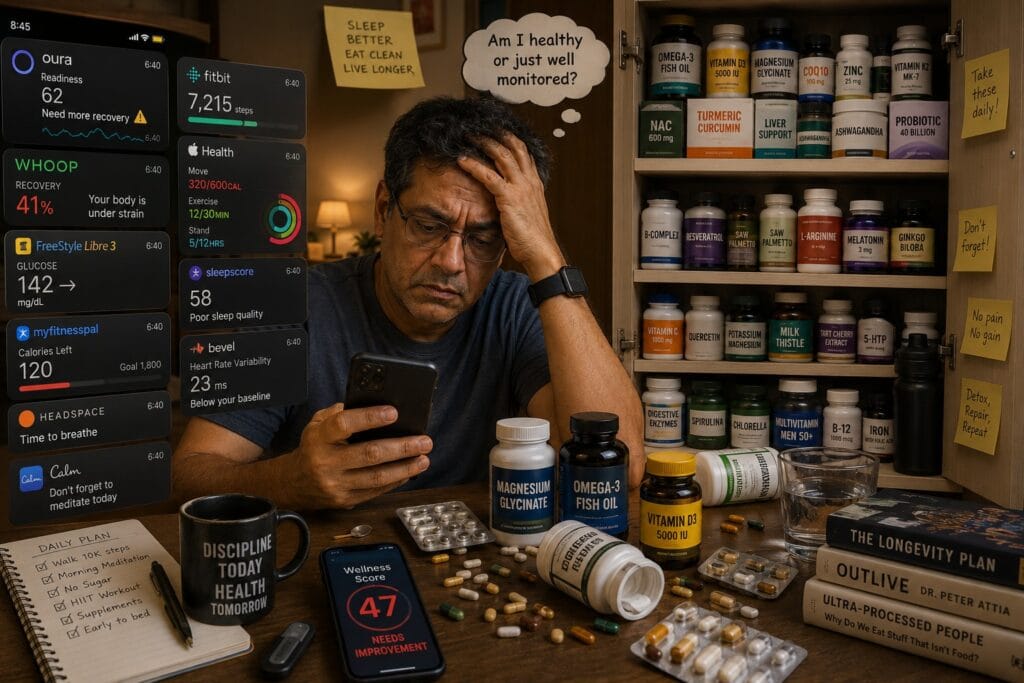
Today, my watch is merely the opening act. WHOOP quietly judges my recovery. An Oura Ring analyses my sleep. A continuous glucose monitor keeps an eye on every bite I take. Pacer counts my steps with the enthusiasm of an overzealous school prefect. The blood pressure machine patiently waits for me to panic over all the other readings before delivering its own alarming verdict. Somewhere in the background, half a dozen wellness apps generate colourful graphs, trends, badges and notifications. My phone now has more health dashboards than an Airbus cockpit. The only question nobody seems interested in asking is the only one that really matters: How are you actually feeling today?
The irony is exquisite. Every one of these devices was marketed as a way to reduce anxiety. Instead, they manufacture fresh anxiety before breakfast. A tiny dip in HRV is enough to send me down an internet rabbit hole. A slightly higher resting heart rate convinces me that I am either on the verge of becoming an elite endurance athlete or require emergency medical attention. Every statistic comes with the hidden promise that somewhere there is another statistic capable of explaining the previous one. We are no longer monitoring our health; we are conducting forensic investigations into perfectly normal bodily functions.
The supplement industry deserves a standing ovation for taking this theatre of the absurd to another level. Whoever designed Omega-3 capsules clearly believed that the average human oesophagus was roughly the diameter of a municipal drainage pipe. Swallowing one feels less like taking a supplement and more like negotiating customs clearance for oversized cargo. I’ve choked on them often enough to wonder whether the cure might outlive the patient. Then comes the magnesium tablet that promises deep, restorative sleep. By the time I’ve wrestled that rock into my stomach, I’m already exhausted enough to sleep standing up. The tablet deserves no credit whatsoever.
The comedy reaches its peak one morning when I discover that my urine has turned an alarming fluorescent yellow. Naturally, my imagination goes into overdrive. Liver? Kidneys? Some rare tropical disease? Within minutes I’ve mentally diagnosed myself with conditions that medical science is probably still discovering. Five anxious minutes later I discover it’s merely riboflavin—Vitamin B2—politely leaving my body after doing its job. The supplement industry doesn’t merely sell vitamins; it provides enough harmless side effects to keep your imagination permanently employed.
As if that wasn’t enough, an entire ecosystem now exists to remind us that we are never doing enough. Social media overflows with wellness gurus plunging into ice baths before sunrise, influencers demonstrating breathing techniques that resemble labour pains, podcasts arguing that coffee is either the elixir of life or liquid poison depending on which expert is speaking that week, and advertisements insisting that unless I consume eighteen different supplements before lunch, I am ageing at double speed. Somewhere along the way, good health stopped being a state of being and became a competitive sport. The person with the most apps, the longest supplement list and the highest number of tracked biomarkers is declared the winner.
Then comes the OTP circus. Every wellness app, pharmacy, diagnostic lab and supplement website insists on sending me a One-Time Password to verify my existence. My phone spends half the day announcing that an OTP has arrived so another app can remind me that I didn’t sleep well enough to deserve happiness. Even staying healthy now requires two-factor authentication.
What amazes me most is how willingly we’ve surrendered common sense. Our grandparents knew they had slept well because they woke up feeling refreshed. We wake up feeling perfectly energetic, glance at a sleep score of 72 and immediately decide we must actually be tired. We have outsourced instinct to algorithms. We trust a wristwatch more than our own body. We have become managers of data instead of participants in life.
Perhaps this is the wellness industry’s greatest triumph. It has convinced healthy people that they are unfinished projects. There is always another metric to improve, another supplement to swallow, another gadget to strap on, another notification to acknowledge and another graph to interpret. The finish line keeps moving because perfection, unlike good health, is wonderfully profitable.
Maybe the healthiest thing any of us can do tomorrow morning is commit a tiny act of rebellion. Leave the watch charging on the bedside table. Go for a walk without recording it. Eat breakfast without calculating its glycaemic impact. Resist photographing your avocado or interrogating your glucose graph after every morsel. Meet a friend without comparing sleep scores. Spend a few hours blissfully ignorant of your HRV.
For thousands of years, humanity somehow managed to fall in love, raise children, build civilizations, write poetry, create music, build businesses, discover continents and live remarkably fulfilling lives without ever knowing an overnight recovery score.
Perhaps good health isn’t measured by how many biomarkers you track.
Perhaps it’s measured by how many hours you spend forgetting that your body exists because you’re too busy enjoying your life.
That’s a metric no wearable has learnt to measure.