Poor Khichdi.
No other dish in India has suffered such a spectacular branding failure. The moment someone announces, “We’re having Khichdi tonight,” the room falls silent. Children assume they are being punished. Teenagers instinctively reach for food delivery apps. Adults nod politely, as though accepting an unavoidable medical procedure. Nobody has ever exclaimed, “Fantastic! Khichdi!” Which is deeply unfair.
Khichdi is not boring. It is misunderstood.
Every great cuisine has its comfort food. Italy has risotto. Japan has okayu. China has congee. Britain has mashed potatoes whenever life becomes unbearable. India has Khichdi. The difference is that the rest of the world celebrates its comfort food. We apologise for ours.
Think about when Khichdi enters our lives. When we’re ill. When the stomach has staged a rebellion. When the doctor has banned everything worth eating. Or when the cook has gone on leave and someone in the family sighs, “Let’s just make Khichdi.” Imagine introducing a Ferrari only as an ambulance. That’s exactly what we’ve done to Khichdi.
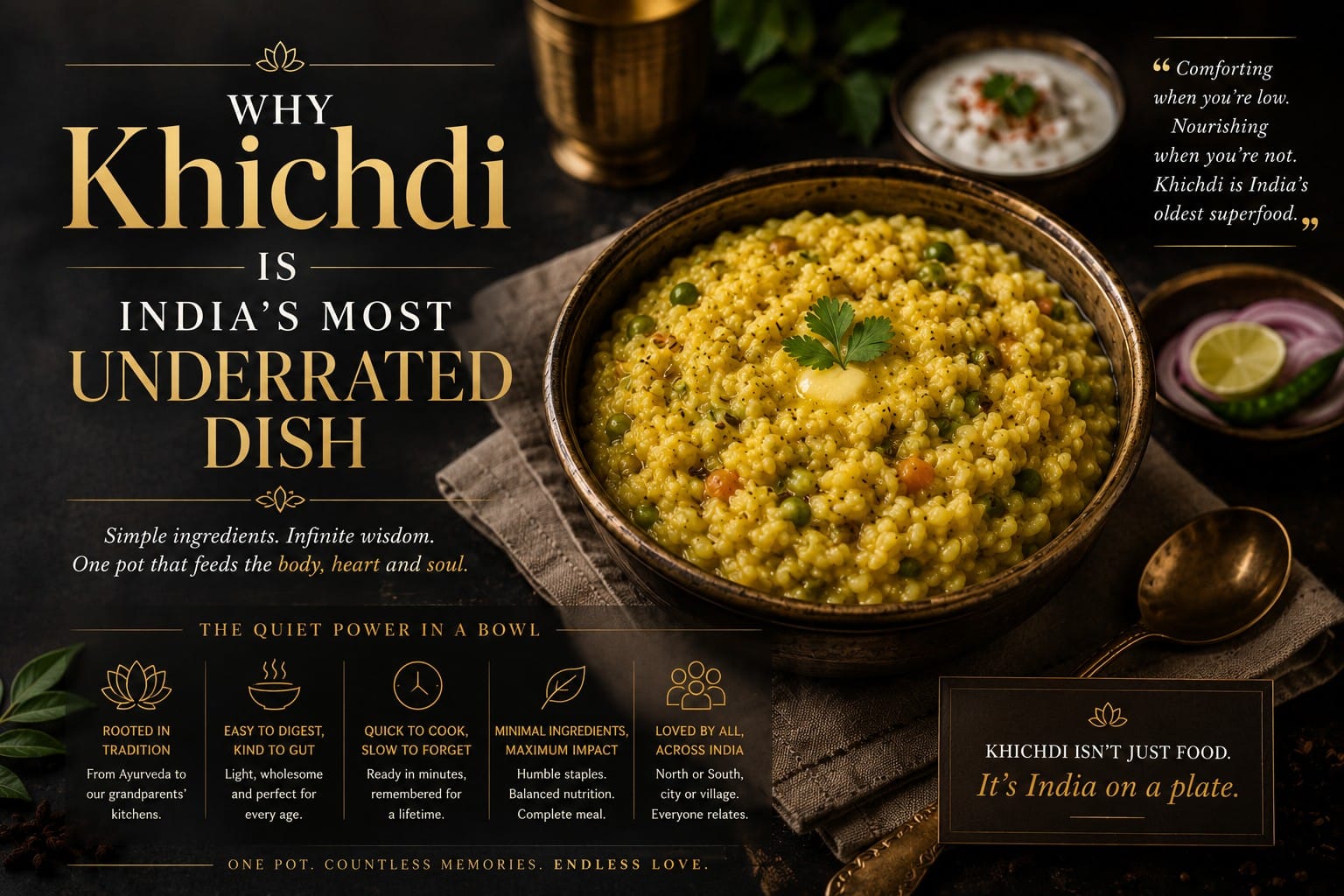
A properly made Khichdi is one of the most sophisticated dishes in Indian cuisine. Rice and lentils surrendering to each other, cumin crackling in hot ghee, a hint of asafoetida, ginger, perhaps a green chilli or two, and suddenly the kitchen smells like home. It doesn’t shout. It doesn’t seduce. It simply reassures. Like truly intelligent people, Khichdi has nothing to prove.
The real genius of Khichdi, however, lies in what accompanies it. A spoonful of ghee slowly melting into the bowl. Thick curd. Crispy papad. Mango pickle. Perhaps a dollop of homemade butter if your cardiologist happens to be on holiday. Suddenly this supposedly humble dish transforms itself into a royal feast. It is rather like an unassuming actor who quietly steals the film from the stars.
And then there is a combination that deserves a standing ovation—Khichdi with egg bhurji. If you haven’t tried it, you have quietly denied yourself one of life’s simpler pleasures. Make the bhurji with onions, tomatoes and green chillies, but don’t overcook it. Keep it slightly slushy rather than dry. Now pour it generously over steaming Khichdi and ensure every spoonful carries both. The creaminess of the Khichdi, the sweetness of onions, the gentle acidity of tomatoes, the bite of green chillies and the richness of eggs merge into something that is far greater than the sum of its parts. It is comfort food discovering its soulmate. Michelin inspectors may never discover it, but Indian bachelors, hostel students and countless homes certainly have.
Curiously, have you ever seen Khichdi occupying centre stage on a restaurant menu? Almost never. And if it does appear, it hides apologetically under “Light Meals”, sandwiched somewhere between plain curd and steamed vegetables, as though the chef himself is embarrassed by it. Nobody celebrates a promotion over Khichdi. Nobody says, “Let’s go out for Khichdi tonight.” It has somehow acquired the image of culinary mediocrity.
Which is ironic.
Because some of the world’s greatest dishes don’t impress you by showing off.
They impress you by making you feel at home.
Notice something else. Nobody eats Khichdi in a hurry. Nobody stands balancing a bowl in one hand while replying to emails with the other. Khichdi insists that you sit down, slow down and breathe. Perhaps that is why it appears whenever life becomes difficult. Somewhere deep down we know it heals more than the stomach. It calms the mind.
There isn’t one Khichdi. There are hundreds. The Bengali Bhuni Khichuri, fragrant enough to perfume a monsoon afternoon. The Gujarati versions with their gentle sweetness. The robust Rajasthani Khichdis that can sustain you through a desert. The simple Moong Dal Khichdi that every Indian mother believes can cure almost anything short of a constitutional crisis. Every region quietly claims to have perfected it. I have a feeling they’re all right.
Modern nutritionists have finally discovered what Indian grandmothers knew all along. Rice and lentils complement each other beautifully, creating a wholesome protein. Add vegetables, yoghurt and a little ghee, and you have a meal that is nutritionally balanced, deeply satisfying and remarkably easy to digest. Grandmothers, of course, never needed research papers. They had grandchildren.
I sometimes think a civilisation should never be judged by the food it serves at weddings. Weddings are all about display. Judge a civilisation instead by what it cooks when someone comes home tired, heartbroken, exhausted or unwell. That is where a culture reveals its heart.
In India, that heart usually arrives in a steel bowl filled with steaming Khichdi.
Perhaps Khichdi doesn’t suffer from a branding problem after all.
Perhaps we do.
We have become so obsessed with celebration that we have forgotten to appreciate comfort. We applaud food that dazzles and quietly ignore food that heals.
Growing older has also taught me another lesson. The dishes we chased in our twenties impress us. The dishes we return to in our fifties nourish us. Somewhere along that journey, Khichdi quietly moves from the edge of the table to the centre of it.
Like the wisest people we know, it never demands attention.
It simply deserves it.
If khichdi means comfort rather than compromise to you, you may also enjoy:



In Tamil Nadu, there is also the ubiquitous Pongal which must have lashings of ghee and cashewnuts and is accompanied by a flavourful “Gothsu” accompaniment – That’s the real “Chicken Soup for the Soul”
Spent several weekends and months in Chennai for work. Murugan Idly was the best. It was piping hot, the guy never gave eating spoon to me, poured a ladel full of steaming sambhar on already hot idly, my fingers scalded but i loved the softness and sponginess. Pongal was another favourites. Also I loved going to Karikudi opposite Nilgiris next to the church as i remember. I relished the south indian Thali and the non veg preparation of Sora Puttu & Nandu Puttu!!