
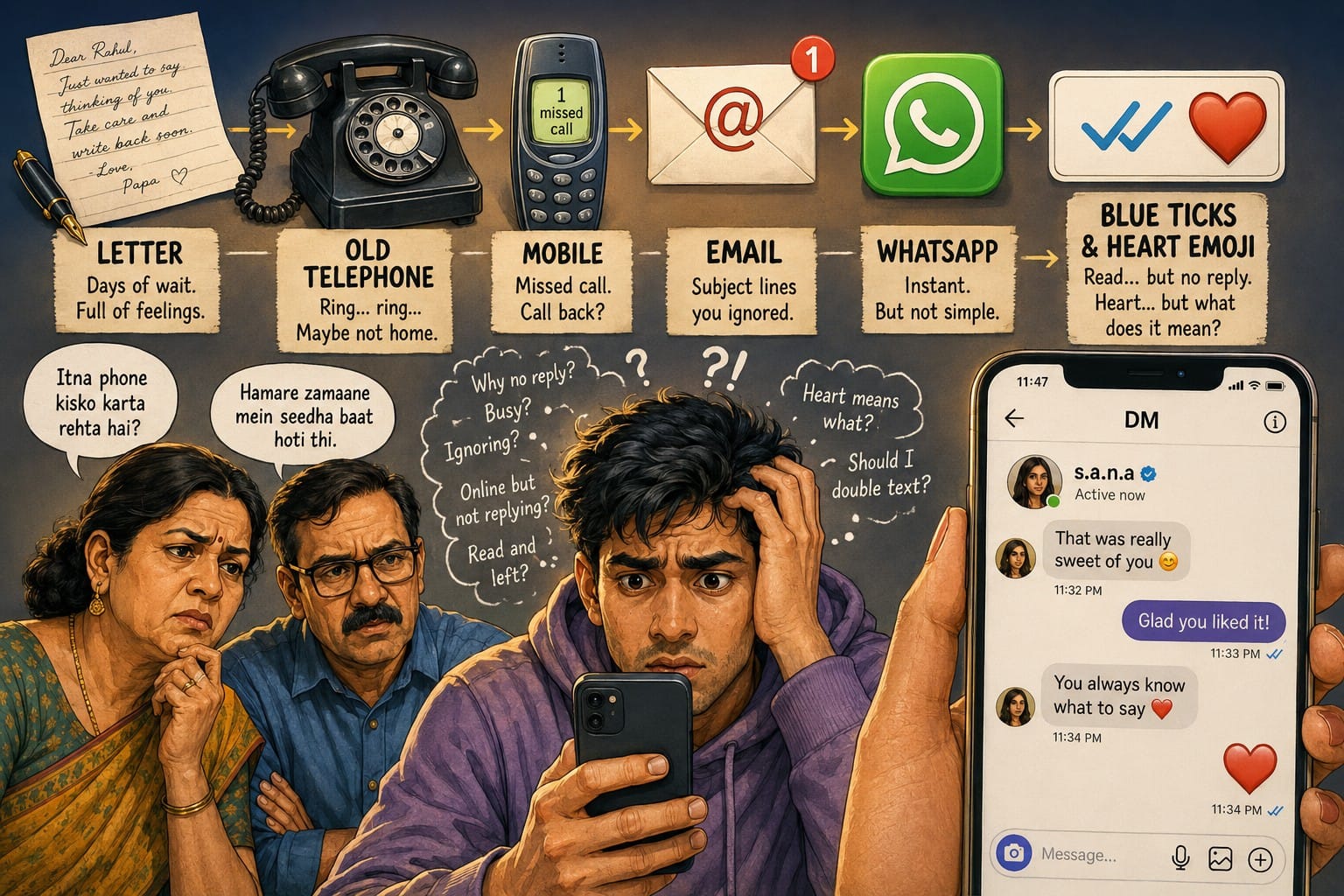
There was a time when somebody did not reply and that was the end of the available evidence. The landline rang, nobody picked up, you tried later. A letter took four days, sometimes seven, and for most of that period you had no idea whether it was sitting in a post office, travelling somewhere or had already reached the person who was now deciding not to answer you. Ignorance was frustrating, but at least it was clean.
WhatsApp has improved things considerably. It now gives you enough information to ruin your evening.
You send a message. One grey tick, then two. Delivered. Fine. Ten minutes later you check again, not because you are checking, obviously, but because you happened to open WhatsApp for something else. Still grey. The person is probably busy. Very reasonable. Then you notice that little word at the top: online.
Now Sherlock takes over.
He is online, but my message is not blue. So he has opened WhatsApp but has not opened my chat. Maybe he is in a meeting. Perhaps he opened a family group. Perhaps somebody called him. Perhaps he is reading somebody else’s message. That last possibility is unnecessarily irritating because clearly there are priorities in life and apparently you are not one of them.
Then he disappears. Last seen 10:28. Your message remains grey. So he had time to come online, do whatever he wanted to do there and leave without reading my message. This is how perfectly respectable adults begin behaving like rejected teenagers at eleven in the night.
Of course, he may have seen the notification on his locked screen. Which makes it worse because now he may have read the message without officially reading the message. You start wondering how much of the message appears in the notification. Was the whole sentence visible? Only the first line? Did he expand it? Has he disabled previews? A perfectly normal adult is now conducting a technical audit of somebody else’s phone settings because a message has not been acknowledged.
WhatsApp itself does not help. Somebody calls you on WhatsApp and ten minutes later the chat says Last Seen yesterday. Now what is that supposed to mean? She called me ten minutes ago. Was she online without being online? Has she hidden Last Seen? Has WhatsApp developed some mysterious definition of presence? You begin blaming the software because accepting that you don’t actually know what another human being is doing has become strangely difficult.
Then there are the blue ticks, perhaps one of technology’s finest contributions to low-grade emotional instability. Blue ticks were meant to tell you that the message had been read. Instead, they merely move the investigation to the next stage. She has read it. Fine. Why hasn’t she replied? Maybe she is thinking. Thinking about what? I asked whether she is free at seven, not whether she wants to reassess the direction of her life.
You wait, and then suddenly typing… appears. Relief. A response is coming. Then typing disappears and nothing arrives. Somebody somewhere started saying something to you and then decided against it. You will never know whether it was affectionate, irritated, complicated or completely ordinary. Naturally, the mind chooses the most dramatic explanation available and then improves upon it.
Then comes the heart emoji. ❤️
Now what exactly does that mean? She has fallen for me. Or she liked the message. Or she liked one sentence in the message. Or she had nothing particular to say and pressed a heart because it looked warmer than “okay”. There is absolutely no way of knowing, which of course does not prevent you from knowing with total confidence.
The problem becomes much more interesting if a wife, husband, boyfriend or girlfriend happens to be looking over your shoulder. You may think somebody merely liked your message. The person behind you may see documentary evidence of an affair developing in real time.
“Why is she sending you hearts?”
“She isn’t sending me hearts. She reacted to the message.”
“With a heart.”
“Yes.”
“Exactly.”
You now find yourself explaining the constitutional difference between sending a heart and reacting with a heart, while privately wondering whether that distinction is quite as convincing as it sounded when you began the defence.
The recipient thinks, Wow, she has fallen for me. The partner thinks, Wow, he is drifting away. Meanwhile the sender may simply have meant, Nice message.
One tiny red symbol can therefore encourage a romance, create a domestic inquiry or merely acknowledge a photograph of somebody’s dog. Human beings spent thousands of years developing language and then decided this was progress.
At some stage a sensible person tells you to switch off read receipts and Last Seen. Excellent idea. Privacy, mental peace, freedom from surveillance. You switch everything off and feel wonderfully evolved for perhaps half an hour.
Then you send another message and immediately wonder whether she has read it.
Now there are no blue ticks, so perhaps she has and perhaps she hasn’t. Maybe she saw it on the lock screen. Maybe notifications are off. Maybe she is driving. Maybe she is asleep. Maybe she simply does not feel like replying. The old uncertainty has returned, except now you know there is a setting somewhere that could have resolved part of it and you voluntarily turned it off. So eventually you turn the blue ticks back on.
We have somehow created a communication system in which every feature designed to provide certainty produces another category of doubt. Delivered is not read. Read is not replied. Online does not mean your chat was opened. Unread does not mean unseen. Typing does not mean a message is coming. A heart does not necessarily mean love. Last Seen may not be the last time anybody saw anything.
And still we behave as though these little signals are sworn testimony. He was online at 10:17, my message was delivered at 10:03 and there is no blue tick. At some point this stops being messaging and starts resembling a case file.
Then comes another modern torture device: the person who reads your message, does not reply, and twenty minutes later uploads a photograph on Instagram. At that point all charitable explanations collapse. Busy? Apparently not. Phone away? Clearly not. In a meeting? Unless the meeting involved cocktails and a sunset, unlikely.
The funniest part is that all of us know the sensible explanation. People are busy. They get distracted. They read notifications and forget. They open WhatsApp for something else. They postpone replies. Sometimes they simply do not feel like talking. We ourselves do exactly the same thing and consider it perfectly innocent. When somebody else does it, motive is immediately established.
And some people, of course, know exactly what they are doing. They know you can see the blue tick, they know you can see they are online, and they read the message, remain online for another twelve minutes and say absolutely nothing. Maybe innocent, maybe not. By then you have already drafted three possible replies, deleted all of them and decided that whenever they finally write, you will also wait exactly seventeen minutes before responding.
Earlier, silence was just silence. You could dislike it, misunderstand it or brood over it, but you did not have a digital trail to assist the prosecution. Now silence arrives accompanied by timestamps, delivery reports, read receipts, emojis, online status and occasionally photographic evidence that the accused was happily eating sushi while allegedly too busy to answer you.
Technology did not remove uncertainty from human communication. It simply gave uncertainty more data.
The healthiest solution is obvious: turn off Last Seen, turn off Online, turn off blue ticks, stop doing amateur detective work, send the message and get on with your life.
You can do all of that.
And five minutes later still look at the phone and wonder whether she has read it.
If the above resonates, lets go back in time and revisit……….