
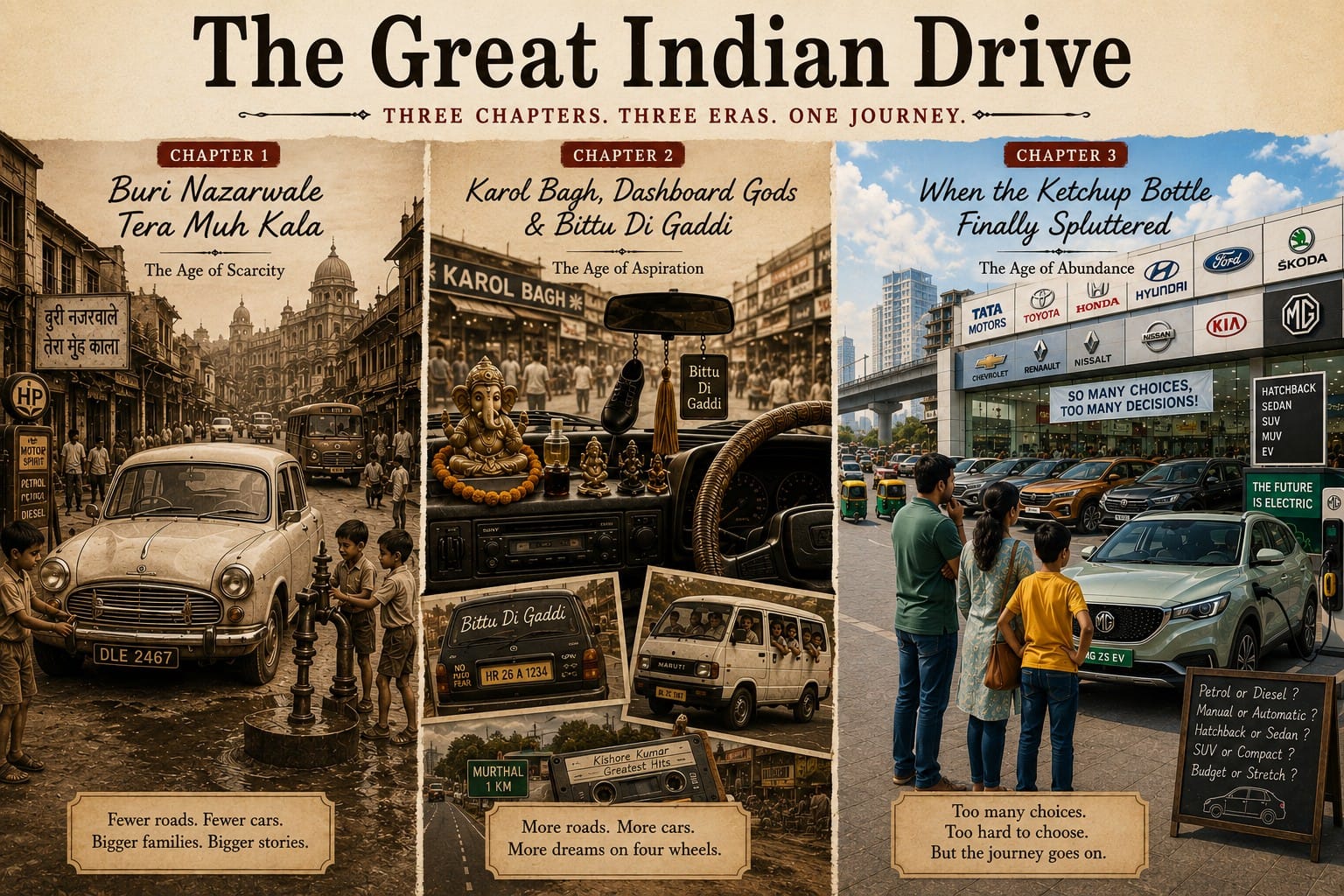
Chapter 2: Karol Bagh, Dashboard Gods & Bittu Di Gaddi
Missed the beginning? The Great Indian Drive started with Ambassador, Premier Padmini and the wonderful theatre of getting somewhere. Read Chapter 1 here.
The Maruti 800 did something no Indian car had managed before. It simply worked.
It started every morning without persuasion, steered where you pointed it and never demanded a family conference before setting out on a long drive. Compared to the Ambassador and the Premier Padmini, it felt almost futuristic. Families that had grown up coaxing reluctant engines into life suddenly discovered the strange luxury of turning a key and… just driving away.
It was tiny, of course, although nobody seemed particularly bothered by that. Indian families had never allowed the manufacturer’s recommended seating capacity to interfere with travel plans. Two adults in front, three at the back, one child on a lap and another squeezed somewhere nobody quite remembers now was considered perfectly reasonable. Luggage went into the boot until the boot protested, after which bags migrated to laps, under feet and occasionally onto the rear parcel shelf. The car might have been small. Our ability to fit ourselves into it wasn’t.
Waiting periods stretched endlessly. Booking receipts were guarded more carefully than fixed deposit certificates and people happily paid hefty premiums simply to get one a little earlier. Neighbours no longer asked, “Which car have you bought?” They asked, “Kitna waiting tha?”
Of course, we couldn’t leave it alone. No Indian family has ever looked at a perfectly good machine and said, “Let’s keep it exactly as the engineers intended.”
The dashboard was the first casualty.
Within days, a tiny Ganesha, Hanuman, Sai Baba, Jesus, Guru Nanak or whichever deity the family trusted most quietly occupied pride of place. Someone added a fresh garland. Someone else found tiny coloured bulbs. Hanging from the inside rear-view mirror appeared a miniature jooti, a tassel or the sacred scarf that Panditji had handed over at the temple, rolled neatly into a knot. Before long, a tiny perfume bottle joined the party, bravely attempting to overpower the unmistakable aroma of rexine seats, warm vinyl, petrol fumes and yesterday’s samosas.
The pilgrimage to Karol Bagh, Opera House or the neighbourhood accessory market wasn’t far behind. A perfectly respectable Maruti returned looking as though it had acquired a second personality. Heavy crash guards appeared at the front and rear. Headlights found themselves protected by elaborate steel cages. Chrome strips surfaced in places where nobody had previously noticed empty space. Wheel caps, steering-wheel covers stitched by hand, neck pillows, mud flaps with impossible promises, cassette players, equalisers and speakers powerful enough to entertain three neighbouring cars quietly found their way in.
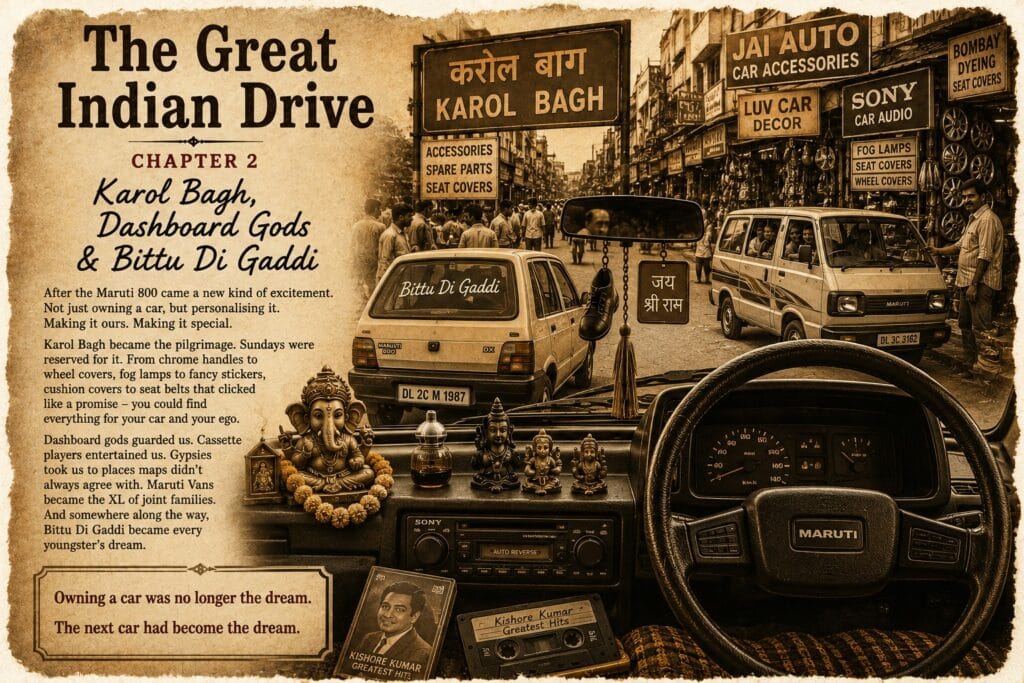
Seat covers were an industry by themselves. The original upholstery had barely experienced daylight before somebody covered it with another fabric to protect it for some mysterious future owner. For a while there were beads on seats, furry covers, towels carefully spread over headrests and little cushions that promised lumbar support without anybody quite knowing what lumbar meant. The objective seemed to be to preserve every original surface of the car so perfectly that the person who eventually bought it second-hand could enjoy what you had spent years protecting.
If an accessory existed anywhere in India, somebody eventually found a way to bolt it onto a Maruti.
The back of the car slowly became a public introduction to its owner. Bittu Di Gaddi. Sher Singh. Sunny Paaji. Some preferred King. Others announced No Fear, Jaat Boy or simply their own name in lettering large enough to be read from the next district. These weren’t discreet little stickers tucked into a corner. They were declarations. You didn’t need Facebook, Instagram or a bio. The backside of your car had already told the world everything it apparently needed to know.
The Maruti also gave India one of its more amusing contradictions. Its sheet metal was so thin that owners worried about somebody leaning against the door too enthusiastically. The solution, naturally, was to fit crash guards sturdy enough to survive a minor war. We protected a lightweight car by making it progressively heavier.
Seat belts existed, of course, but in the early years they were hardly part of everyday driving. On basic models they could be charged separately as accessories, much like the air-conditioner and the cassette player. Since wearing them wasn’t compulsory, most people didn’t think about them at all. Airbags were not even part of the conversation. Nobody stood in a showroom asking how many airbags the car had because the question itself hadn’t entered our heads.
Horns, on the other hand, received enormous attention. The factory horn was apparently never expressive enough. Twin horns, musical horns, shrill horns, deep horns—some sounded like trucks, some like wedding bands and a few seemed designed purely to announce that the owner had arrived before the car did. The accessory market could give you almost any sound you wanted, except perhaps silence.
Safety, such as we understood it, was often highly visible. Reflective strips and little red or yellow reflectors were plastered on bumpers, mud flaps and assorted corners of the car with great enthusiasm. At night, once the headlights, extra lamps, dashboard bulbs and all those reflectors caught the light, the poor Maruti could look less like a family car and more like a carousel at a mela.
Parking had its own technology. Sensors hadn’t arrived, cameras hadn’t arrived and that reassuring electronic orchestra of beep-beep-beep was still years away. You reversed slowly until somebody standing behind began waving frantically, or until the bumper made the faintest contact with something solid. A tiny thuk often meant you had arrived. Nobody called it parking by sound, but that was essentially what it was.
Children meanwhile travelled with a freedom that would give today’s parents palpitations. They moved from one side of the rear seat to the other, leaned between the front seats to participate in adult conversations and, when sleep finally arrived, simply collapsed wherever gravity allowed.
Long drives eventually turned the back seat into a dormitory. One child slept with his head on somebody’s lap, another stretched diagonally across whatever territory remained and an unfortunate adult sat compressed against the door pretending to be comfortable. Nobody carried neck pillows designed by aerospace engineers. A mother’s lap worked perfectly well.
Air-conditioning introduced another family debate. Somebody invariably complained that it was too cold while somebody else insisted it wasn’t cold enough. The person sitting next to the window then tried to open it and immediately heard the immortal warning: “Window band karo, AC bahar nikal jayegi.” As children, many of us probably imagined cold air physically escaping down the highway, never to be seen again.
A plastic box full of cassettes travelled everywhere. Kishore Kumar, Rafi, Lata Mangeshkar, Jagjit Singh, Bappi Lahiri—there was something for everyone. Every family also had one member permanently entrusted with changing cassettes. The driver’s authority ended at the steering wheel. Music belonged to somebody else. Every now and then the cassette would decide it had heard enough, the music would slow to a drunken drawl and out came the pencil. A few careful turns, the tape tightened obediently and the journey resumed as though nothing had happened.
Then there was the Maruti Gypsy. It wasn’t comfortable, refined or particularly quiet, but it looked adventurous even when parked outside the neighbourhood grocery shop. Olive green, with a canvas roof in the early years that flapped enthusiastically above your head, it convinced an entire generation that they were perpetually one weekend away from conquering the Himalayas.
We had our own version of open-air motoring anyway. Somewhere on the road to Shimla, Mussoorie or Nainital, an arm inevitably found its way outside the window. A handkerchief held by one corner danced wildly in the mountain breeze as the car rolled along. Dangerous? Certainly. But darr ke aage jeet hai suddenly made complete sense.
The Gypsy made you dream. The Maruti Van made you practical.
It was a breadbox on wheels, and somehow that was exactly its charm. Family car on Sunday, school van on Monday, office transport on Tuesday and furniture carrier by the weekend. If something needed moving, the Maruti Van quietly volunteered.
Its greatest contribution, however, was to school transport. Every morning children climbed in carrying school bags almost as large as themselves and every afternoon they climbed out carrying somebody else’s tiffin box by mistake. I still don’t know whether the Maruti Van had a seating capacity or merely a capacity for optimism. Every school had at least one driver who firmly believed there was always room for one more child.
And somehow, there always was.
The last child didn’t really get a seat. He became an engineering adjustment. Everybody shifted two inches, somebody’s school bag went on somebody else’s lap, knees reorganised themselves and the door was persuaded shut. Nobody thought this particularly remarkable. It was simply how school vans worked.
By the time we reached school, we knew more about each other’s lunch boxes than report cards.
Then came the Esteem. If the Maruti 800 announced that your family had bought its first car, the Esteem quietly suggested that life was treating you rather well. Doctors bought one. Chartered accountants bought one. Company executives proudly parked one outside their homes after the first significant promotion. It wasn’t flashy. It simply got everything right and stayed around for years because there was very little to complain about.
Something had changed by then. The first Maruti had been celebrated because there was finally a car in the driveway. The next purchase involved discussions about upgrading, engine size, boot space and whether the neighbour’s new car looked better. We had barely finished enjoying ownership before aspiration quietly moved the goalpost.
Owning a car was no longer the dream.
The next car had become the dream.
The Journey Continues…
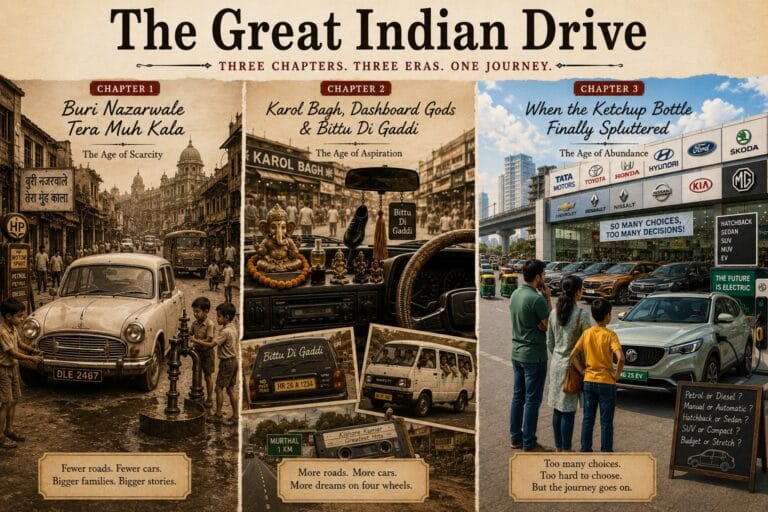
Coming Soon — Chapter 3: When the Ketchup Bottle Finally Spluttered
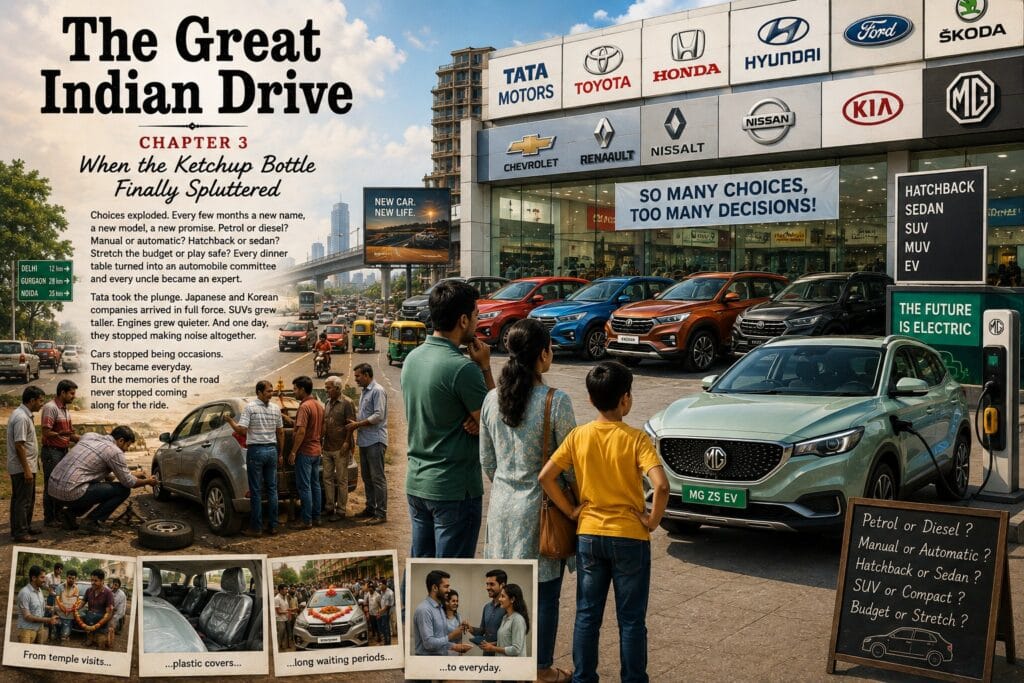
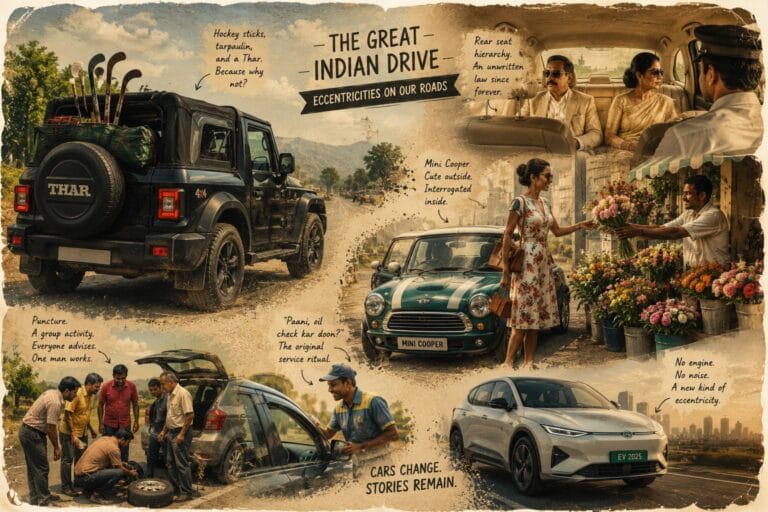
Tata joins the race. Toyota, Honda and Hyundai arrive in force. Beemers, Mercs and Audis continue watching from the stratosphere while India’s roads suddenly fill with choices nobody could have imagined a decade earlier. Petrol or diesel? Manual or automatic? Hatchback, sedan or SUV? And somewhere along the way, the engine itself begins to go quiet.
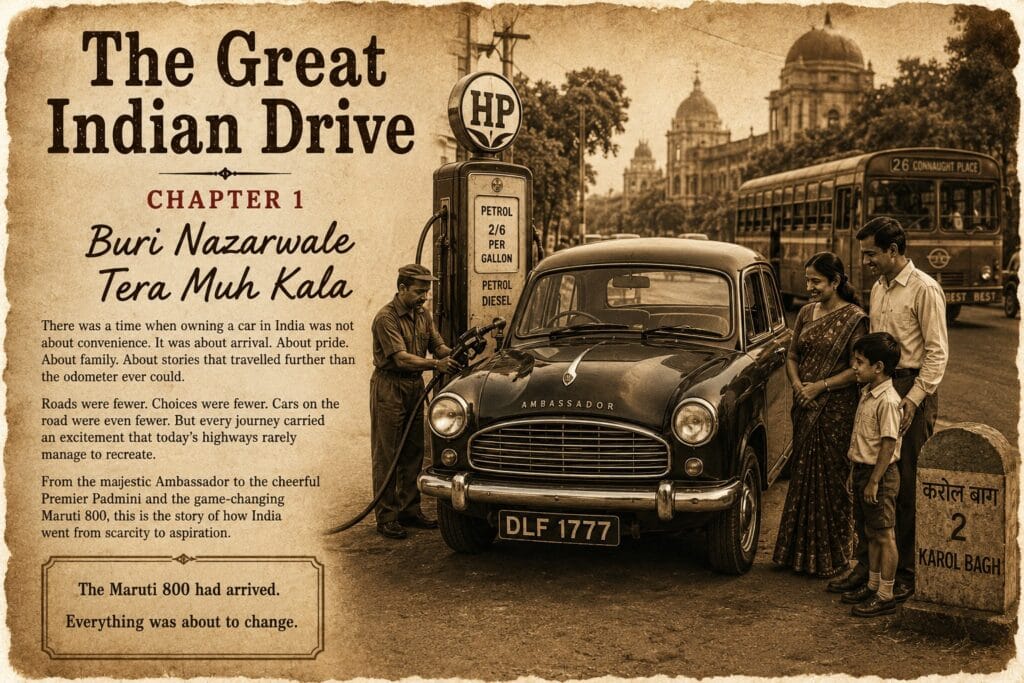
If you missed reading Chapter 1 , read on….. Click on the image below:
Enjoyed every word of chapters 1 and 2 of ‘The Great Indian Drive’ bringing back fond memories – Especially the ambassador.
When will chapter 3 be available?
Thank you, Radhika. The Ambassador has clearly refused to retire gracefully from our memories 😊. So glad you enjoyed Chapters 1 and 2. Chapter 3 is coming soon — there are still a few kilometres, characters and questionable driving decisions left in this journey.