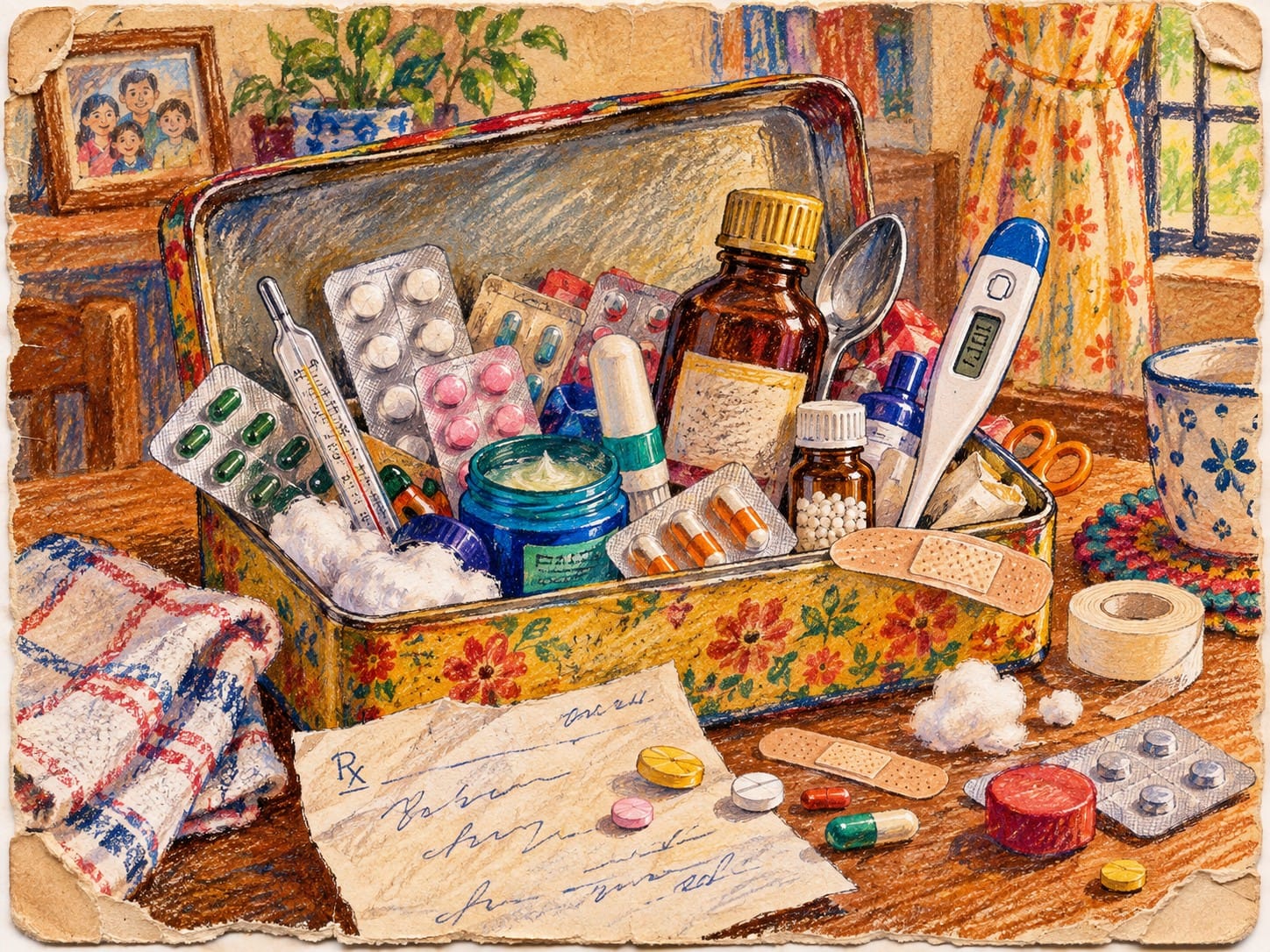
Every Indian house had a medicine box, although calling it a medicine box was often giving it more dignity than it deserved. It could be an old biscuit tin, a plastic dabba, a shaving kit, one shelf in a Godrej almirah or a drawer that also carried passport photos, batteries, safety pins, old prescriptions, a screwdriver and a few mysterious keys whose locks had disappeared years ago. Somehow everybody knew where it was. You could forget where the insurance papers were kept or which drawer had the spare house key, but if somebody shouted “Crocin kahan hai?”, the hand moved automatically towards the right cupboard.
Crocin had permanent residency. Vicks had a status of its own. Digene came out after weddings, Sunday lunches and meals where someone had insisted on “bas thoda sa aur.” Burnol waited for the kitchen to fight back. Band-Aid was there for scratches and bruises, though most bruises seemed to happen in exactly those parts of the body where Band-Aid performed badly. Around all this sat a cough syrup bottle with a sticky neck, two tablets left in some strip nobody remembered buying, eye drops opened “recently”, which could mean last Tuesday or two years ago, and ointments whose expiry dates had faded so conveniently that nobody felt obliged to throw them away.
There was always one medicine remembered only by appearance. “Woh chhoti safed wali dena.” Which white one? “Arre wahi, doctor ne pichli baar di thi.” That was often enough. Home medicine operated on prescription, memory and extraordinary confidence. Mothers had their own diagnostic system anyway. Headache could be gas, stomach pain was usually gas, feeling heavy was gas, feeling weak meant you had not eaten properly, and a poor appetite or excessive appetite could both somehow become worms. Bad mood meant lack of sleep, too much television or, in later years, too much phone. And when no diagnosis quite fitted, Vicks entered the conversation. Chest, throat, nose, forehead, back — there were very few parts of the body that Indian families considered outside the jurisdiction of Vicks.
The Vicks inhaler was even better because it was one medicine that was actually fun. That little white cylinder was supposed to be held near the nostril, but nobody was that disciplined about it. Sometimes you pushed it right up against the nostril, closed the other side and took one deep breath. That rush of menthol went straight through the nose and seemed to reach somewhere behind the eyes. For a few seconds the entire head felt cold and open, and even if the nose was not particularly blocked anymore, you did it again because the sensation itself was enjoyable. One nostril, then the other, then another round for good measure.
Fathers, meanwhile, had a completely different contribution to domestic medicine: the belief that expiry dates were mostly a commercial conspiracy. “Yeh expiry-vixpiry company wale likhte hain,” would be said while examining a tube whose packaging itself belonged to another era. Medicines were not really thrown away; they were pushed backwards. Front shelf meant active duty, second row meant maybe useful, and the back corner was reserved for things nobody could identify but nobody had the courage to discard either.
The cough syrup bottle was a different level of irritation altogether. Opening it was often harder than recovering from the cough. The person who designed those old caps must have had something against patients. First you tried with your hand and the cap slipped. Then you wiped your palm carefully because clearly the issue was friction. You tried again, harder this time, but nothing happened. Then came the towel. Wrap it around the cap, grip it with both hands and twist till your face changed colour. Still nothing. By now the cough was no longer the main problem; the bottle had become personal.
Eventually somebody brought out a knife. You started prying at the thin metal ridges around the cap or cutting whatever looked cuttable. The same knife used for mangoes, vegetables and birthday cake was suddenly being asked to solve medicine packaging. Sometimes it slipped and cut your finger, which was a particularly efficient outcome because you had started with a cough and now had blood on your hand as well. Dettol and Band-Aid could now join the treatment plan.
And when the cap finally surrendered, there was often a plastic seal underneath. Naturally, that too looked as if it should peel off easily but rarely did. You tried with the fingernail, then another corner, then the knife returned for a second round. By the time the bottle was actually open, two or three people had participated, one towel had been used, a finger may have been cut and the patient had already coughed through the entire exercise.
The cap was never quite the same afterwards. Once opened, it often just sat on top of the bottle instead of closing properly. Tilt the bottle and the syrup leaked, and cough syrup was not ordinary liquid. It was sticky beyond reason. It got onto the neck of the bottle, the shelf, your fingers, the spoon and whatever medicine strip happened to be lying nearby. One small leak could turn an entire corner of the medicine box into a permanently tacky zone.
Doctors then introduced another idea that sounded simple only on paper: half a tablet. Fine, but how exactly was one supposed to manufacture half a tablet at home? Some tablets at least had a ridge down the middle, which gave you false confidence. You put the tablet on whatever plate was nearby, steel or bone china, and once again the knife appeared. You placed the blade on the ridge and pressed. Nothing happened. You pressed harder. Still nothing. Then somebody gave it a proper whack and the tablet finally broke, though almost never into two neat halves. One part survived reasonably well while the other became powder, crumbs and fragments. Then came the judgment call about which of the two qualified as fifty percent.
Sometimes patience ran out and the tablet simply went between the teeth. You lined the ridge up as well as possible and gave it one confident bite. Surprisingly, this often worked better than the knife. The awkward part was the other half, because now it had your saliva on it and had to go back into the strip for tomorrow. Nobody treated this as a hygiene crisis. You pushed it back under the foil, folded the strip and moved on with life.
A tablet without a ridge was worse. The doctor had written half, but half by what logic? Weight, area, volume? You cut it anyway. One piece became sixty percent, another maybe thirty, and the rest scattered across the plate. At such moments one did wonder why somebody could not simply manufacture a lower dose instead of turning every home into a badly equipped pharmacy. Perhaps there was one psychological advantage: if the doctor had prescribed half a tablet, it somehow sounded as if things were not that serious. You were unwell, yes, but not full-tablet unwell.
Capsules were another nuisance. Who decided that those strange little cylinders were naturally suited to the human throat? Some were hard, some soft, some slippery, but none inspired confidence once they reached your mouth. You swallowed one with water and immediately wondered whether it had actually gone down. Another sip followed, then another. You tilted your head, swallowed harder and sometimes ate a piece of banana or bread in the hope that food would push the capsule along. If a capsule opened or broke, the rough edge scraped somewhere inside and suddenly you became aware of your food pipe, an organ you had happily ignored until that moment.
Band-Aid looked simple but had its own complications. In theory, peel, place gauze over wound, stick. In practice, you first had to decide whether to remove the whole cover or peel it slowly. Remove the whole thing and one sticky end folded onto itself before you even reached the wound. Peel it gradually and you needed the steadiness of a surgeon. Quite often you finished the operation, looked down and discovered that the gauze was sitting comfortably beside the bruise while the actual wound remained exposed.
Knees were particularly hopeless. Children injured knees all the time, yet Band-Aid seemed to have been designed for some flat part of the human body. You stuck it on, bent the knee and one side lifted; straightened the leg and the other side loosened. After a few hours it hung from one corner, collecting dust and fibres, and eventually somebody tore it off in one quick movement, producing a level of pain completely disproportionate to the original injury.
Then there was the thermometer, around which entire family committees could form. Even using it raised questions. Below the tongue or above? Someone always said “neeche rakho” with great confidence. Below the tongue never felt particularly pleasant, but you kept it there and then came the next uncertainty: how long? One minute, one and a half, two? Nobody seemed completely sure.
The answer also depended on whether you wanted to go to school the next morning. If you did not, the thermometer became an opportunity. You tried blowing warm air over it while it was still in your mouth, hoping to push the reading upwards just enough to make the case convincing. Not too much, because 104 could bring a doctor into the picture and spoil everything. Something respectable like 100.2 was ideal: enough to stay home, not enough to create panic.
If, on the other hand, you badly wanted to go to school because something interesting was happening the next day, the same thermometer became unbearable after thirty seconds. “Nikaal doon?” “Abhi nahin.” Why not? What dramatic change in body temperature was expected over the next forty-five seconds?
Reading the old mercury thermometer was another family ritual. One person held it under the tube light, another rotated it slowly, somebody said “idhar se dekho,” and then a third person took over. Everyone squinted at that tiny silver line as if the difference between 99 and 100 had national consequences. “99 hai.” “Kahan? Mujhe toh 100 lag raha hai.” “Light ke neeche lao.” While the thermometer moved from hand to hand, you sometimes wondered whether the mercury was quietly slipping back during all this inspection. Depending on your school plans, you either feared that possibility or hoped for it.
Thermometers also fell, and when those old glass ones broke, out came mercury in those beautiful little shining balls, round one moment and stretched the next, sliding around the floor like they had a life of their own. For children, it was fascinating. You pushed two droplets together and watched them merge, then separated them again. Somebody brought a spoon, a katori or a folded piece of paper and everyone participated in collecting the stuff. We knew mercury was toxic, but our understanding of toxic was fairly loose. It basically meant do not eat it and do not do anything obviously stupid. Nobody evacuated the room. Somebody collected it, hands were washed and life continued.
The digital thermometer was supposed to solve all this, but it merely changed the confusion. Now there was no mercury line and no tube-light conference. Instead, the thermometer was supposed to make a faint buzz when it had finished. A faint buzz, in an Indian room where somebody was watching stand-up comedy on a smart TV, someone else was talking, another person was laughing and somebody was asking where the remote had gone. The poor thermometer completed its scientific duty and made one polite sound into this chaos, which nobody heard. Then began another discussion: “Baj gaya?” “Pata nahin.” “Kitni der ho gayi?” “Ek minute toh ho gaya hoga.” Earlier we could not read the thermometer properly. Now we could not hear when it had finished.
Homeopathy, whatever one thought of its medical merits, had excellent relations with children. Those tiny sugary white balls were in a completely different category. No bitter tablet, no capsule stuck in the throat, no cough syrup cap requiring a towel and knife. Just little sweet globules poured into the palm. The only problem was dosage. “Bas chaar.” Why four? There were fifty sitting there. If this was medicine, it was the first medicine you actually wanted more of. You tilted the bottle carefully and secretly hoped six or seven would fall out by mistake.
Travel made the medicine box even more entertaining. Indian parents did not pack according to destination; they packed according to possible disaster. A two-day trip to Jaipur could involve Crocin, Avomine, Digene, Electral, Band-Aid, antiseptic cream, cough syrup, something for loose motions, something for constipation, something for acidity, an antibiotic just in case and one medicine nobody wanted to explain in front of children. You could be driving peacefully on NH48 and be medically equipped for a minor expedition.
Then, slowly, the medicine box changed. Nobody noticed exactly when. Crocin remained, Vicks stayed, Band-Aid stayed, but other strips began appearing. Blood-pressure tablets, sugar medicines, cholesterol medicines, calcium, Vitamin D, blood thinners. The names became longer, the instructions more precise, and eventually pill organisers arrived with Monday, Tuesday and Wednesday written on them.
The same box that once contained scraped knees, cough syrup, fever after school and all this household improvisation had become more serious, and the roles changed just as quietly. The child who had once been told, “Medicine box ko haath mat lagana,” was now saying, “Papa, this one is after breakfast,” or “Mummy, this is half only,” or “This strip is getting over, I’ll order it.”
Nobody announced that something had changed. There was no family meeting. One day you simply opened the same drawer and Crocin was still there, Vicks was still there, some old Band-Aids were still there, but now there were blood-pressure tablets and pill organisers sitting beside them, and somehow you were the one telling your parents which one to take after dinner.