Childhood Nightmares
There were vegetables we ate because we liked them, and then there were vegetables that came with a lecture. Tinda belonged firmly to the second category. Nobody ever had to explain paneer to us. Nobody stood behind rajma saying, “Beta, this is very good for you.” But the moment tinda appeared, suddenly the whole household became an expert on nutrition.
Even today I wonder who walks into a vegetable market, sees a heap of pale green tindas and feels genuine excitement. Tori was worse. At least tinda held its shape. Tori would collapse into a soft, slippery mess and sit on the plate looking as if even it had lost interest in being eaten.
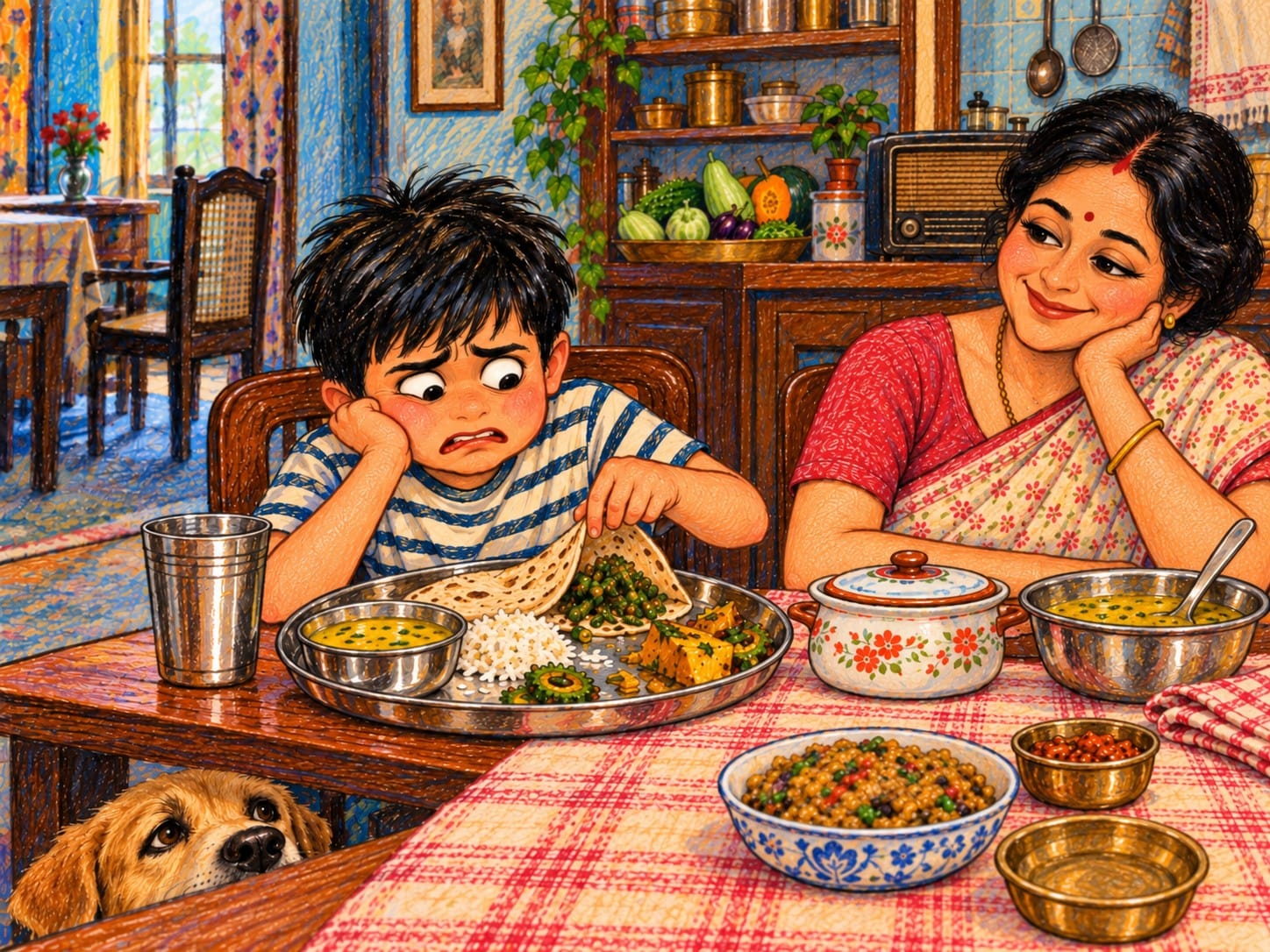
Then came the cousins. Lauki, parwal, karela, kaddu, small baingan and assorted green things that mothers bought with great enthusiasm and children viewed with deep suspicion. Collectively, they were the Green Mafia. You could come back from school absolutely starving, lift the lid of the casserole and see tori. Hunger immediately became negotiable.
That was when the bargaining started. Half roti. Two spoons. Only gravy. Just taste it. And finally the weapon that ended all debate: “Health ke liye bahut achchi hai.” I think half our childhood hostility towards vegetables came from that one sentence. If something needed that much salesmanship, there was obviously a problem.
Ghiya had a special place in this gallery of horrors because my mother sometimes cut it into small cubes and put it into dal. That was double jeopardy. Dal itself was never exactly a celebration. It was more of a gulp-down operation. You used it to soften the roti, swallowed quickly and moved on. Then suddenly there were pale little cubes of ghiya floating inside it.
That ruined even the escape route. You took a spoonful expecting harmless dal and one of those soft cubes would turn up without warning. You could see it coming, which somehow made it worse. Why take two difficult things and combine them? What problem were we trying to solve?
Parwal was another strange vegetable. The outside looked respectable enough, but then came the seeds, the texture and that slightly slippery interior. Those seeds were particularly irritating. Were they meant to be chewed, swallowed or collected for next year’s crop? Nobody explained.
Bhindi and beans occupied a slightly different territory. They were borderline Green Mafia. You did not necessarily revolt when they appeared, but you were hardly going to ask for a second helping either.
Bhindi was particularly confusing. Cut it and those slimy, lacy threads appeared, stretching between the pieces as if the vegetable was producing its own glue. And who called it ladyfinger? There was nothing remotely ladylike about that sticky, hairy thing.
Then there were what we called France beans. First somebody sat there snapping both ends and occasionally pulling that annoying string down the side. Then they were chopped and cooked, but somehow always seemed slightly half done. Not raw enough to complain about, not cooked enough to enjoy. You kept chewing and the bean kept fighting back.
And who named them France beans? Did the French actually eat these things? As a child I had my doubts. Years later I discovered Chinese string beans and realised that beans could actually be delicious. Crisp, blistered, garlicky, spicy, sometimes with chilli — suddenly the same vegetable had a reason to exist.
Karela at least had the courage to be openly unpleasant. It was bitter, it knew it was bitter and it did not pretend otherwise. You could stuff it, fry it, drown it in masala or tie it with thread like some small green criminal, but the bitterness remained. There was almost something admirable about that level of honesty.
Kaddu had a different problem because the word itself had already been destroyed for us. “Kya kaddu jaisa baitha hai?” was not exactly helping the brand. By the time kaddu arrived on the plate, it was already carrying baggage.
And of course our mothers did not care about any of this. They had bought the vegetable, cooked the vegetable and therefore the vegetable would be eaten. There was no concept of consumer choice. You could spread the sabzi thinly, hide it under the roti, mash it into something unrecognisable or slowly push it towards one corner of the plate hoping nobody would notice.
The roti-covering technique was particularly useless. You carefully placed a piece of roti over the rejected sabzi as if you had made it disappear. Mothers could detect three hidden pieces of tori from across the dining table. We had invented concealment; they had already invented surveillance. Children who had dogs were operating under a far superior food disposal system. The rest of us had to manage on our own.
The funny thing is that the Green Mafia does not leave you alone. Years later it returns through another door, only now the names have changed. Nobody says tori anymore. They say fibre, and then the lectures become even longer.
The nutritionist starts with soluble fibre, insoluble fibre, gut health, microbiome, blood sugar, digestion, ageing and longevity. By the time the consultation ends, the same tori you once pushed to the side of the plate is suddenly something you are expected to respect.
And the irony is that you now pay for this advice. Your mother told you essentially the same thing for free. You ignored her. Forty or fifty years later, you pay a nutritionist a few thousand rupees to tell you to eat lauki, tori and karela, only now the advice comes in a PDF.
We did not have words like gut health and microbiome growing up. Our mothers had two broad medical categories: pet saaf and pet kharab. The vocabulary was limited, but the confidence was absolute.
Lauki is now “light”. Parwal is “good for digestion”. Karela is discussed with the seriousness normally reserved for medicine. Suddenly all those vegetables we fought over at the dining table are back, except this time they have better branding.
And then there is the baba.
No, I was not watching a baba channel. I was on YouTube looking for news when he popped up. There he was, twisting his body into shapes no body should voluntarily enter, one leg behind the neck and one arm disappearing somewhere near the spine, while calmly explaining why I needed more lauki, more fibre and more discipline.
I watched him once. That was my mistake.
Now the bloody algorithm thinks I am devoted to him. He appears on YouTube, then on the television, then on the mobile and somehow even on Instagram. I watched thirty seconds of a man folded like a human pretzel and apparently that was enough to establish a lifelong relationship.
The irritating part is that once he unfolds himself, he starts saying things suspiciously similar to what our mothers said forty or fifty years ago: eat seasonal vegetables, eat simple food, control yourself. My mother managed the same message without a television channel, a microphone or putting her foot behind her head.
Then age starts doing its own mischief because, much against your better judgement, a few members of the Green Mafia begin to taste good.
Parwal is the biggest surprise. Bengalis and Biharis know what to do with it. My Bengali chef makes parwal with poppy seeds and it is delicious. Tori with poppy seeds also becomes something entirely different. The same slippery childhood nuisance suddenly tastes rather good.
Tinda has also improved its standing. Cook it with achaar masala and it tastes really good. The same with chhota baingan. Give it pickle masala and suddenly you are eating it happily and wondering what exactly went wrong forty or fifty years ago.
Even baingan bharta tastes rather nice now, which makes me wonder where baba ganoush was hiding during our childhood. We were roasting baingan, peeling it and mashing it long before anyone around us had heard the words baba ganoush. Of course, true to its name, we make a bloody mess of baingan in bharta. Tomato, onion, chilli, coriander, masala — everybody gets invited and the poor baingan is beaten into submission. Baba ganoush seems almost restrained by comparison: roasted aubergine, tahini, lemon, garlic, olive oil and not much drama. Perhaps bharta is simply baba ganoush after it has spent a few years in an Indian joint family.
Perhaps the vegetables were not entirely to blame. Perhaps we just cooked the life out of some of them while throwing the entire masala box at others.
I am not ready to forgive everything, though. Kaddu, for example, has one proper role in life and should stick to it. It belongs with bedmi puri, preferably in Lucknow, Prayagraj, Benaras or Agra. There the combination works perfectly. The slightly sweet, spicy kaddu, the hing, the hot bedmi, the grease and the masala are made for each other.
Take kaddu away from bedmi puri and it becomes pointless. With ordinary roti it just sits there, and with dal and rice it feels even more unnecessary. Why keep forcing it into places where it clearly does not belong? Of course age has something to do with all this. At ten, kaddu was punishment. At sixty, eaten with a hot bedmi in Benaras, it suddenly becomes tradition, memory and great food.
That is the real betrayal of growing older. You begin eating the same things you once resisted. You hear yourself saying, “Tori is actually very light.” You discuss fibre, voluntarily order karela and begin sounding suspiciously like the people you spent your childhood complaining about.
I can now eat tinda, praise tori and willingly order karela. I even like bhindi now, provided somebody has managed to cook the lady’s finger without leaving behind her lacework.
Age does terrible things to a man. But put small cubes of ghiya into my dal and we are back in 1974.