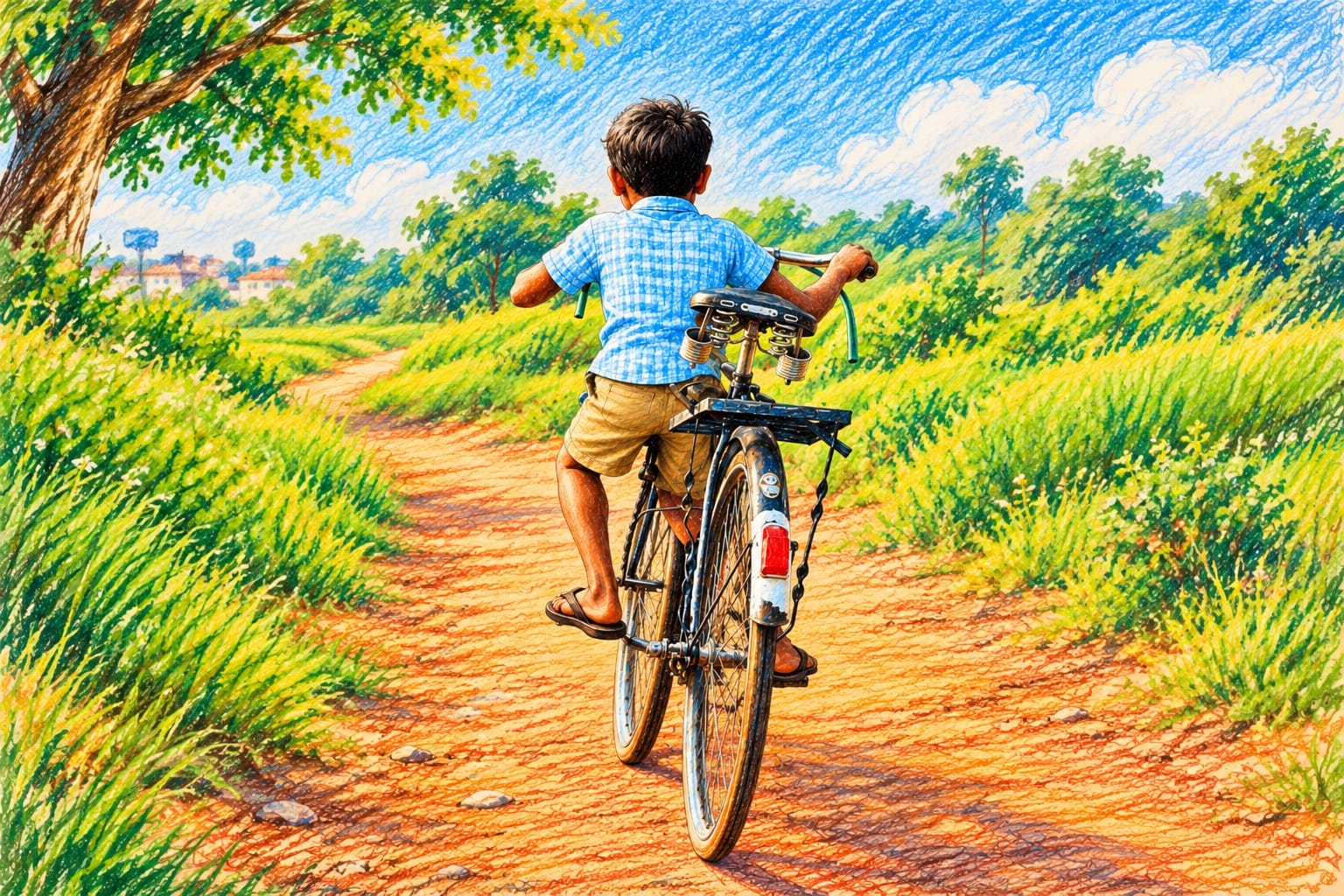
When twenty-five paise bought an hour of freedom
There was a peculiar way of riding a bicycle when you were too short to sit on the saddle of an adult one. It was called Kainchi. One leg went through the triangular space beneath the horizontal crossbar, the body tilted awkwardly to one side, the arms stretched towards the handlebar, and somehow the feet managed to keep the pedals moving. The saddle remained entirely unoccupied.
It was body contortion at its height, enough to make an accomplished yoga practitioner proud. Had someone invented a Sanskrit name for it, Kainchi might well have qualified as an advanced asana. Except that in yoga you held the pose in one place. Here, you had to maintain it while negotiating potholes, pedestrians and stray cows. It wasn’t elegant, was probably terrible for the spine, but gave us enormous satisfaction. We were riding an adult bicycle without having grown up sufficiently ourselves.
Of course, Kainchi was the advanced course. Our introduction to cycling had begun much earlier, and strangely enough, on four wheels.
Our first bicycle was tiny, but apparently our parents had little confidence in our balance. Two additional wheels, attached to metal supports, were fitted at the rear. You could lean alarmingly to one side and still not fall. Eventually, those supporting wheels were removed, and a father, elder brother or obliging neighbour would hold the carrier while we pedalled furiously. At some point, without informing us, he would let go. Everything went beautifully until we turned around to check whether he was still holding on. That was generally when we landed on the road.
As we grew taller, we graduated to a bigger bicycle, though still not the formidable adult version. Not everyone owned one, and the neighbourhood cycle rental shop was therefore an important institution. For twenty-five paise, a quarter of a rupee, you could rent a bicycle for an hour. Those sixty minutes were precious. We raced around the colony, visited friends and explored unfamiliar streets. The last few minutes were invariably a frantic dash back to the shop. Nobody wanted to explain why a quarter-rupee rental had become more expensive.
Bicycles also observed the gender conventions of the day. The men’s bicycle had a straight horizontal crossbar, while the ladies’ version had a lower, often curved frame, making it easier to get on and off, particularly in a sari or salwar kameez. Nobody questioned why two machines performing exactly the same function needed separate masculine and feminine identities.
Bollywood, of course, had its own interpretation of cycling. The hero would pedal merrily along with the heroine perched on a little seat mounted on the horizontal bar in front of him. How he managed to see the road past her, maintain his balance, steer the bicycle and sing a romantic song simultaneously remains one of Hindi cinema’s great unsolved mysteries. The heroine sat perfectly composed, her hair blowing in the breeze, occasionally turning towards him with a smile. Neither seemed concerned about potholes or approaching traffic. Perhaps love was the ultimate shock absorber. Bollywood bicycles never suffered from punctures or slipping chains, especially in the middle of a romantic song.
Our bicycles were considerably less cooperative. Gears had not entered the Indian cycling vocabulary then. There were pedals, a chain, brakes and two wheels. If the road went uphill, you pedalled harder. If that didn’t work, you stood on the pedals and threw your entire body weight into the effort. And if even that failed, you got down and pushed. The strength of your legs decided how fast you went.
Accessories, however, were another matter. A dynamo light was a luxury. A little contraption fitted beside the wheel had a roller pressing against the tyre. As the wheel rotated, it generated electricity for a small lamp in front. Pedal fast and it shone brightly. Slow down and it became feeble. Stop altogether and you were back in darkness. Worse, the dynamo made pedalling noticeably harder, teaching us rather early that electricity did not come free.
The bell was our favourite accessory. The magnificent mechanical tring-tring variety, operated with a little thumb lever. We rang it to alert pedestrians, announce our arrival, greet friends and frequently for no reason whatsoever. A new bicycle bell could provide more entertainment than the bicycle itself. Some cycles had rubber horns, but nothing matched the authority of a proper tring-tring.
And then there was the chain, that greasy, temperamental arrangement which had an irritating habit of slipping off the sprocket at the most inconvenient moment. One second you were pedalling happily, and the next, the pedals were spinning freely while the bicycle refused to move. There was no option but to crouch beside it and attempt to put the chain back.
This was a specialised skill acquired through experience. The chain had to be positioned over the sprocket teeth in a particular way while the pedal was rotated carefully. Get it wrong and it slipped off again. Finding the right method required patience and considerable contact with thick black grease. By the time it was restored, your fingernails were filthy, and there was a good chance you had wiped your forehead with the same hands. Some bicycles had a metal chain cover, which protected your trousers from grease but made repairing the chain considerably more complicated.
The wheels had their own problems. Occasionally, a few spokes would loosen or bend, and the wheel would begin wobbling sideways. The local mechanic had a contraption on which he mounted the wheel and spun it slowly, watching its movement. Armed with a small spoke wrench, he tightened some spokes and loosened others until the wheel rotated smoothly again. It was rather like modern wheel alignment, except there were no computers or digital readings. Just the mechanic’s eyes, fingers and years of experience.
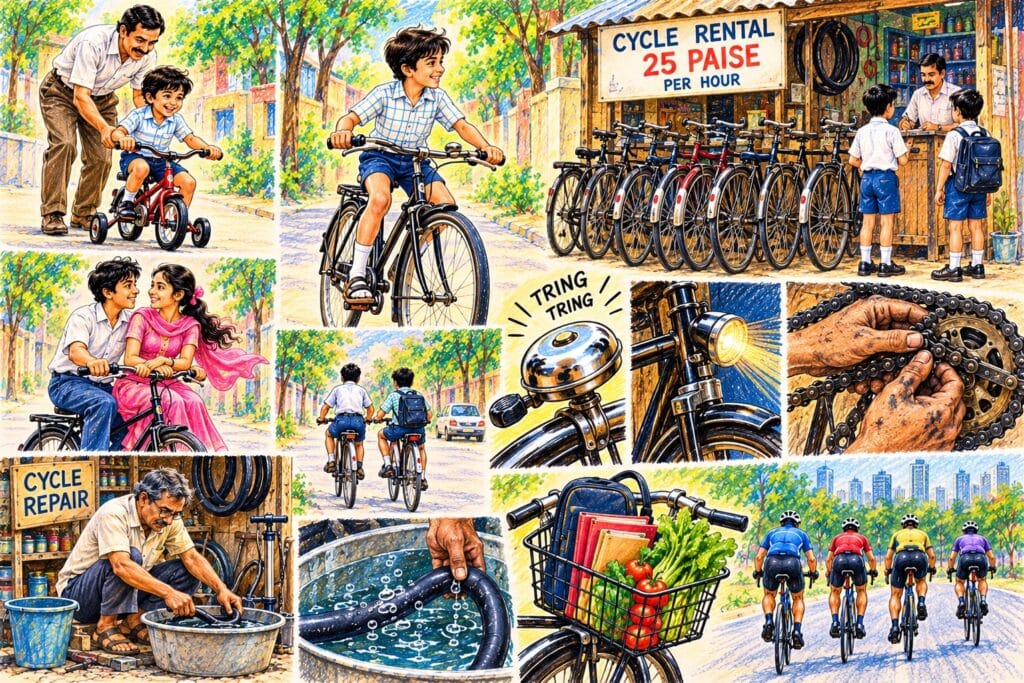
The cycle repair shop was a fascinating place. Bicycles hung from hooks, old tyres and tubes dangled from the walls, and assorted chains, mudguards, nuts and bolts occupied every available corner. The air carried a permanent mixture of grease, rubber and adhesive. A hand pump stood nearby, along with a basin of murky water. The mechanic’s hands were permanently black, but he seemed capable of fixing practically anything. There were no appointments, job cards or service advisers. You simply arrived with your bicycle and a suitably distressed expression.
The puncture had its own drama. It announced itself through a gradual loss of speed, followed by an uncomfortable wobble and the depressing discovery that the tyre had gone flat. You then dragged the bicycle to the nearest repair shop, sometimes from a considerable distance. The mechanic extracted the inner tube, inflated it with a hand pump and immersed it section by section in the basin of water. We watched with enormous interest, waiting for the telltale bubbles. Finding them was almost as exciting as solving a mystery.
He marked the spot, dried the tube, rubbed it with sandpaper, applied rubber solution and pressed a small patch over the hole. There was some waiting, pressing and occasionally a little hammering. The tube returned to the water for inspection. Meanwhile, we wondered whether the operation would cost one rupee or two, whether we had enough money, and whether our parents would believe that the puncture was an accident rather than the consequence of riding over broken glass.
Multiple punctures were particularly depressing. Each new stream of bubbles added to our anxiety. Occasionally came the dreaded verdict, “Tube badalni padegi.” A new tube was no longer a minor repair. It was capital expenditure requiring parental approval, delivered by the mechanic with the seriousness of a surgeon recommending further intervention.
The carrier at the back had its own stories. Officially intended for luggage, it was generally the second seat. A friend would sit sideways, holding the rider’s shoulders while the legs dangled alarmingly close to the spokes. Who pedalled, who sat and whether the favour would be returned on the way back required considerable negotiation. Sometimes the passenger offered unsolicited advice on cycling, rarely appreciated by the person doing all the work.
And when the person on the carrier, or perched on that little seat in front, happened to be someone special, cycling acquired an altogether different charm. A bicycle ride became a romantic affair, with conversations, stolen glances and the pleasure of having someone sitting close enough to hear even the things you said softly. The rider had to keep both the bicycle and the romance on course, not easy when a pothole appeared unexpectedly. There were no mobile phones to coordinate every movement or cars in which to arrange a rendezvous. Just a bicycle and the anticipation of spending time together. The humble carrier could become a seat of romance, even if it offered considerably less comfort than the back seat of a car. Perhaps the discomfort was part of the charm.
The little basket in front was more respectable. It carried schoolbags, vegetables, cricket balls and whatever our mothers had sent us to buy. Load it unevenly and the handlebar developed ideas of its own. Between the carrier and the basket, a bicycle could transport a remarkable amount of luggage and humanity, occasionally both together.
Then bicycles began to change. Gears appeared, followed by helmets, knee pads, elbow guards and specialised cycling attire. Steel frames gave way to aluminium alloys and carbon fibre. There were mountain bikes, road bikes, racing bikes and hybrids. What we had done in shorts, slippers and occasionally barefoot began acquiring the seriousness of a professional sporting activity. Our scraped knees had once been considered an unavoidable part of learning to cycle. Now there was protective equipment for almost every exposed part of the body, undoubtedly sensible, even if it made a morning ride look like a planned expedition.
The prices underwent an even more astonishing transformation. We had once paid twenty-five paise to rent a bicycle for an hour. Today, a sporty bicycle can cost several lakh rupees. People spend extraordinary sums saving a few hundred grams with a carbon-fibre frame, then add water bottles, cycling computers, lights and other accessories, quite possibly restoring the weight they had so carefully eliminated.
Perhaps the biggest change is in why we cycle. For us, the bicycle was a means of getting somewhere. We rode to school, friends’ houses, the market or simply to explore unfamiliar streets. Today, enthusiasts get up before sunrise, dress in specialised cycling gear, ride fifty kilometres and return to exactly where they started. They call it fitness. We called it going out.
I have nothing against modern bicycles. Helmets make sense, gears are useful and lighter frames make riding easier. But I wonder whether all that sophistication has made cycling any more enjoyable than when we rented a bicycle for twenty-five paise, rang its bell incessantly, returned with greasy fingers and occasionally pushed it home with a punctured tyre.
We eventually moved on to scooters, motorcycles and cars. They were faster, more comfortable and took us much farther. But somehow, none matched the excitement of that first bicycle ride when we looked back, discovered that the hand holding the carrier had disappeared, and realised we were still moving.
And for twenty-five paise, we could enjoy that freedom for an entire hour.