Remember the Good Morning WhatsApp Uncle?
Every morning, before you had even opened your eyes, your phone would light up with a rising sun, two roses, a waterfall, folded hands and a quote that Buddha, Einstein and Shakespeare collectively never wrote. Nobody had asked for it, yet he felt personally responsible for ensuring your day began with enlightenment. Whether you wanted it or not was entirely your problem.
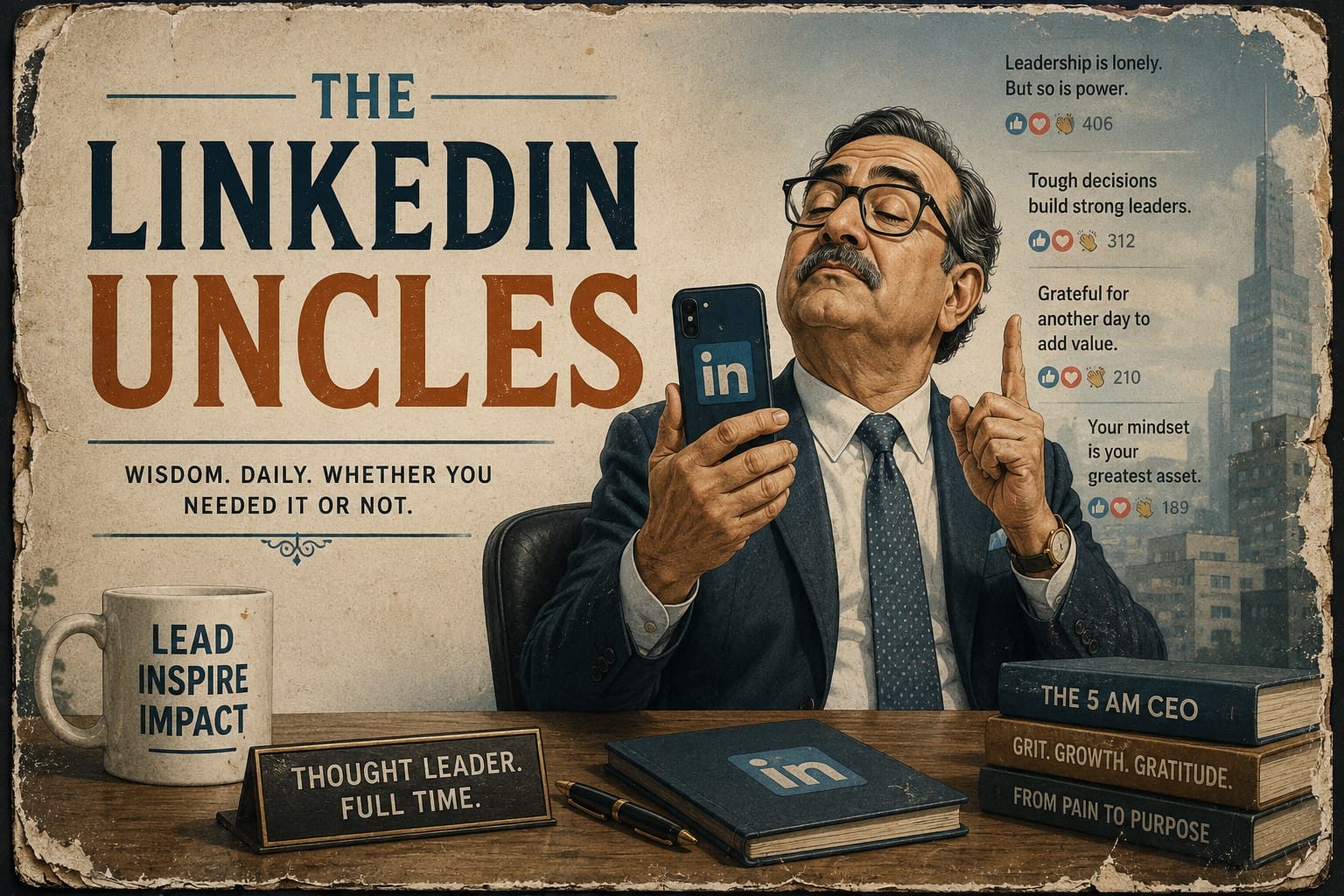
That species hasn’t disappeared. It has simply evolved. It now has a LinkedIn profile.
And don’t be misled by the word uncle. On LinkedIn, the species can be twenty-eight or sixty-eight. “Uncle” is no longer an age. It is a state of mind. The flowers have disappeared. The grammar has improved. The confidence, however, has become almost supernatural.
The LinkedIn Uncle wakes up every morning convinced the world has spent the entire night waiting for his thoughts on leadership, AI, geopolitics, investing, parenting, resilience and why successful people apparently begin every day at four in the morning. By breakfast, he has solved problems that generations of managers, economists and philosophers have debated for decades. By lunch, he has reposted someone else’s quote with the immortal introduction, “My thoughts…”
It isn’t the advice that fascinates me. It’s the certainty. There are no doubts, no nuances and certainly no “it depends.” Every complicated issue facing business or society somehow fits neatly into seven bullet points placed over a photograph of a mountain climber, an eagle or a sharply dressed executive staring thoughtfully through a glass window.
Then come the comments, which deserve a sociological study of their own.
“Powerful.”
“Brilliant insight, Sir.”
“Much needed.”
“Couldn’t agree more.”
Nobody ever asks the obvious question: needed for what?
The real masters, however, are the Corporate Sages. The company has just missed its numbers. A business has been shut. Thousands of employees have discovered that “we are family” has an expiry date. The share price, however, is smiling.
Within hours the CEO appears on LinkedIn.
“Today was one of the hardest decisions of my career…”
What follows is rarely an explanation. It is usually a sermon. Leadership is lonely. Tough decisions define character. Every ending is a new beginning. Employees are family.
Apparently, some families come with severance packages.
Corporate India has developed an interesting coping mechanism. Every crisis now requires a philosopher. Every restructuring needs a storyteller. Every uncomfortable question is treated with an inspirational anecdote. It’s almost as if every organisation keeps its own corporate Iodex in the top drawer.
Sales have dipped? Call the thought leader. Employees are unhappy? Bring in the storyteller. Layoffs have made headlines? Publish a heartfelt piece on resilience. Culture is fraying? Organise a trust workshop. The assumption seems to be that every management problem can be soothed with a generous application of wisdom.
It can’t.
Sometimes organisations need fewer sermons and more solutions. Fewer motivational posts and more managerial accountability. Inspiration certainly has its place. It just isn’t a substitute for leadership.
HR, of course, has embraced this industry with characteristic enthusiasm. Every conference now has a professional storyteller, usually an excellent one. He narrates moving tales about butterflies, fishermen, pencils or bamboo that somehow end with innovation, resilience and organisational culture. For an hour the audience is spellbound. By Monday morning the appraisal process continues exactly as before.
And then comes my favourite corporate invention—the trust workshop.
A perfectly sensible adult is asked to climb onto a platform, fold his arms, close his eyes and fall backwards into the hands of colleagues he barely knows. The person falling is terrified. The people catching him are equally terrified, particularly if gravity has been generous to him over the years. The facilitator smiles, declares that trust has been established and everyone heads home convinced organisational culture has taken a giant leap forward.
Ask HR six months later whether trust actually improved and the answer is beautifully crafted.
“Even if ten percent carried the learning home, the workshop was a success.”
No data. No measurement. Just corporate astrology presented through PowerPoint.
Like every stereotype, this one has its honourable exceptions. LinkedIn is also home to some remarkable people who write from experience, admit mistakes, explain difficult decisions and leave you genuinely wiser. They don’t preach. They don’t chase profundity. They simply have something worth saying.
The problem isn’t wisdom. The problem is the industrial-scale manufacturing of it. Somewhere along the way, every second executive became a leadership guru, every third person a storyteller and every fourth person a motivational philosopher. If all this daily wisdom actually worked, organisations would have no politics, no toxic managers, no attrition and no Monday morning blues.
The old Good Morning WhatsApp Uncle genuinely believed he was making your day better. The LinkedIn Uncle genuinely believes he is making your career better. The only difference is that one forwarded messages, while the other writes them.
And that’s how an entire generation of Good Morning WhatsApp Uncles quietly migrated to LinkedIn.
Before you go…
If you have ever received unsolicited leadership wisdom before breakfast, there is more corporate enlightenment here:
This is hilarious but very true. And now with AI generating the content for most people, LinkedIn drivel is pumped out with even more speed than ever.
I hope you have published this in LinkedIn!!
Brilliant hahahaha
“Powerful.”
“Brilliant insight, Sir.”
“Much needed.”
“Couldn’t agree more.”
🙂