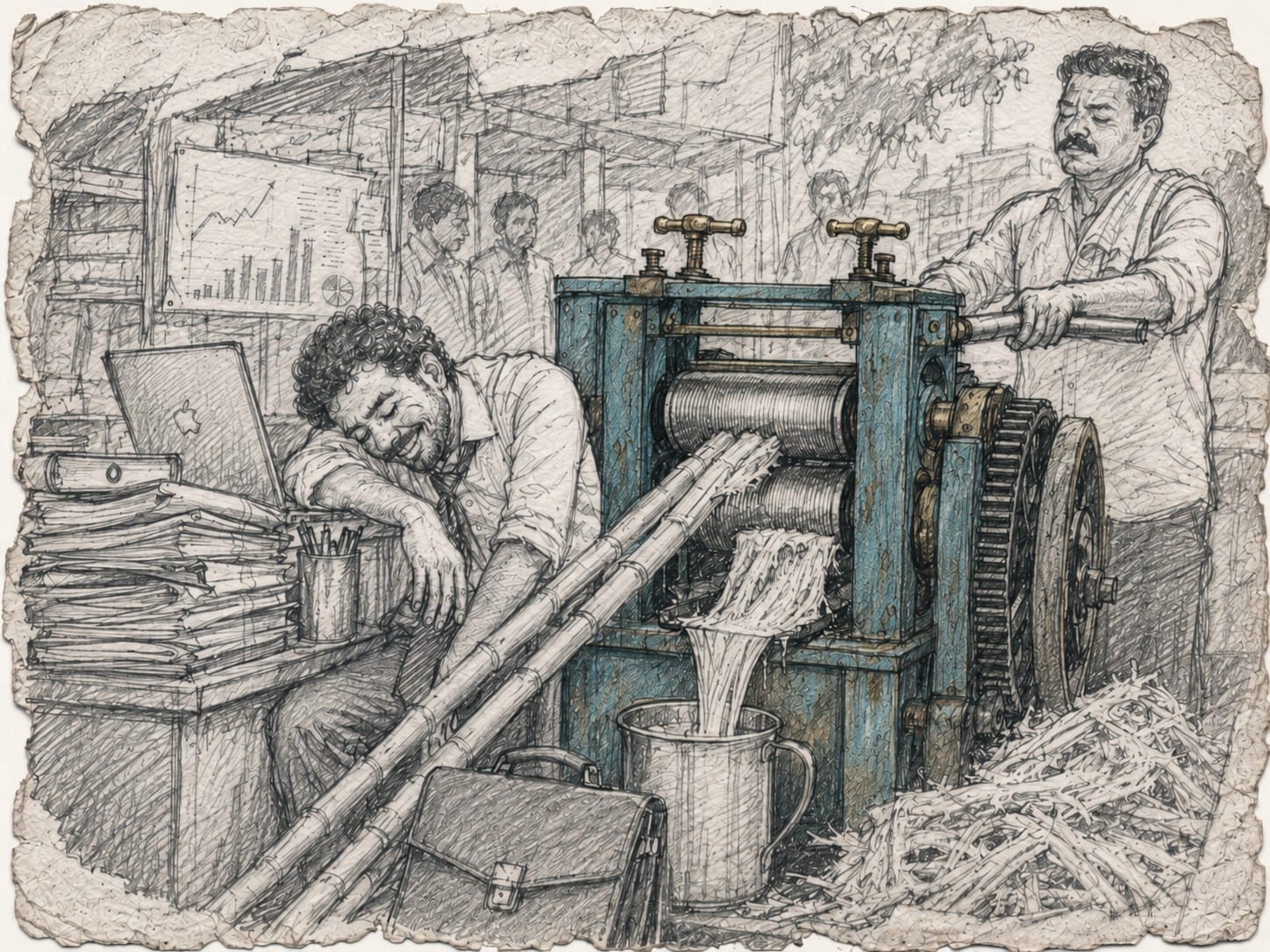
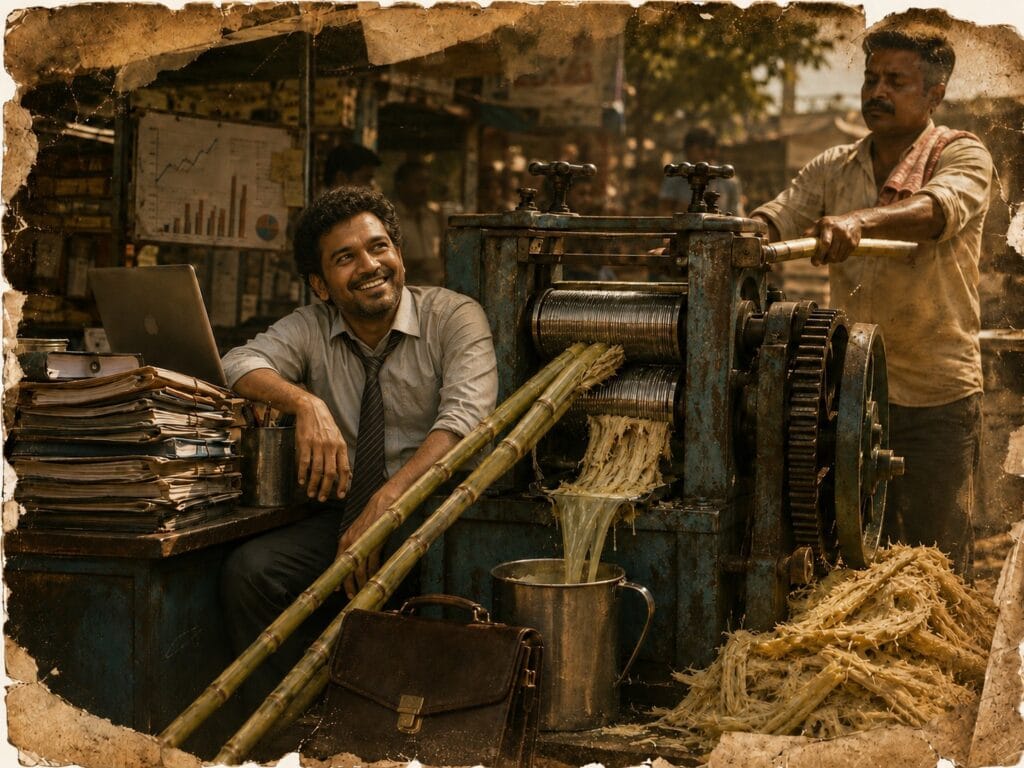
Have you ever seen the vision statement or purpose of a sugarcane? It would probably say something like, “We make your life sweet.” Simple, tidy, no consultant required.
Corporate life, however, is remarkably similar to the sugarcane juice machine you see on the roadside. Two giant steel rollers, one poor sugarcane, and a fellow who is clearly not going to stop after the first pass. He pushes the cane through, pulls out the flattened remains, folds them and sends them back again. Then once more. By now you would imagine there is nothing left in the bloody thing, but he is still not satisfied. Somewhere, according to him, there is one more drop hiding inside. Then he throws in ginger, sometimes lemon, sometimes some assorted herbs which nobody asked for but which make the operation look more sophisticated.
Corporate life works pretty much the same way. The only difference is that the sugarcane is given a PowerPoint before entering the rollers. You are told about purpose, passion, empowerment, ownership and vision because saying, “We intend to squeeze a little more out of you this year,” would sound unnecessarily harsh.
Suppose you delivered 100 last year. Everyone is delighted. Excellent performance, great teamwork, proud of what we have achieved together. Naturally, the target this year becomes 125. You ask what has changed in the market to justify 125 and discover that this is not really the discussion. The discussion is about whether you have hunger. Hunger is a wonderful corporate concept because it normally appears exactly when the target has gone up but the resources haven’t.
Someone then calls it a stretch target, which makes the whole thing sound oddly healthy. Stretching is good for your back, good for yoga and presumably good for EBITDA. Nobody says that somebody sitting in a budget meeting needed the graph to keep moving upwards and therefore 125 looked better than 110.
You are then asked to own the target. Ownership in corporate life is a fascinating arrangement because you can own the target, the delay, the customer complaint, the cost overrun and occasionally even a mistake made several organisational layers away. The upside generally has a more complicated ownership structure.
Still, you are empowered. You are empowered to take decisions within the framework, after consultation with stakeholders, subject to the delegation of authority, provided finance agrees, legal has no objection and your boss is kept appropriately informed. Somewhere on the intranet there is usually a long matrix explaining exactly how free you are.
After some months of this, management senses that people may be getting tired, so a leadership offsite is organised. For two days the sugarcane is temporarily removed from the machine and informed how valuable it is. You travel to a nice resort, sometimes near a lake because apparently strategic thinking improves in the presence of water. There are Post-it notes, flip charts and an external facilitator who asks everyone to describe how they are feeling. Energised, curious and excited are popular answers. Exhausted is not, possibly because there are career-limiting levels of honesty.
By lunchtime, perfectly respectable senior managers who run factories, businesses and balance sheets are drawing bridges with sketch pens and discussing what trust means to them. The next morning a consultant explains that the organisation needs to become more agile, which everyone agrees with because disagreeing with agility somehow makes you sound in favour of bureaucracy.
A few weeks later there is a restructuring, invariably described as an exercise in simplification. Nobody explains why simplification requires a forty-slide presentation and three town halls. Boxes disappear, new boxes appear, dotted lines multiply and reporting relationships become so sophisticated that sometimes even the person drawing the chart cannot explain them properly. A few people are told that their roles have become broader. A few others discover that their roles have become so broad that they no longer exist.
The survivors are congratulated for their resilience. Resilience is another useful word. It is what you expect from the sugarcane after the third pass through the rollers.
Somewhere along the way comes the great corporate philosophy of doing more with less. Less people, usually, along with less budget, less time, less travel and less support. Everything becomes less except expectation. If you told a factory manager to produce more steel with less iron ore, he might object on technical grounds. Ask an organisation to deliver 20% more revenue with fewer people and it immediately becomes an efficiency initiative.
Then comes transformation, which generally means new systems, new KPIs, new reporting structures, new dashboards and several meetings explaining why everybody should embrace change. The old Excel sheets continue because nobody fully trusts the new dashboard, so for a while everyone enters the same information twice. This is called digital transformation.
After all this, HR quite reasonably wants to know how everybody is feeling and the employee engagement survey arrives. It is anonymous, completely anonymous and absolutely anonymous, which is why half the organisation spends ten minutes wondering whether it really is.
The results come back and management discovers that employees want better communication. This is excellent because communication is cheaper than hiring people, so management responds with more town halls. The CEO speaks about transparency, collaboration and the exciting journey ahead. Someone asks why three colleagues who resigned six months ago have still not been replaced. Another asks about increments and somebody else asks why the workload keeps increasing. The moderator says these questions will be taken offline, without which corporate civilisation might actually collapse.
Then comes the annual performance review, the strange ritual in which you spend eleven months working and the twelfth trying to remember what you did. You search old emails and reconstruct your year. A project that nearly destroyed your sanity becomes “successfully led a cross-functional strategic initiative.” A fight with finance becomes “stakeholder management.” A crisis becomes “demonstrated leadership under ambiguity.” Everything sounds considerably better by December.
Your boss tells you that you had a very good year, which sounds promising until the sentence continues. There is always room for improvement because there has to be; otherwise the rollers might actually have to stop. You need to become more strategic, more visible, more collaborative or more decisive, and sometimes all four. Then the rating arrives. It is good, but somehow not quite as good as the conversation suggested. Nobody really knows where calibration happens or who exactly does the calibrating, but your performance appears to have entered one room and emerged slightly smaller.
Competition certainly helps keep the machine moving. There is always somebody younger, hungrier, cheaper, faster or more willing to take the 11 p.m. call. But aspiration is even more efficient because you do not have to push the sugarcane particularly hard if you can persuade it that getting into the machine is progress.
There is the promotion, the bigger designation, the corner office, the ESOPs, the international assignment, the business-class travel, the photograph at the leadership conference and the promise that one more difficult role will demonstrate that you are ready for the next one. Somewhere along the way, the person operating the machine can almost step aside because the sugarcane begins feeding itself into the rollers.
And this is perhaps where the idea of Chutir Ghanta — ছুটির ঘণ্টা becomes interesting. At Santiniketan, the bell meant enough for now. Class was over. You could step away, wander, look at a tree, draw, think or simply do nothing particularly productive for a while.
On that same Santiniketan landscape is Ramkinkar Baij’s Mill Call, with workers responding to the summons of labour. One sound releases you. The other calls you back to work.
Corporate life has become extremely good at the second sound. The first one seems to have gone missing somewhere.
Then the next year starts with another target, another transformation, another small ask, another review and another presentation required tomorrow morning because somebody in global suddenly needs it. The machine keeps moving because there is always the possibility that one last drop remains somewhere inside, and just when the sugarcane imagines it may finally be done, somebody throws in the ginger in the form of a new strategic priority.
Perhaps the genius of corporate life is not that it squeezes people. Work has always done that. Farmers work hard, factory workers work hard and entrepreneurs work hard. There is nothing particularly new about exhaustion. The corporate innovation was to give the squeezing inspirational vocabulary: purpose, passion, ownership, empowerment, transformation and resilience.
Sometimes I think the fellow at the sugarcane juice stall understood management theory long before the consultants did. He pushes the cane in, pulls it out, folds it, runs it through again, adds a little ginger and extracts whatever remains. The corporate version does roughly the same thing, except at the end somebody stands in front of the dry bagasse and tells everyone how proud we should be of what we created together.
जला है जिस्म जहाँ दिल भी जल गया होगा
कुरेदते हो जो अब राख जुस्तुजू क्या है
If you find the above essay insightful, do read :