
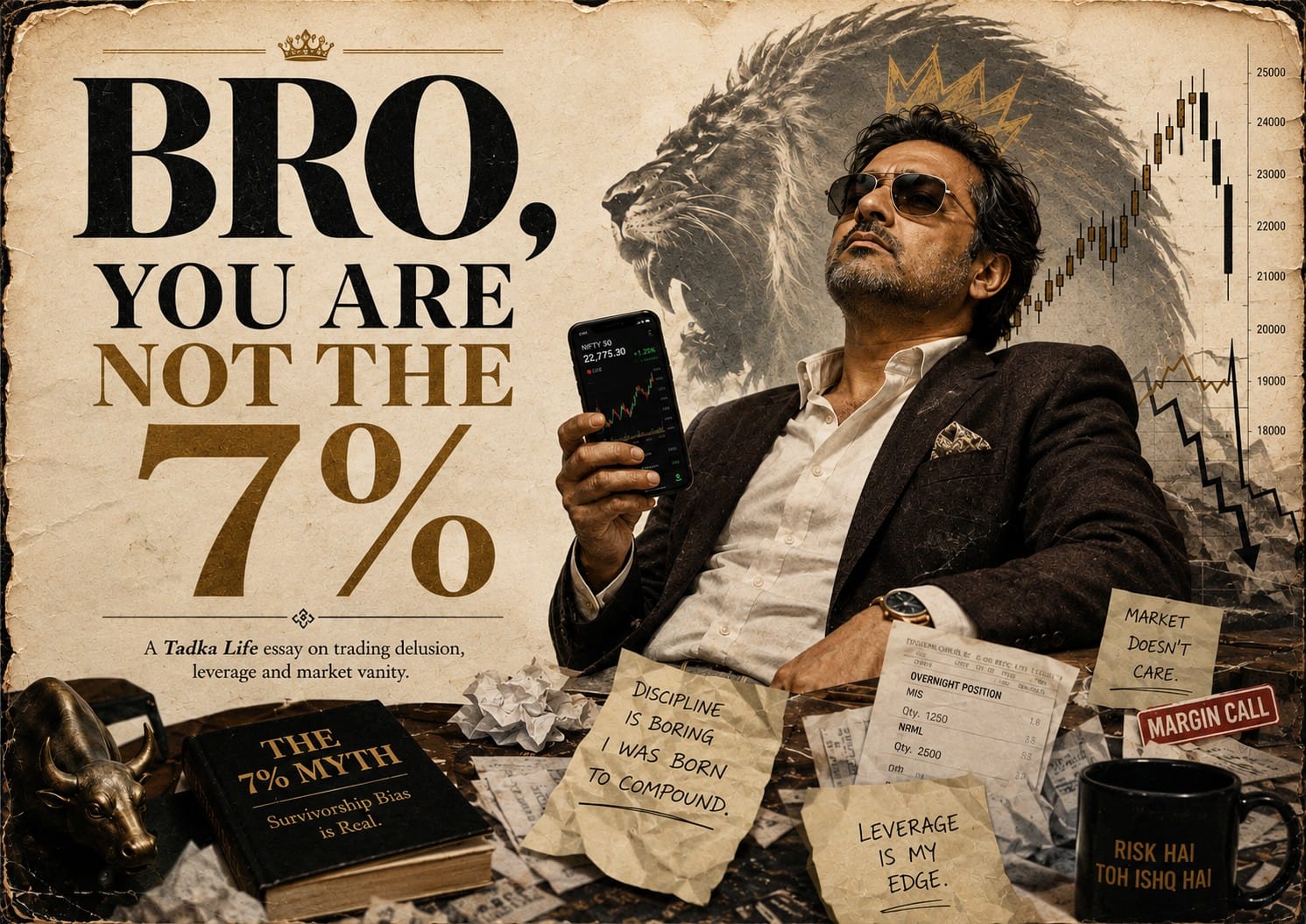
You were told, for God’s sake, not to venture into derivatives, F&O and other corners of the market where people lose money using vocabulary nobody at home understands. Buy good companies, invest through mutual funds and leave the money alone.
But that sounded painfully ordinary.
Then somebody mentioned a trader who had made ten times his money. The parts about leverage, luck, previous losses and the possibility that the story had been polished for a podcast passed you by. Ten times was enough.
Mentally, you were already a billionaire. The trading account had not even been opened, but you had started wondering whether sudden wealth would change you. You hoped not. You would remain grounded, perhaps upgrade the car, buy a holiday home and allow old acquaintances to discover, entirely by accident, that you had done rather well.
The people who lost money were obviously idiots. They traded emotionally and had no system. You had one.
A bloke on a podcast had explained it in forty-three minutes. He had several screens, many charts and the confidence of a man who knew where every candle was headed. You understood perhaps one-third of what he said, but that third sounded foolproof. He also kept using the word discipline, which made the entire business respectable. Losses became tuition fees, recklessness became conviction, borrowed money became capital efficiency and greed, once properly dressed, became financial ambition.
The broker increased your margin limit. You took this as recognition of your talent. In reality, he had merely enlarged the pool in which you could drown, complete with flashing screens, surround sound and live notifications announcing the disappearance of your capital.
The first few trades went well, which was the worst possible thing that could have happened. A loss might have frightened you. A small profit convinced you that the strategy worked. Another trade went right, so you increased the position. Luck was promoted to a system, and within weeks you were explaining the market to people who had been investing for twenty years.
Their caution irritated you. They lacked hunger. They were trapped in old thinking. You understood the new market, despite having acquired your expertise between dinner and midnight over three weekends.
By then, you had joined several WhatsApp groups populated by traders, marauders and assorted market veterans whose principal qualification was the ability to type “upper circuit tomorrow” before breakfast. Telegram channels sent multibagger tips every Monday morning, accompanied by rockets, fire emojis and urgent instructions not to miss the opportunity.
A completely illiquid penny stock that had slept peacefully for years suddenly woke up. Hundreds of people received the same message, rushed in together and pushed the price higher through sheer mob enthusiasm. You saw the first green candle and immediately began seeing stars. The Mercedes was only a bumper away.
Bro, why do you believe every bloke on a business channel who talks about a stock as though you are about to miss the gravy of the century? There is no gravy. The only gravy is in your tiffin box, and even that has probably spilled because you forgot to press the lid properly.
Every tip arrived wrapped in authority. Promoters were increasing their stake. A major order was expected. Accumulation was happening. Nobody knew who was accumulating what, but the stock had moved four per cent and the group had begun congratulating itself.
You joined the army of lackeys pushing the price up, unaware that those who sent the tip might already be near the exit. By the time you entered, they were preparing to leave. By the time you averaged, they had left. By the time you began explaining the long-term fundamentals, the Telegram channel had changed its name.
Your bank and broker were not going to discourage you. Every morning they dangled instant funding, leverage and MTF before you. MTF sounded respectable. It had three capital letters and came from the same institution that safeguarded your fixed deposits. How dangerous could it be?
You knew you had messed up the last time. There had been forced selling and solemn promises never to repeat it. But the brain does not preserve financial humiliation with the same clarity with which it remembers a six hit thirty years ago. The loss became a learning experience. The folly became bad timing. Bad timing became unfinished business.
So you did it again.
By 9:08 in the morning, adrenaline had flooded the control room. Overseas markets had done something, index futures were indicating something else and five experts had offered seven opening strategies. At 9:15, you entered the Roman Colosseum carrying a spreadsheet and a recently discovered system.
The gladiators had faster machines, deeper pockets and no emotional attachment to your survival. You were trying to remember what the podcast fellow had said about support levels while the price fell through all of them.
Then one position moved against you. Nothing serious, you said. Temporary volatility. You averaged. It fell further, so you averaged again because it was now available at a better price. This is one of the market’s oldest jokes: the thing hurting you becomes more attractive merely because it is hurting you at a discount.
The podcaster had said remain calm. Lalaji on YouTube had said winners never quit. The broker had said more margin was available. The universe appeared to be sending a coordinated message, and you followed it straight into the pit.
Lalaji had been inspiring. He wore a large watch and the calm expression of a man who had survived several financial disasters, most of which he had probably created himself. He spoke about perseverance and how he had once lost everything and risen like a phoenix.
His wife had pawned the jewellery, relatives had stopped taking calls and most of his shares were still pledged somewhere, but none of this entered the motivational section. The phoenix story works better when nobody asks who paid for the fire.
By now, your position was sinking, but you remained convinced that you belonged to the magical seven per cent who actually make money. The other ninety-three per cent were emotional and uninformed. You were different. You had rules, a spreadsheet and a strategy, although you had broken every rule written on it.
The stop-loss had been shifted three times. The position had doubled. A trade meant to last two hours had become a long-term investment, and an option bought for momentum had become a matter of personal honour. You were no longer managing a position. You were defending your character.
The market did not care that you were good at mathematics, understood balance sheets or had run a company. It has watched engineers, doctors, chartered accountants and CEOs lose money with equal efficiency. Intelligence can help in the market. It can also help you construct a more sophisticated explanation for why you should not exit.
Everyone entering F&O assumes that the ninety-three per cent are other people: reckless punters, tip-seekers and men trading from paan shops. You are educated. You read. You analyse. You watch podcasts.
The market is perfectly happy to eat an MBA.
Then there is always the uncle who bought Eicher years ago, forgot about it and woke up rich like Rip Van Winkle. His story is repeated at family gatherings as proof that wealth requires only foresight and patience.
Bro, your sample size is one uncle.
You ignore the bundles of worthless shares he also accumulated because both of you prefer the Eicher story. Perhaps he is rich because of good karma from a previous life. Let him enjoy it. Do not turn one lucky relative into an investment philosophy.
Once the listed market begins to feel crowded, somebody leads you into the unlisted market. A friend explains that IPO allotments are rare, so why not buy before the IPO?
“When it lists, boom.”
Nobody mentions the companies whose valuations collapsed, listings vanished or investors were left holding shares they could neither sell nor explain at home. The unlisted market is often the same old bazaar wearing a suit and tie, with opaque prices, poor liquidity and a magnificent difference between the price at which somebody sells to you and the price at which anyone will buy it back.
The company is always planning an IPO shortly. Shortly may mean six months, six years or after your children inherit the shares and begin asking what they are.
Then somebody tells you mutual funds are terribly middle class.
“Grow up, man. PMS is where serious money goes.”
Mutual funds begin to look like economy class. PMS sounds curated, exclusive and faintly European. They identify businesses, unlock value and construct concentrated portfolios. They also extract their Merchant of Venice pound of flesh with the finesse of an Italian butcher slicing Iberian ham.
If one-year performance is poor, look at three years. If three years is awkward, wait for five. If five is still disappointing, you are reminded that you invested for ten.
You begin feeling ashamed that you even checked the returns.
The PMS manager says he is a long-term investor. Your chartered accountant looks at the trade statement and wonders why this patient portfolio has turned over several times during the year. At filing time, somebody calls the losses “tax-loss harvesting.”
Bro, harvest a profit occasionally as well.
After your tour of PMS managers, another gentleman offers to remove the paperwork.
Welcome to the AIF.
The language becomes heavier and the room quieter. There are vintages, drawdowns, waterfalls and a minimum ticket of one crore, delivered not merely as a threshold but as a test of character. You have travelled from middle-class mutual funds to upper-middle-class PMS and now stand at the gates of HNI heaven.
You politely decline but decide that one day you will enter. That will be the Eldorado.
Except Eldorado keeps moving. First wealth was hiding in F&O, then Telegram tips, unlisted shares, PMS and finally AIF. Every time you get close, another velvet rope appears and another man explains that the real opportunities begin just beyond the amount you currently have.
The problem is not always the product. It begins when you use investments as social promotions, moving from one to another because the higher ticket size makes you feel wealthier and closer to some secret chamber where extraordinary returns are distributed among people with private bankers.
There is no secret chamber.
The same intelligence and energy might have earned you more elsewhere. Had you used those hours to crack a sales deal, prevent a transformer from burning out, solve a customer problem or sit with a villager and explain the land-acquisition process, your bonus and increment might have exceeded the profits from your trapeze performance in the market.
Your career was offering returns on actual competence. The market was offering excitement on borrowed money.
But competence is slow. It does not open at 9:15 with flashing numbers. Simple investing is equally unsatisfactory because it offers no theatre. You buy a decent fund, invest regularly and wait. There is no applause, no adrenaline and no feeling that your life may change by Friday.
That is probably why it works.
The broker will not stop you. The podcaster will not reimburse you. Lalaji will rise like a phoenix in another video. The Telegram channel will change its name, the unlisted broker will promise another IPO and the PMS manager will ask for patience.
The seven per cent do exist. The trouble is that the other ninety-three per cent enter the market equally certain that they are part of it.
Continue reading in business series…….





Very well articulated. The lure of easy money on the stock market can lead to temptations resulting in disaster. Unfortunately in India other than land, immovable property and recently bullion, gold, silver, etc there is no other instrument which can give a post tax return which beats inflation and ensures peaceful retirement. Capitalism thrives on private enterprises which reward the diligent investor. Corruption and nepotism are hallmarks of over regulated economies and a compromised law & order and judiciary add fuel to the fire. The black money circulating in the real estate sector is huge, specially in land deals amounting to more than 70% of the value in some cases.
Thanks for the comment.