
Nothing Ever Retired in an Indian Home
There was a time when retirement did not exist. At least not for household objects.
Nothing was ever thrown away. It was merely transferred to another department.
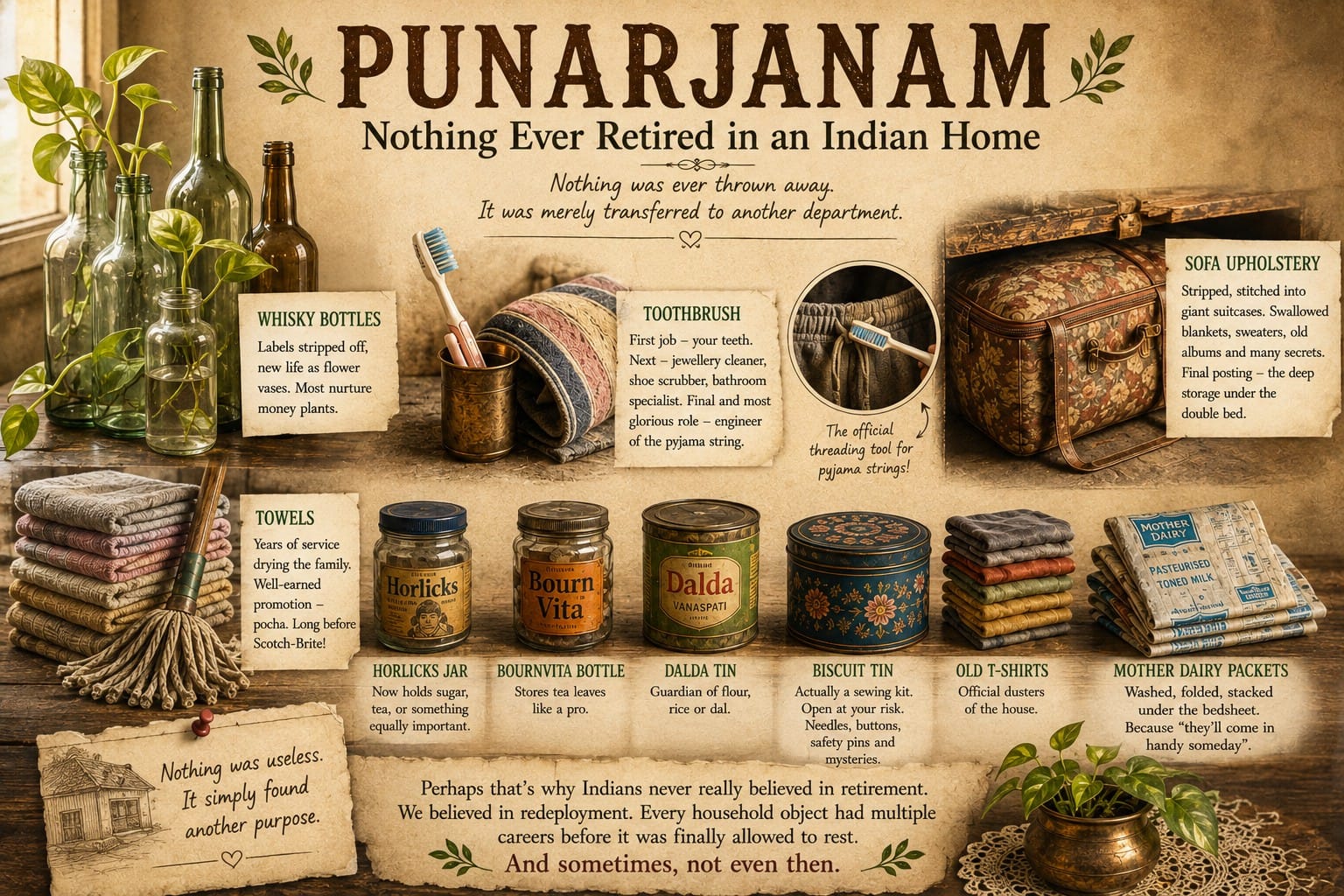
Whisky bottles of every conceivable vintage rarely made it to the recycling bin. Their labels were painstakingly stripped off after a patient soak in warm water, revealing surprisingly elegant glass beneath. They quietly acquired a second life as flower vases, almost always nurturing a money plant by a window or on the balcony. Apparently, even empty whisky bottles had a future.
We laughed at our parents for carefully washing and folding Mother Dairy milk packets, stacking them neatly under the bedsheet because “they’ll come in handy someday.” We thought that generation was incapable of throwing anything away.
Then Instagram arrived.
Today we lovingly preserve artisanal jam jars, gourmet sauce bottles, scented candle containers and impossibly stylish mouth freshener bottles because they look too beautiful to discard. They occupy kitchen shelves waiting for a future purpose that nobody has quite identified yet.
We haven’t changed.
Only the packaging has become more expensive.
Nothing, however, enjoyed a more distinguished second career than the humble toothbrush.
Having faithfully cleaned your teeth for months, it was reassigned to jewellery cleaning, bathroom corners, shoe soles and countless other odd jobs. But its greatest contribution to Indian civilisation lay elsewhere.
It was the official engineer of the pyjama.
The cotton pyjamas of yesteryear possessed a remarkable talent. Their drawstrings would inevitably disappear into the waistband, turning a simple act of dressing into an emergency operation. The entire household would join the search for the missing end. Once located, the retired toothbrush would be recruited as a threading tool, bravely navigating the dark, twisting tunnel inside the waistband before emerging triumphantly from the other side.
It was less a household chore and more a civil engineering project.
Even sofas weren’t allowed to retire with dignity.
Once they had faithfully served the drawing room for years, their upholstery was stripped off and stitched into enormous, flexible suitcases. These ungainly creations could swallow blankets, winter clothes, old albums and anything else that refused to fit elsewhere. Their final destination was the cavernous storage beneath the double bed, where they disappeared for years before resurfacing during Diwali cleaning or an unexpected wedding.
A retired shawl, meanwhile, had a rather important winter posting. Once it was no longer respectable enough to be worn outside, it was wrapped snugly around the vessel in which curd had been set, providing just enough warmth for the bacteria to quietly multiply through a cold winter night. By morning, if all went well, there was fresh dahi inside.
The shawl had stopped keeping us warm. It was now keeping the curd warm.
Towels, too, enjoyed long and respectable careers. After years of drying generations of family members, they didn’t become waste. They graduated into pochas. This was long before Scotch-Brite convinced us that floor cleaning required specialised technology. A retired towel had already been quietly cleaning Indian homes for decades without a marketing budget or an ergonomic handle.
Horlicks jars stored sugar. Bournvita bottles held tea leaves. Dalda tins guarded flour, rice and lentils. Biscuit tins became sewing kits so reliably that opening one in an Indian home was always a gamble. You hoped for biscuits. You found needles, buttons, safety pins and a measuring tape.
Nothing was ever useless.
It simply found another purpose.
Perhaps that’s why Indians never really believed in retirement. We believed in Punarjanam.
Every household object lived several lives before it was finally allowed to rest.
There was, however, something that happened even before Punarjanam. We didn’t grant rebirth easily. First, every possible attempt was made to extend the existing life.
Take socks. Their elastic invariably gave up long before the socks did, so there was a special elastic band with a little metal clasp that went around the calf. Fold the sock over it and presto, the sock stayed up. It also left a bright red ring around your leg by the end of the day, but apparently circulation was a small price to pay for longevity.
That wasn’t Punarjanam. The sock was still a sock.
We were simply refusing to let it die.
But that’s another story — The Great Indian Life Extension Programme.
It will come after a few hoops and turns.
Keep watching this space.
Before you go…
If this brought back a few memories, you may enjoy these journeys into another India:



One Comment