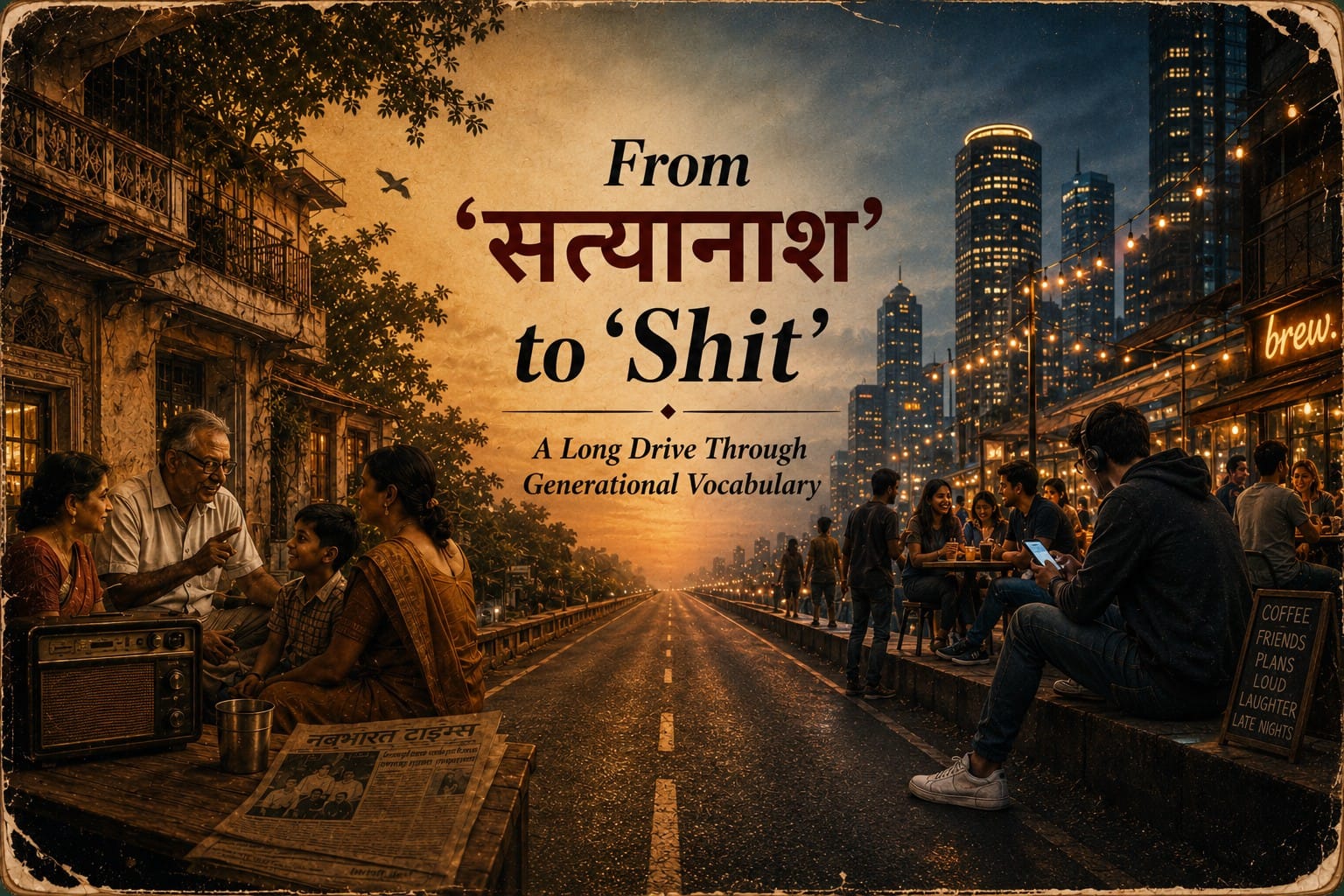
There was a time when Indian households had a remarkably economical vocabulary for disaster. The scooter refused to start, सत्यानाश. The pressure cooker gasket gave way, सत्यानाश. The child came home with 41 in mathematics, depending on the parent, either सत्यानाश or a more personalised नालायक. Nobody said shit. At least not in the homes I remember.
We had हाय राम, हे भगवान, बकवास, बुद्धू, निकम्मा, उल्लू, and in Punjabi households an entire supplementary vocabulary where मरजाना and खोता could be used with affection, irritation or both at the same time. Nobody paused to analyse the emotional impact.
मोटा, काला, बुड्ढा, बुद्धू, stupid, idiot were casually lobbed across dining tables, school corridors and family gatherings. An uncle could inspect a child after six months and announce, ओए, कितना मोटा हो गया, before asking how studies were going. A grandmother could call someone खोता and still feed him an extra paratha five minutes later.
Were people hurt? Of course some were. Did anybody know? Maybe. Did anybody care? That is where things get interesting.
It wasn’t necessarily that previous generations had thicker skins. Perhaps they simply had less time to examine the skin. Life had other hygiene factors still waiting to be sorted out. Homes were smaller, families larger, money tighter. Electricity disappeared regularly. Water arrived on schedule, not on demand. Admissions mattered. Jobs mattered. Marriages mattered. Transfers mattered. Pensions mattered. Whether Chachaji’s comment about your weight had damaged your self-esteem was unlikely to make the household priority list.
You were told not to be so sensitive. In fact, sensitive itself was often not a compliment.
Then somewhere along the way, we acquired a new dictionary. Body shaming. Colourism. Ageism. Bullying. Toxic. Triggered. Trauma. Boundaries. Emotional safety. The feelings probably existed earlier. What changed was that somebody finally gave them names. Once something has a name, it becomes much harder to pretend it doesn’t exist.
And vocabulary elsewhere changed just as dramatically.
Our generation said चक्कर चल रहा है. That one phrase could accommodate an astonishing range of romantic possibilities. Two people exchanging suspiciously frequent glances at a wedding could have a चक्कर. Someone making STD calls every Sunday evening could have a चक्कर. A full-blown affair involving letters, parental opposition and somebody threatening to leave home was still, somehow, a चक्कर.
Gen Z has brought proper classification to the subject: talking, dating, seeing someone, situationship, ghosting, breadcrumbing, benching, orbiting. We had one चक्कर doing the work of an entire relationship-management consultancy.
Even rejection was simpler. Nobody needed closure. Someone married somebody else and eventually you understood. Today closure itself may require three conversations, two voice notes and possibly a therapist.
This is not entirely mockery. In many ways, it is progress. Our generation was extraordinarily casual about hurt. The family fat child remained the fat child. The dark child heard comments about complexion from people who genuinely believed they were being helpful. The boy who cried was teased. The girl who protested too much was difficult. Schoolyard bullying was often dismissed as normal growing up.
Some of those people undoubtedly carried scars. We simply didn’t have much interest in inspecting them.
But the pendulum rarely stops in the middle. If we were too casual about hurt, the present generation can occasionally become remarkably forensic about it. A joke is no longer simply funny or unfunny. It may require a small environmental clearance. Who said it? About whom? From what position of privilege? Could somebody somewhere feel diminished?
The old response was, अरे यार, मज़ाक था. The new response can be, your intention doesn’t determine my experience. Somewhere between those two sentences lies forty years of social change.
Even ordinary words migrated. बकवास became cringe. झगड़ा became drama. परेशान became stressed and then sometimes triggered. Someone once described as अजीब may now be toxic. Someone who simply thought too highly of himself may be diagnosed over coffee as a narcissist. And the dependable Indian यार now competes with bro.
Bro is no longer merely a relationship. Bro is punctuation, grammar and emotional support.
Bro, what? Broooo. Seriously, bro? Bro is cooked.
Meanwhile, those of us from an earlier generation are still trying to understand why sick can mean excellent and slay no longer requires either a sword or a dragon.
But we shouldn’t get too smug. Our parents probably disliked our vocabulary too. Timepass was hardly Queen’s English. Setting acquired meanings no dictionary had sanctioned. Fundoo, bindass, jhakaas arrived, flourished and occasionally disappeared. Every generation vandalises the dictionary it inherits and then becomes strangely protective of its own vandalism.
The more interesting change is not really that सत्यानाश became shit. It is that the society around the words changed.
Families became smaller. Homes became more comfortable. Children increasingly became projects rather than merely members of a household. Parenting became more attentive. Psychology entered ordinary conversation. Schools began talking about bullying. Offices acquired codes of conduct. Social media gave one person’s discomfort access to ten thousand people who recognised the same discomfort.
Prosperity probably played a role too. Once the water tank is full, the inverter is working, the child has a laptop and dinner can arrive through an app, the emotional weather inside the house becomes easier to notice.
That does not make today’s concerns frivolous. Quite the opposite. Societies often notice finer forms of discomfort only after some of the larger discomforts have receded.
The person called मोटा thirty years ago may indeed have been hurt. We just didn’t ask. Today we ask. Sometimes perhaps we ask too much.
That is the tension. One generation believed resilience meant learning to absorb things. Another increasingly believes self-respect means refusing to absorb them. Neither idea is entirely foolish. Neither is entirely sufficient.
And beneath all the new vocabulary, remarkably little has changed. Teenagers still think their parents understand nothing. Parents still think teenagers understand nothing about life. People still fall in love with the wrong people. Friends still tease each other. Relatives still interfere. Someone at a family dinner will still say something they shouldn’t.
Thirty years ago, the room might have gone quiet for a second and somebody would pass the dal.
Today, there is a fair chance somebody will explain why the remark was problematic.
Perhaps that is the real journey from सत्यानाश to shit. The emotions were always there. We have simply become much better at naming them.
Whether we have become better at handling them is another matter altogether.