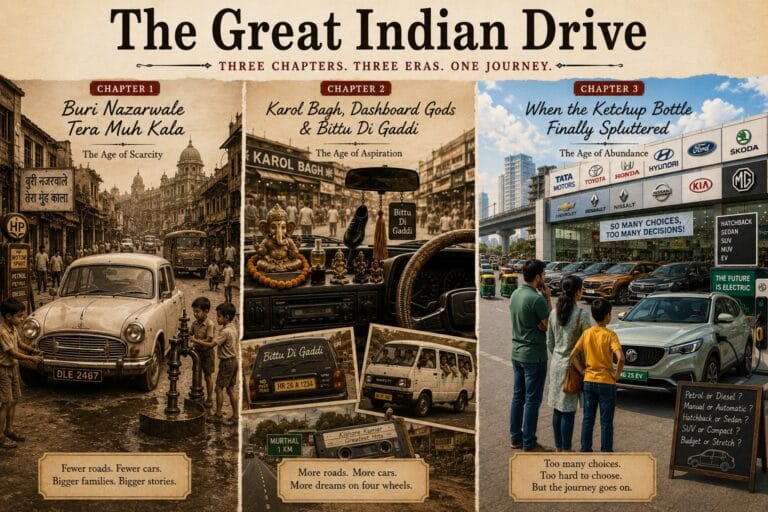
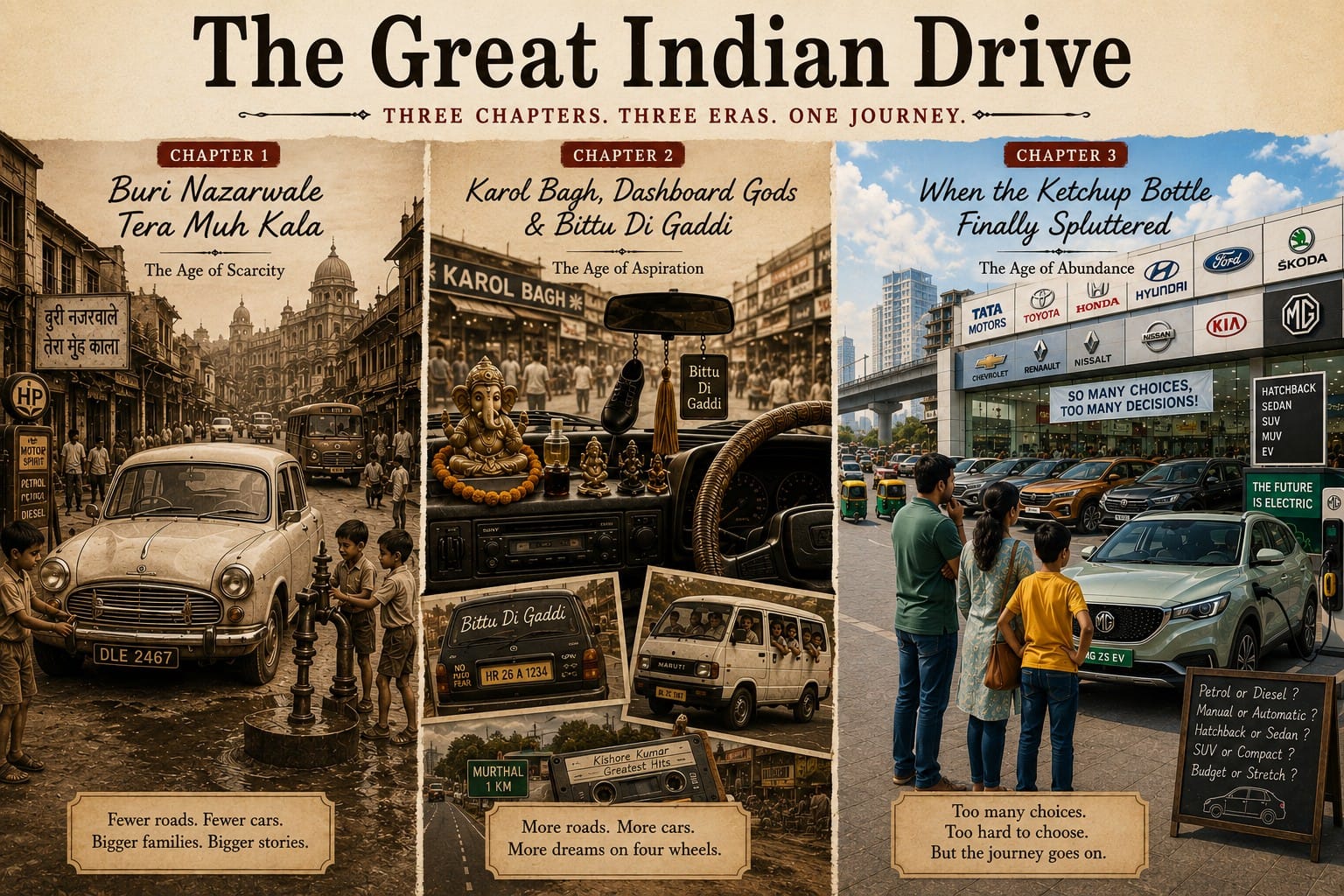
Chapter 1: बुरी नज़र वाले, तेरा मुँह काला.
What was India’s first anti-theft device?
“Buri Nazarwale Tera Muh Kala.”
Long before motivational quotes colonised LinkedIn and Instagram, this was probably the most widely read sentence on Indian roads. It stared back at us from the rear of lumbering trucks, usually accompanied by dangling lemons and chillies, colourful artwork and an unwavering confidence that the evil eye could be defeated with a few words painted in bold letters.
Perhaps that explains why the very first drive in a brand-new car was almost never to the market.
It was to the neighbourhood temple.
If Buri Nazarwale Tera Muh Kala was the antidote painted on trucks, the temple was the antidote for the family car.
A coconut appeared from nowhere. Four lemons quietly took their places under the tyres. Panditji enthusiastically drew a large vermillion swastika across the bonnet, pressed grains of rice into it with great care and stepped back to admire his handiwork. He had also, quite deservedly, become a little richer. After all, he had just witnessed your family move up in the world. It seemed only fair that his dakshina moved up a notch too.
The ceremony, however, wasn’t quite over.
No sooner had we reached home than a tiny idol of Ganesha, Hanuman, Sai Baba, Jesus, Guru Nanak or whichever deity the family trusted most quietly took up permanent residence on the dashboard. Before long came a fresh garland, perhaps a string of tiny coloured bulbs and, hanging from the inside rear-view mirror, a miniature jooti, a tassel or the little sacred scarf that Panditji had handed over after the puja, neatly rolled into a knot and left there to continue its silent vigil. Somewhere along the way, a small perfume bottle also appeared, bravely attempting to overpower the unmistakable aroma of rexine seats, warm vinyl, petrol fumes and yesterday’s samosas.
As a child, though, I had been worrying about something entirely different.
The moment Panditji picked up the coconut, I was convinced he was about to smash it on the bonnet or, worse still, on the engine. Once that danger had passed, another anxiety took over. Would the vermillion stain the paint? Would the grains of rice refuse to come off? My first prayer after leaving the temple was usually not for prosperity but for the swastika to disappear without leaving a mark.
Come to think of it, we are curious people. We happily accept a tilak and grains of rice on our forehead, only to rub them off at Godspeed the moment we step outside the temple gates.
Owning a car itself was a luxury. Many middle-class families happily spent decades on scooters, motorcycles, buses, auto-rickshaws and the occasional taxi. A car wasn’t bought because you needed one. It was bought because life had finally smiled upon you.
The day it came home, neighbours appeared without invitation. Children immediately negotiated for the front seat. Fathers developed an inexplicable urge to polish an already spotless bonnet every Sunday morning. Plastic seat covers often outlived the car itself. Removing them was treated almost as an act of financial irresponsibility.
Long drives had rituals of their own.
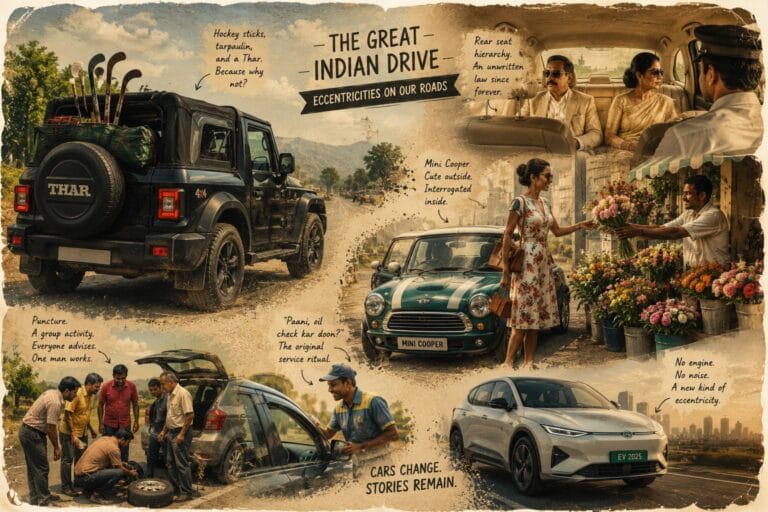
Nobody left home until somebody asked, “Sabne bathroom kar liya?” It had absolutely nothing to do with the car, yet every holiday seemed to begin with that question. The next ritual came at the petrol pump. The attendant invariably asked, “Paani, oil check kar doon?” Before anyone answered, the bonnet was already open. The windscreen received a quick wipe with a cloth that somehow managed to redistribute the dirt more evenly than remove it.
Every father also had his own pre-departure inspection. The bonnet was opened once more. He peered inside with great seriousness, touched a hose, checked something the rest of us could never identify, nodded quietly to himself and shut the bonnet with the confidence of a Formula One pit engineer. Nobody questioned the ritual.
Every now and then, especially after a long climb in the hills or a particularly hot afternoon, the radiator decided it had had enough.
The first sign was a thin wisp of steam escaping from under the bonnet. Within seconds it became an alarming white cloud. The car was pulled over immediately while everyone climbed out and stood at a respectful distance, staring at the engine as though something catastrophic had just happened.
The driver, meanwhile, became the reluctant hero of the moment. A handkerchief was wrapped carefully around one hand, the bonnet lifted with due ceremony and then came the bravest act of all—trying to loosen the radiator cap that was by now blisteringly hot and hissing angrily. Every tiny turn of the cap was accompanied by a chorus of warnings from the assembled experts standing safely behind him.
Back then, it felt as though the holiday itself had come to an abrupt end.
The funny thing was that, despite all this excitement, there wasn’t much of a choice anyway.
India didn’t really have a car market.
It had two cars.
The Ambassador and the Premier Padmini.
One was macho. The other, as the name suggested, dainty and feminine. They couldn’t have been more different if they had tried.
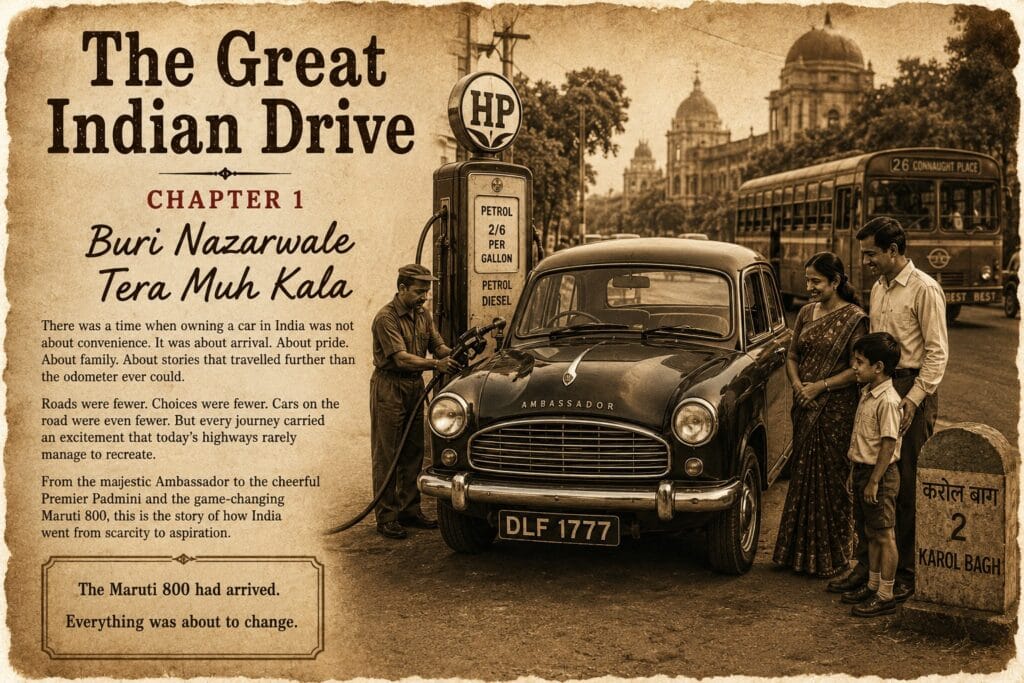
The Ambassador looked as though somebody had begun with a very simple brief: somehow make six people fit inside. Draw a large box, soften the corners a little, bolt on four wheels, insert an engine and call it a day.
It drove exactly as it looked. The suspension belonged more naturally on a truck, the steering had enough free play to qualify as a recreational activity and tall people folded themselves into the driver’s seat like oversized origami. Every few years came the Mark I, Mark II, Mark III and Mark IV. To the untrained eye they all looked suspiciously like the same car wearing different spectacles.
Government officers in safari suits seemed permanently attached to the rear seat. Ministers, district collectors, engineers and police commissioners all appeared to own one. Bollywood had no complaints either. Heroes and heroines happily sang romantic songs while this giant white box floated through Kashmir, Ooty and Marine Drive looking far more graceful on screen than it ever did negotiating Delhi traffic.
The Ambassador eventually found its true calling as a taxi. Nowhere was this more evident than Kolkata. Long after the rest of India had begun flirting with newer cars, endless yellow Ambassadors continued to rumble alongside trams, puffing away as though the city had quietly decided there was absolutely no reason to hurry into the twenty-first century. Their leisurely diesel clatter became part of Kolkata’s soundtrack. Delhi too had Ambassador taxis, while Mumbai seemed almost inseparable from the Premier Padmini.
Long before the IPL, our cities had already picked their franchises. Kolkata proudly backed the Ambassador. Mumbai cheered for the Premier Padmini. Regional loyalties weren’t invented by cricket. They had been quietly rolling on four wheels for decades.
If the Ambassador was a heavyweight wrestler, the Premier Padmini was a ballerina. Tiny, neat and almost toy-like, it resembled the Matchbox cars we all treasured as children. It steered better, drove better and actually behaved like a proper little car.
The monsoon, however, had a habit of reminding the Padmini who was really in charge. The first proper shower often became its annual engineering examination. Water somehow found its way into places where electricity firmly believed it had no business being. The starter sulked, the engine coughed twice and then retired hurt while half the neighbourhood gathered around the open bonnet. Nobody really knew how to fix the problem, yet everybody knew exactly how it should be done. One blamed the battery. Another insisted it was the plugs. A third was convinced the carburettor needed attention. At least two gentlemen contributed absolutely nothing except folding their hands behind their backs and supervising proceedings with the authority of Formula One engineers. Miraculously, after enough contradictory advice and generous quantities of perspiration, the car usually came back to life. Nobody quite knew why. Everybody went home convinced they had played a crucial role.
The Premier 118 NE briefly attempted to carry the family name forward. Poor fellow. It possessed neither the Ambassador’s personality nor the Padmini’s charm and wandered politely through Indian roads for a few years before quietly disappearing into automotive history.
And then, one morning, a cheerful little car arrived.
Small enough to fit where the Ambassador wouldn’t.
Reliable enough to start when the others occasionally sulked.
Modern enough to make everything else suddenly look old.
The Maruti 800 had arrived.
Everything was about to change.
It didn’t have the bulk of the Ambassador or the old-world charm of the Premier Padmini. It didn’t need to. It started when you turned the key, squeezed through streets where the Ambassador hesitated and, for an entire generation, made the idea of owning a brand-new car feel surprisingly attainable.
Waiting periods stretched endlessly. Booking receipts were guarded more carefully than fixed deposit certificates. People happily paid hefty premiums simply to get one a little earlier. Neighbours no longer asked, “Which car have you bought?” They asked, “How long did you have to wait?”
The Maruti 800 had arrived.
Everything was about to change.
The Journey Continues…
The story, however, was only just beginning.
In many ways, buying the Maruti was the easy part.
Owning one was where the fun really began.
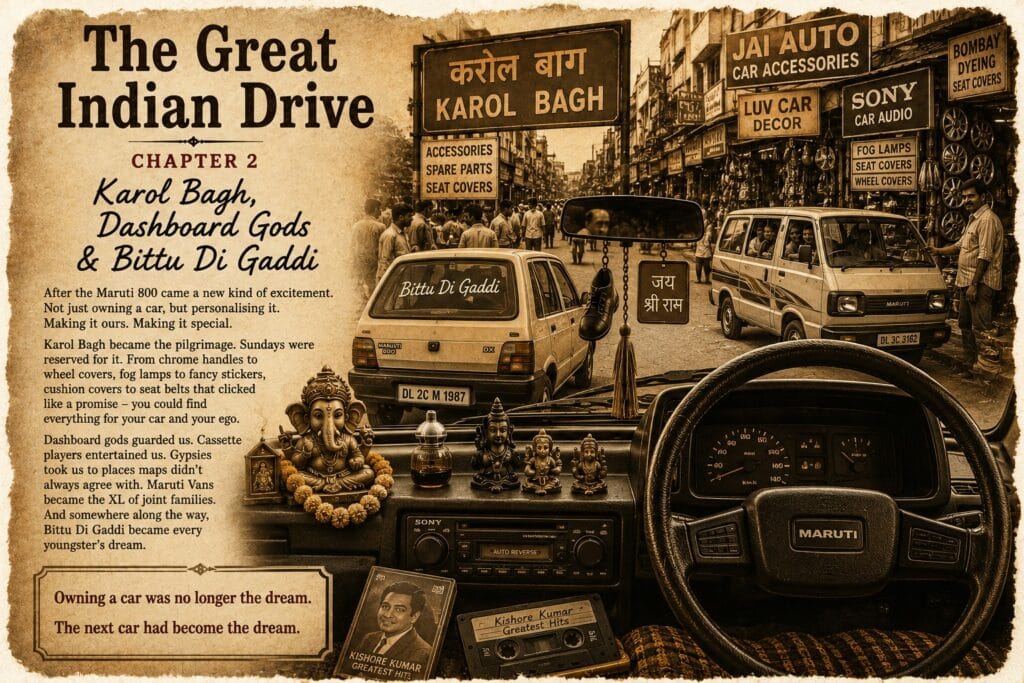
Within days, Indian families started improving a perfectly good Japanese car with the enthusiasm only we can muster. Dashboard gods quietly took charge, Karol Bagh accessory shops flourished, crash guards appeared where none were required, perfume bottles fought losing battles against rexine and petrol fumes, and somewhere on the back of an otherwise respectable car, Bittu Di Gaddi announced itself to the world.
That story deserves a chapter of its own.
Coming Soon
Chapter 2: Karol Bagh, Dashboard Gods & Bittu Di Gaddi
The Maruti 800 changed India. Indians immediately changed the Maruti. Dashboard gods, hanging jootis, cassette players, crash guards, Karol Bagh accessories, the Gypsy, the Maruti Van and a generation that firmly believed there was always room for one more child.
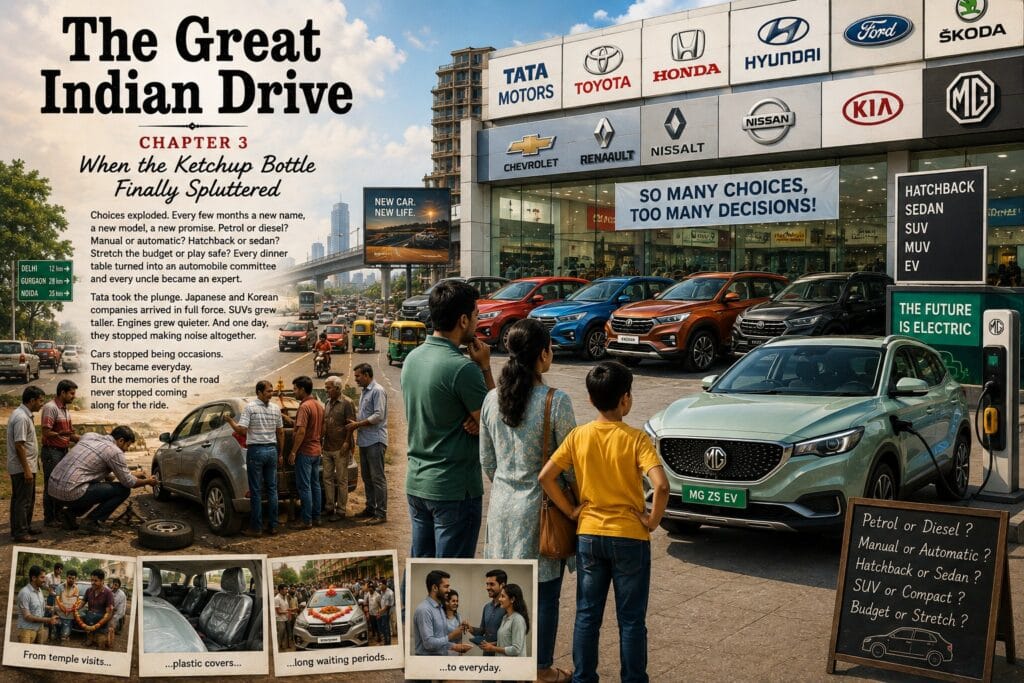
Chapter 3: When the Ketchup Bottle Finally Spluttered
Tata dreams big. Japan and Korea rewrite the rules. Beemers, Mercs and Audis remain in the stratosphere while the Nano, SUVs, EVs and an explosion of choice transform Indian roads forever. And why a puncture was never just a puncture.