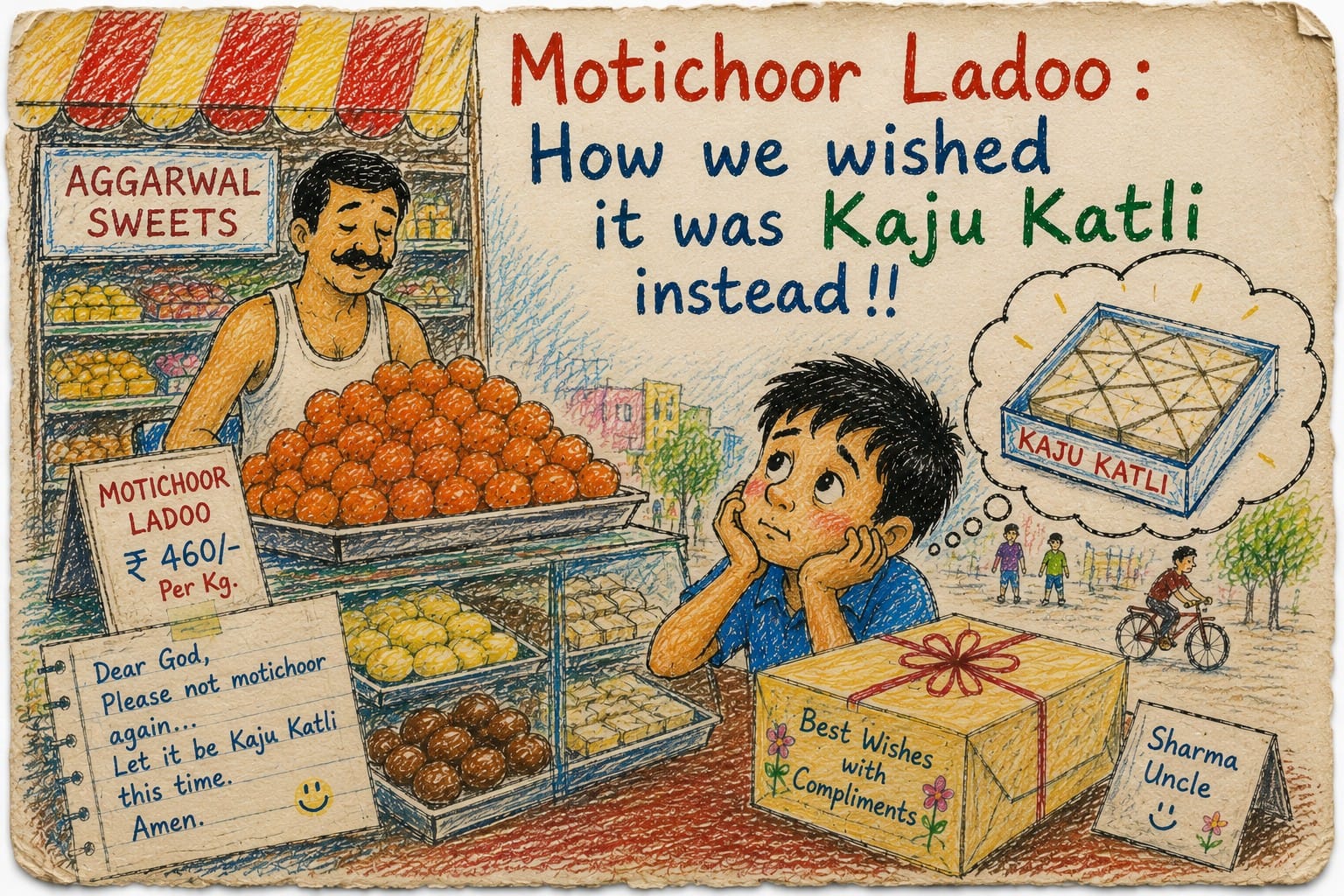
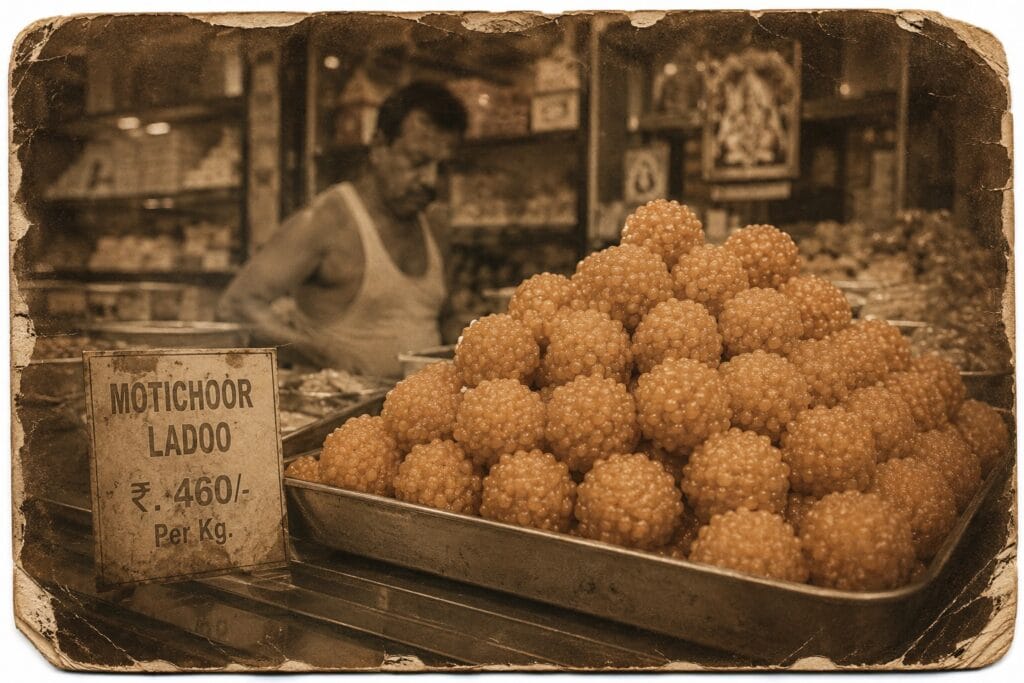
Who eats those violently orange motichoor ladoos, where hundreds of tiny balls somehow coalesce into one larger ball? Apparently, a lot of people, judging by the mountains of them one still sees at the neighbourhood Aggarwal Sweets or Om Sweets.
Behind the counter, the guy in the sweaty banyan keeps churning them out, tray after tray, those hundreds of little motis or pearls being persuaded into one obedient round ladoo. Motichoor is everywhere. Birthdays, pujas, office celebrations, exam results, someone buying a new scooter, someone getting promoted, somebody’s son getting engaged. Sometimes four pieces in a small cardboard box, sometimes the full one-kilo assault.
On the mithai social ladder, though, motichoor sits somewhere near the bottom. Nobody opens a box of motichoor and screams with joy. The aristocracy lives elsewhere. Kaju katli has class. Kancha gola and chamcham have glamour. Sohan halwa means somebody has made an effort. Even a decent box of pista barfi can lift the mood.
Which is a little unfair because motichoor has pedigree. Moti means pearl and choor crushed — crushed pearls. It came from the finer boondi ladoo tradition and has long associations with Rajasthan and Uttar Pradesh. Over time, it simply became the dependable mithai for pujas, prasad and celebrations.
We, of course, knew none of this.
You rarely ate a motichoor ladoo with any ceremony. You broke it into two, pinched out a few of those tiny orange motis and popped them into your mouth purely for the sugar hit. That was about it. There was no finesse to motichoor, no hidden mystery, no surprise waiting inside. No layer, no filling, no texture to discover. It did not reveal itself slowly. It was sugar, fat, colour and confidence, all compressed into a ball.
Even within motichoor there is hierarchy. Some are made with proper ghee and you can tell. There is a richness, a smell, a softness. Others, one strongly suspects, have taken the Dalda route. Those are heavier, slightly waxy and stay with you long after the sugar rush has disappeared. Perhaps that is part of the economics too. Motichoor is designed to feed numbers.
Purely from geometry, motichoor belongs to the same family as pinni, gulab jamun and rasgolla. They are all round, but that is where the relationship ends. In class, taste and texture they are generations apart. Pinni is dense, ghee-laden and serious. Gulab jamun and rasgolla belong to another universe altogether. Motichoor merely shares their shape.
There is another problem with ladoos. They have no mischief value. A cake can be cut on a birthday and, within minutes, half of it is smeared on somebody’s face while everyone laughs and takes photographs. Try doing that with Indian mithai. You cannot slap a kaju katli onto somebody’s cheek with any conviction, and a gulab jamun would probably just roll down the shirt. A motichoor ladoo is even worse. Press it against someone’s face and it disintegrates into orange motis, ghee and social embarrassment. Indian mithai is meant to be offered, eaten and respected. Cake has learned how to misbehave.
There is, however, one way to rescue motichoor. Dunk it into rabri, or let it sit alongside ras malai, soaking up the thickened milk, and suddenly the same orange ladoo tastes far better. The motis soften, the sweetness gets rounded off and what is fairly ordinary on its own becomes dangerously edible in company. Motichoor, it turns out, works best when it knows its place.
But why it has such enduring appeal is still beyond me. Maybe it is simply the economics of mithai. It is probably among the cheaper things you can buy by the kilo, looks festive because of that radioactive orange, travels reasonably well and can be distributed without anyone asking too many questions.
That may explain why it remains the default sweet of India. Pujas, office promotions, election victories, temple prasad, new shops, new cars, exam results, weddings — motichoor can turn up anywhere.
A box of kaju katli suggests expenditure. Sohan halwa suggests taste. Chamcham suggests someone has gone to a proper Bengali sweet shop. Motichoor merely suggests that an occasion has occurred.
And yet, there are people who genuinely love motichoor, perhaps even more after they leave India. Years later, in London, Toronto, Dubai or New Jersey, somebody opens a box and that familiar orange ladoo sits there looking exactly as it always did. You take a bite and suddenly it is India. It is home. Diwali lights, a puja, a wedding box on the dining table, relatives walking in, the neighbourhood mithai shop, your mother telling you to take one more. And before you know it, the eyes swell up a little. Strange, because when you lived here you may not even have cared much for motichoor. Distance can turn an ordinary mithai into a piece of home.
And how we prayed while an uncle slowly untied the string around a mithai box: please God, not motichoor again. Let there be kaju katli inside. Or chamcham. Anything. We have been good children. Give us some sohan halwa for once.

Truely Fun Sanjay, looking forward always for your Tadka
Thanks Rajit.