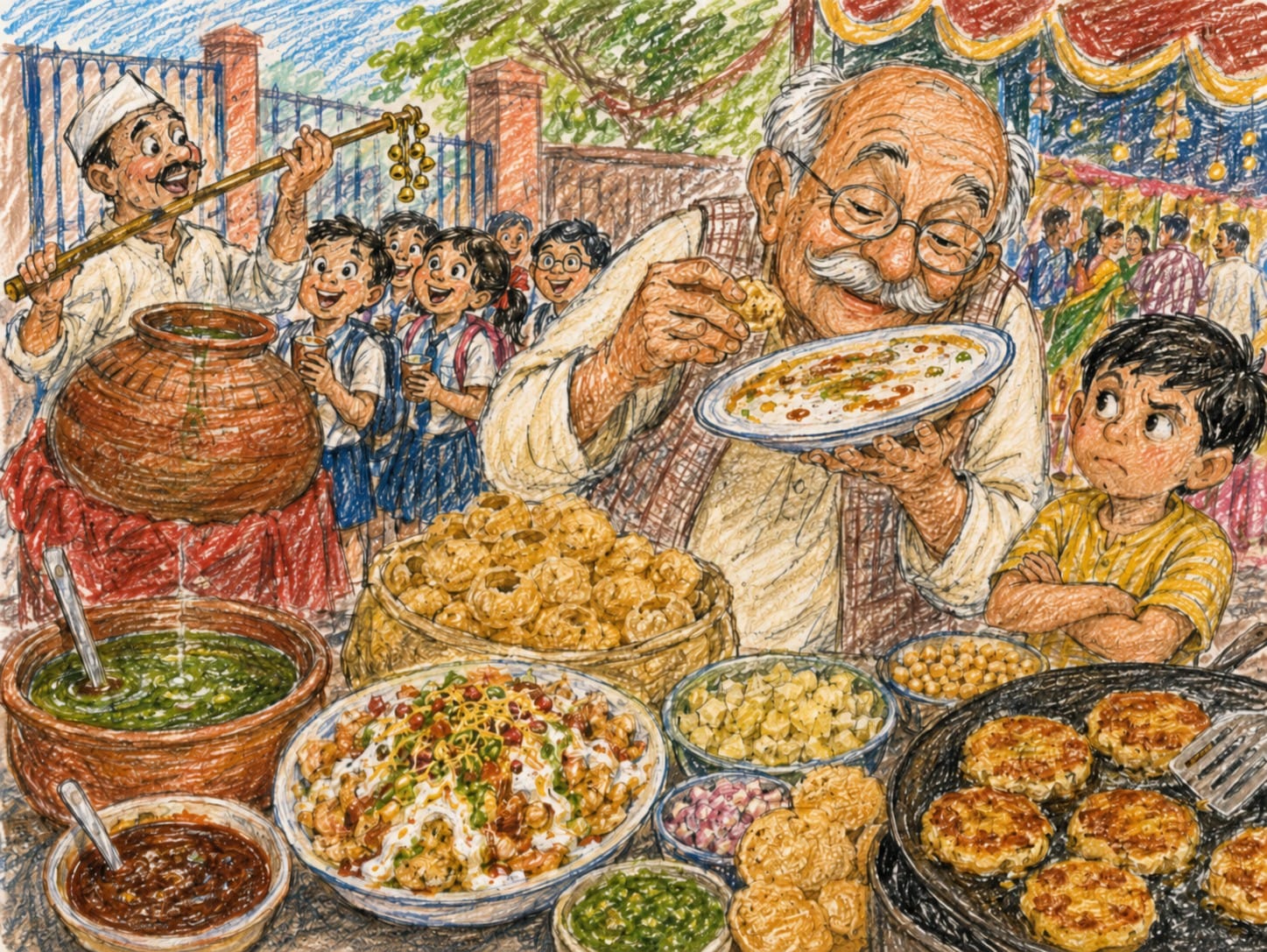
There was always that man outside the school gate with a huge round ghada, or some equally large clay vessel, full of jal jeera. Beside it was his most important piece of marketing equipment: a long wooden stick with a tiny cup fixed at one end and a bunch of ghungroos at the other. Every few minutes he would shake it and the bells would go jhak-jhak-jhak, which was enough to make a line of schoolchildren appear.
Nobody quite knew what was inside that ghada. Mothers certainly did not approve and school teachers were no more enthusiastic. Which, naturally, made it taste even better. For a few coins, he would dip that little wooden cup into the greenish-brown liquid and pour out a glass of something that was sour, sweet, salty and spicy, and occasionally strong enough to make your eyes water. We drank it with complete confidence in our immune systems and very little curiosity about where the water had come from.
Jal jeera somehow survived all this. In fact, it prospered. The man disappeared, the ghada disappeared and so did the long wooden stick with the ghungroos. Hygiene arrived, followed by caterers, event managers and decorative glass dispensers. Today the same concoction sits proudly at almost every Indian wedding in an inverted glass jar with a tap at the bottom. Among the kebabs, pasta counters, live grills and seventeen varieties of dessert, that slightly suspicious green-brown drink still attracts people. We may have become older, wiser and considerably more particular about mineral water, but somewhere inside the head those ghungroos still go jhak-jhak-jhak.
And of course jal jeera and gol gappa are inseparable. That is when the whole thing goes to another level. The gol gappa is cracked open, filled with that sour-spicy water, softened with a little sweet tamarind chutney, and somewhere inside go a few tiny pieces of potato and boiled chickpeas. Tiny, but precious, because once the last gol gappa is eaten, nobody really walks away. The plate is invariably extended towards the bhaiya once again with a request for thoda aloo-chana aur. That final spoonful, with a few chickpeas, two or three pieces of potato and a little imli chutney left on the plate, somehow completes the experience.
At weddings, the most enthusiastic people at the gol gappa counter are often the very senior citizens. Their children immediately become cautious. Papa, bas do. Thoda hi. Doctor ne mana kiya hai. Sometimes a grandchild is quietly deputed to keep an eye on Dadu, as if the old man is about to conduct some illegal operation involving tamarind chutney. Dadu has the gol gappas, takes the extra aloo-chana and, when everybody thinks the matter is over, tilts the little plate and slurps the remaining red imli chutney from one corner. The grandchild promptly reports back that Dadu chutney bhi pee rahe hain.
The irony, of course, is that the son and daughter-in-law doing all this policing have no objection to gol gappas themselves. They will have their share at the wedding and, once in a while, at that familiar chaat corner in the market. Only Dadu is not invited there.
Gol gappas have their own factions too. Some swear by the suji ones, crisp and brittle, while others will accept only atta. People can get surprisingly serious about this distinction. The pani may be the same and the aloo and chana may come from the same steel container, but serve an atta loyalist a suji gol gappa and you will immediately know that you have crossed a line.
There was also a time when standing at a chaat counter, particularly a gol gappa counter, was considered largely a female passion. Groups of women and girls eating chaat looked perfectly natural, but a boy or a grown man showing too much enthusiasm could attract some commentary. For some reason, chaat was considered slightly feminine. Men were perhaps expected to eat more serious things: kebabs, tikkas, chhole bhature, things that required chewing rather than standing obediently in front of a bhaiya waiting for him to drop a water-filled sphere into your open mouth. Thankfully, that nonsense has largely disappeared. Men, women, boys, girls and very senior gentlemen now attack the gol gappa counter with equal gusto, and nobody’s masculinity appears to have suffered.
Papdi chaat is invariably standing right next to the gol gappa counter, almost like its heavier cousin. Flattened crisp papdis, bhalla, generous dollops of yoghurt, kala namak, red chilli, roasted cumin, green chutney and, naturally, tamarind chutney. Dadu appears here again, except this time the objection is different. Dahi mat lena. Bahaar ka thanda hai. Pet kharab ho jayega. Everyone conveniently forgets that yoghurt has spent years being advertised as one of mankind’s great probiotic gifts. Dadu listens carefully, nods, and then at the first available opportunity sneaks in one plate, preferably with extra imli chutney.
The street-side version is even better. The chaatwala takes the papdi in his hand, dips it into the dahi, crushes the bhalla with his fingers, adds the masala and chutneys, some more dahi and gives the whole thing a final mix that would make a germ connoisseur delirious. No gloves, no tongs, no sanitiser. Perhaps it is the masala, perhaps the chutney, perhaps the yoghurt, but generations of street-food lovers have always suspected that the real magic lies somewhere in the fingers.
And after doing all this, he performs one final flourish. He adroitly swipes the periphery of the plate clean with his thumb, almost like a chef signing his creation before handing it over.
Next door there is usually an aloo tikki wallah. And in more recent years, palak patta chaat has also joined the neighbourhood, presumably because somebody realised that if you put spinach into chaat, you can call the whole thing healthy. Never mind that the palak has first been dipped in batter and deep-fried until every trace of nutritional innocence has disappeared. Then comes the dahi, the tamarind chutney, the green chutney and the masala. Somewhere inside all that, there is spinach, so one feels virtuous.
The tikki wallah, though, is a professional of another order. In front of him sits a huge cast-iron tawa with a generous pool of Dalda in the middle. If you are in Old Delhi, it may even be desi ghee. Around the edge he lines up the potato tikkis, each stuffed with a little dal and masala. They wait patiently until their turn comes and then, one by one, he slides them towards the centre into the spluttering fat. Slowly they develop that deep golden crust. He turns them, presses them slightly, waits, then breaks each tikki into two. Immediately the inside steams. On go the red chutney and green chutney, perhaps a little dahi, some masala, and that first spoonful confirms one of life’s more dependable truths: almost anything tastes better once it has been fried properly.
Dadu, incidentally, is usually not invited to this celebration. Too much oil, too much fried stuff, too much everything.
Palak patta chaat, however, we order quite confidently.
After all, it has spinach.
Continue this journey with Tiffin – Love in a Rectangular Box, Motichoor: How We Wished It Was Kaju Katli Instead!!, Parantha, — more food, memory and everyday Indian life on Tadka Life.