You entered the dabba and immediately knew this was not going to be a gentle journey.
Calling it a coach would have been giving it airs. It was a metal box bolted on wheels, with seats bolted inside, a couple of toilets squeezed in at the ends and, hanging there temptingly, the emergency chain. Every child wanted to pull it. Nobody quite knew what would happen if you did. I never found out. I wanted to, but courage clearly had its limits.
A train journey in the seventies was closer to a camping expedition than travel. In summer the dabba became the Sahara; in winter it was Greenland. Our idea of Greenland came from geography books showing Eskimos smiling outside igloos, so naturally we were well prepared.
We had no igloos. We had holdalls.
And before the holdall came the surahi.
Every family seemed to assign one child the honour of carrying this fragile earthen water carrier through the station. Round belly, long neck, narrow spout — it looked as though it had wandered out of some Mughal-era household and onto Platform Number Three. Yet it had the most important job on the journey: keeping the water cool.
Mineral-water bottles had not yet taken over the country. Water travelled with you.
The thermos flask travelled too, usually with tea for the adults. From outside it looked indestructible. Inside sat a glass liner with the survival instincts of a soap bubble. One careless drop, a faint tinkling sound, and everyone knew what had happened. The outside would still look perfectly respectable while the inside had become glass confetti.
“Who dropped the thermos?”
And the expedition had barely begun.
Then came the holdall. For anyone born after suitcases acquired wheels and dignity, a holdall needs explanation. It was a large canvas contraption into which bedding, pillows, blankets and occasionally half the household could be rolled, tied and transported.
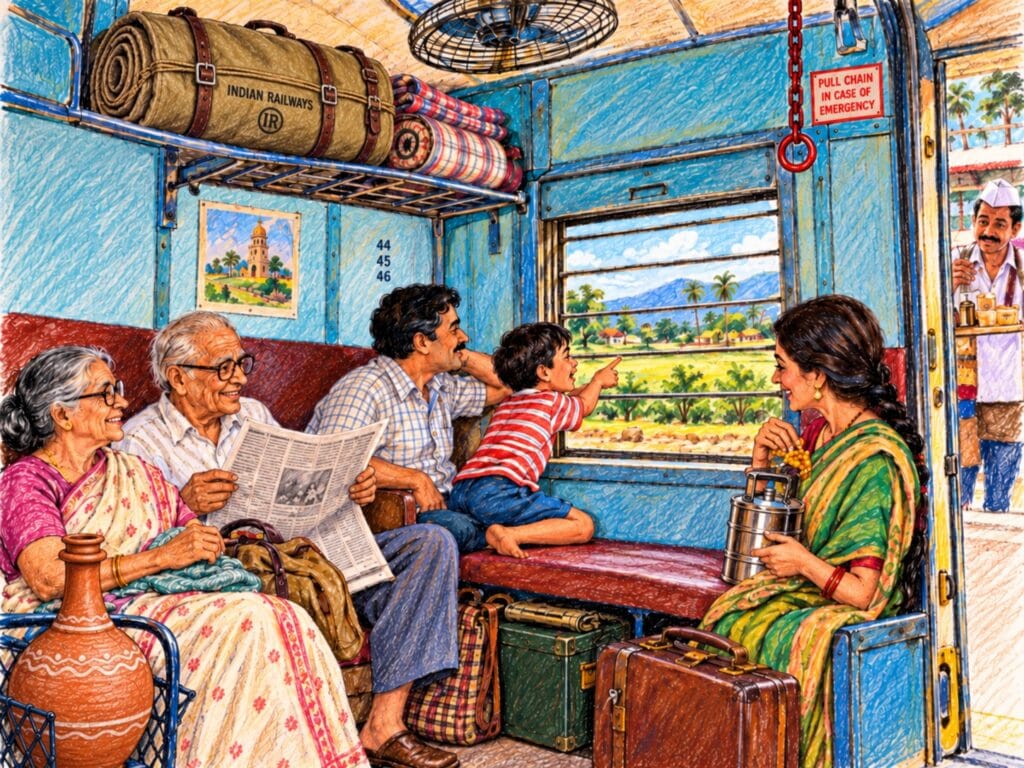
Once opened, it somehow occupied far more space than seemed physically possible. Sheets came out, pillows were allocated and one berth slowly turned into a bedroom while the space underneath became a warehouse of suitcases, baskets, steel trunks, water containers and mysterious packages.
Within half an hour complete strangers had worked out their territorial rights. This bag was ours, that suitcase was theirs, the surahi would stay here and nobody was to put shoes on the bedding.
The most serious dispute was usually over the window seat.
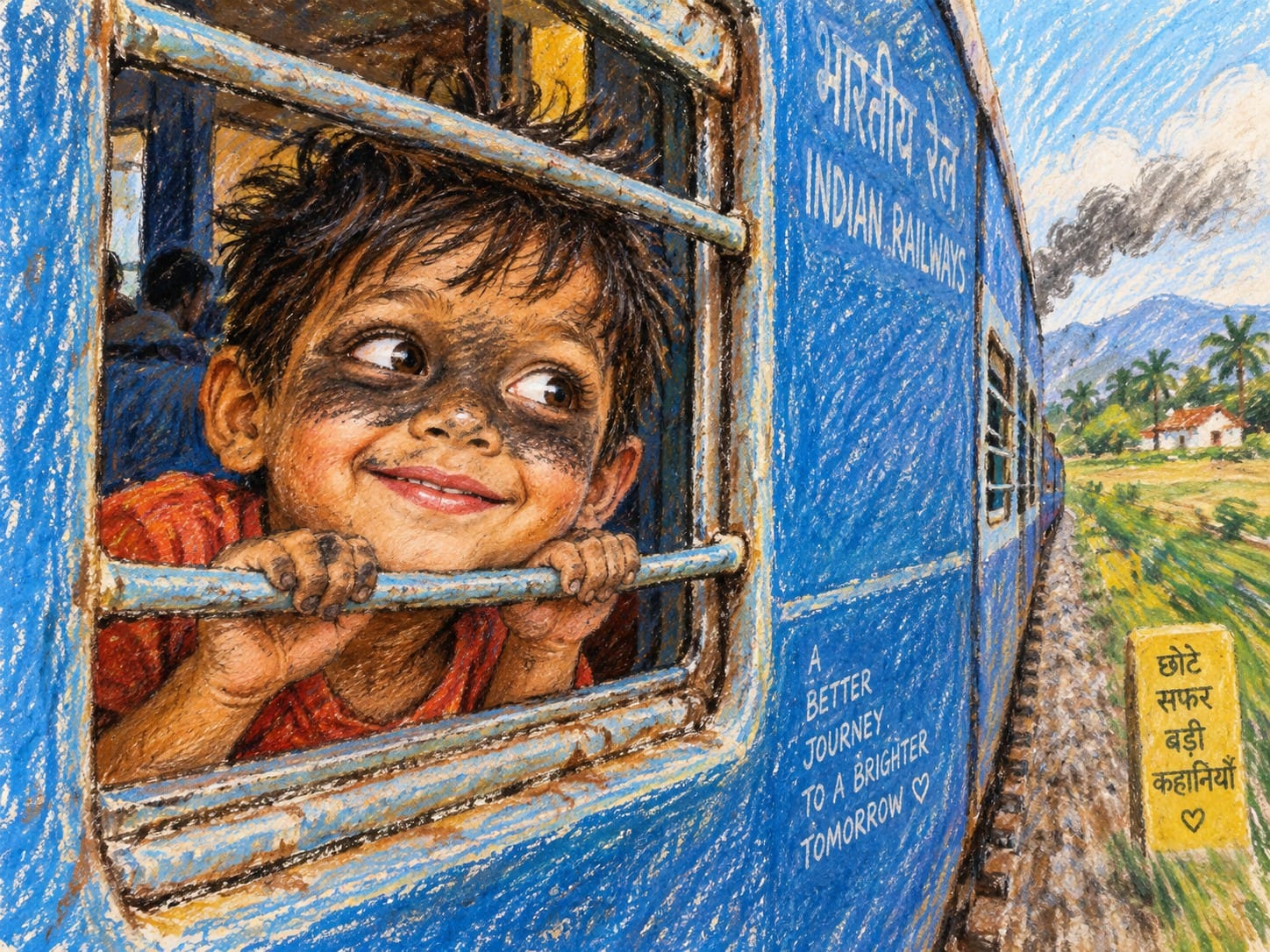
The window belonged to nobody and everybody. Children wanted it, adults claimed they needed it, grandparents acquired it by seniority and siblings negotiated turns with great seriousness. The window itself was basic engineering: steel bars, a heavy shutter, perhaps a glass pane and, if luck was on your side, everything actually moved.
In summer you wanted as much air as possible, except the air never arrived alone. It brought dust, soot and bits of countryside with it, and in the days of steam locomotives sometimes enough coal particles to leave a black mask around your eyes. By the end of it, you could look faintly raccoon-like without having gone anywhere near a forest.
You could shut the window, but then you cooked. So you kept it open.
Once everyone settled, the next institution appeared: the food.
Long before railway catering apps and neatly packed meals, Indian families approached a train journey on the assumption that civilisation might collapse somewhere after Mathura and therefore carried provisions accordingly.
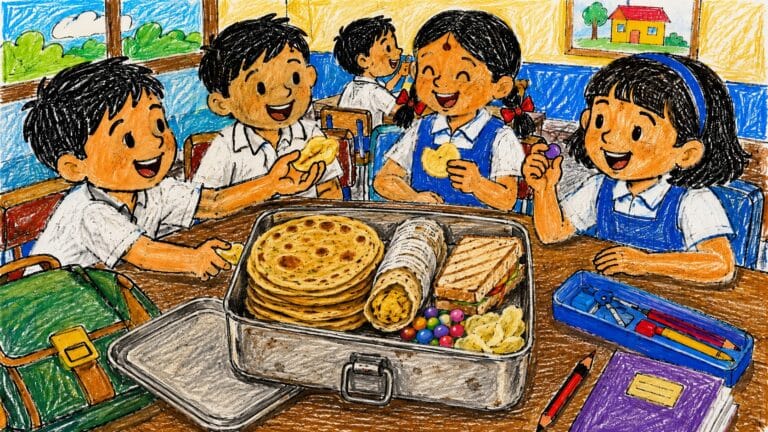
Steel tiffins appeared. Pooris, aloo, pickle wrapped with great care but still somehow capable of leaking through three layers of newspaper, mathri, namkeen, biscuits and boiled eggs whose presence could be detected several berths before they were actually opened.
Food was rarely meant only for the family carrying it. Someone would offer a poori to the people opposite. They would refuse first, as etiquette required. Another offer followed, they accepted, and within ten minutes their own tiffin would open and something would travel back in the opposite direction.
That was also how conversations began. Where are you going? Delhi. Delhi itself? No, Karol Bagh. And suddenly Karol Bagh was sufficient basis for discussing schools, relatives, occupations and whether someone perhaps knew Sharmaji near Ajmal Khan Road.
Then there was the man with the bucket.
Not tea. Not samosa. Roasted dal.
He would walk along the platform or through the compartment carrying a metal bucket full of roasted dal and make a snack with astonishing speed. A square of old newspaper became a cone with one flick of the wrist, two caps of dal went in, some masala followed and then came half a lemon, squeezed vigorously over the whole thing.
Roasted dal, masala, lemon and yesterday’s newspaper. No branding, no packaging, no nutritional label, no expiry date, and it was excellent.
Eating was easy. Cleaning your hands afterwards was the real challenge.
There were no sanitisers, wet wipes had not yet entered Indian life, and water was too precious to be wasted because somebody had pickle on his fingers. So everyone had a system: handkerchief, newspaper, perhaps a tissue if the family was particularly advanced.
You wiped your hands, inspected them, wiped again and eventually accepted that lunch was going to remain with you for a few hours in the form of a glorious smell of poori, achar, roasted dal, lemon and masala.
If matters were considered serious enough, a few drops of water were allocated from the surahi. Someone tilted it carefully while you tried to wash five fingers with approximately three teaspoons of water.
“Bas, bas, bas!”
Drinking water was drinking water.
The handkerchief also deserves its place in the history of Indian travel. Every man seemed to carry one, neatly folded at the beginning of the journey and progressively converted into a multipurpose device for wiping hands, face, spectacles, sweat, spilled tea and occasionally a child. By evening it had usually performed several jobs.
And then there was the toilet.
Every child knew it existed and hoped he would not need it.
Calling it a toilet was already generous. It was a small metal cubicle at the end of the dabba, usually wet for reasons nobody wanted to investigate too closely, with a floor that moved independently of your sense of balance.
The first challenge was simply reaching it. The train swayed while you walked down the aisle gripping berth edges, stepping over shoes, bags and sleeping feet, with adults offering helpful advice such as “careful”, as though that possibility had not already occurred to you.
Inside was a little basin, a tap whose relationship with water was uncertain, a mirror which had long ago given up reflecting anyone accurately and, most fascinating of all, the toilet itself.
You looked down and there was the railway track.
That alone could keep a child occupied with questions. Does everything really fall on the track? What happens when the train is standing? And why exactly does the sign say, PLEASE DO NOT USE THE TOILET WHILE THE TRAIN IS AT A STATION?
The real challenge, though, was using it while the train was moving.
Long before anybody spoke of core strength, squats, balance training or functional fitness, Indian Railways had already created a fairly complete programme. One hand held the support bar, one foot adjusted for a curve, the other searched for a patch of floor that looked marginally less wet. Your knees bent automatically when the train lurched and straightened when it steadied.
A sudden brake could turn the entire operation into something between a squat hold and a survival drill. If the train swayed sharply, you discovered muscles you did not know existed, all while trying to maintain dignity in a cubicle barely large enough for one person standing still.
Today people pay good money for unstable-surface training. We had Indian Railways.
Then came washing your hands. You opened the tap and nothing happened. You opened it harder, as though water pressure could be negotiated. If a thin stream appeared, you washed quickly before the water reconsidered.
Mothers often carried little soap strips for the children, which sounded like a sensible solution until they were actually used. After a couple of washes they became soft, soggy and stuck together inside the packet. Trying to separate one clean strip while the train swayed, your hands were already wet and the packet itself had started dissolving into a small mess was another exercise in patience. By then the soap had usually attached itself to your fingers, another soap strip or the inside of the packet.
Back at the berth, the audit still happened.
“Did you wash your hands?”
“Yes.”
“With soap?”
A pause.
“Yes.”
“Where was the soap?”
Mothers knew.
Stations brought their own excitement. The train slowed, everyone wanted to know where they were and the platform vendors took over.
“Chai, chai, garam chai!”
“Samosa!”
“Paani!”
Every station seemed to have a speciality or at least claimed one. Petha, kachori, samosa, cutlet, bread omelette, tea. Railway food was never really about hunger. The train stopped and suddenly everybody wanted something, even if they had eaten twenty minutes earlier.
Nobody really needed samosas. The point was that the train had stopped and samosas existed.
Then came the whistle and instant panic. The same people who had spent ten minutes deciding whether to buy tea suddenly developed remarkable speed. Children were counted, bags checked and the person who had gone to fill water was located.
Inevitably he appeared at the last moment carrying the surahi, a newspaper and perhaps two samosas nobody had asked for.
Night changed the dabba completely.
The same seats on which people had spent the day eating, reading and guarding window territory became beds. The lower berth was straightforward, the upper berth was adventure and the middle berth was engineering.
Hooks appeared, chains came down and soon the compartment became a three-storey dormitory. Children usually wanted the upper berth because it felt like a tree house. Once up there, you saw the compartment differently: feet sticking out from blankets, suitcases chained beneath berths, someone still eating, someone reading under a dim light, an uncle snoring with absolute confidence and children whispering long after being told to sleep.
Eventually the main lights went off and the little blue night light took over. Outside, India passed in darkness.
Sometimes you woke in the middle of the night with no idea where you were and looked out at a small station: a yellow signboard with an unfamiliar name, two sleepy porters, one dog and a tea stall somehow still open. Then the train moved again and the clack-clack returned.
Morning was perhaps the best part of train travel because you had gone to sleep somewhere familiar and woke somewhere else.
The soil had changed colour, the trees looked different and the houses were different. Sometimes there were endless fields, sometimes rivers and small villages where children stood near railway crossings and waved at the train.
Naturally, we waved back.
Nobody knew anybody and nobody would ever meet again, but for those few seconds there was complete friendship.
The compartment slowly woke. Blankets were folded, middle berths came down, faces were washed with minimal water, tea appeared and yesterday’s leftover mathri re-entered circulation.
Then came one of the great pleasures of railway travel: standing near the open door.
Adults had repeatedly told you not to, which naturally made it irresistible. You stood slightly behind the doorway, holding the metal handle tightly as the wind hit your face and the tracks rushed below. When the train took a long curve, you could sometimes see the engine far ahead pulling the entire line of dabbas behind it.
That sight never became boring.
Eventually somebody announced that the destination was only an hour away and the atmosphere changed. Suitcases came out, holdalls were rolled, missing slippers located and everyone began looking out of the window as though the city might suddenly appear without warning.
Then came factories, more tracks, signals, railway quarters and finally the platform itself.
The aisle filled with luggage, porters appeared, relatives were spotted through windows and instructions flew in every direction. Suddenly the little world in which you had lived for twelve, eighteen or sometimes thirty hours began to break apart.
The family opposite disappeared into the crowd. The uncle who had shared his newspaper was gone. The child whose comic you had been reading vanished with his parents.
No phone numbers were exchanged and there was no promise to stay in touch. You simply walked away.
Perhaps that is what made those journeys special. For a day or two, strangers became neighbours, food was shared, children became friends, adults exchanged life histories and somebody guarded your luggage while you went to the toilet.
Then the train reached the station and that little world disappeared.
We remember the heat, the cold, the soot, the surahi, the holdall, the roasted dal, the broken thermos, the chain we never pulled and the toilets we would rather forget. What stayed with us, though, was the journey itself.
Back then, reaching somewhere was only half the holiday. Getting there was the other half.
Hope you enjoyed the ride. Lets walk through something similar, you will recollect and it will bring a smile………