Chapter 3: When the Ketchup Bottle Finally Spluttered
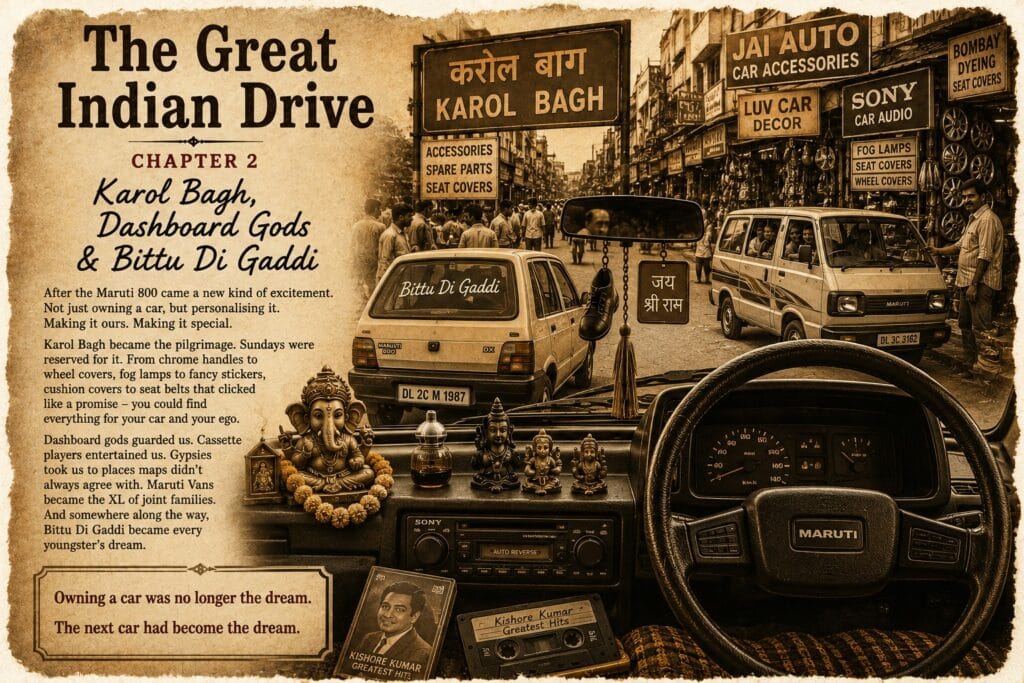
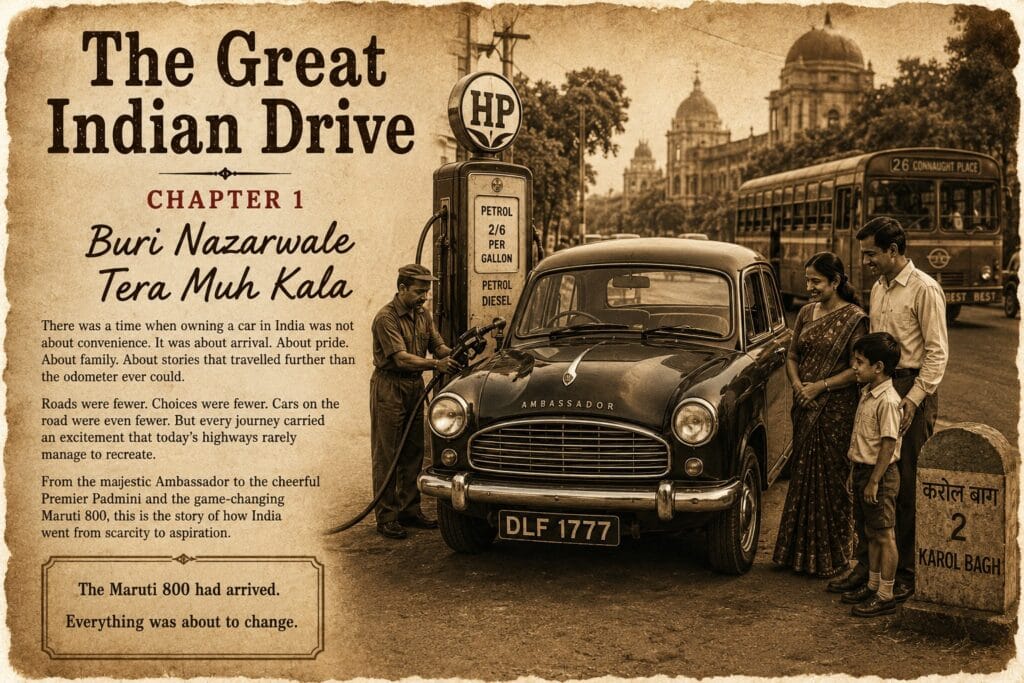
The Great Indian Drive began with the Ambassador and Premier Padmini, before the Maruti changed the way India drove. If you missed the journey so far, catch up with The Great Indian Drive Chapter 1. & The Great Indian Drive Chapter 2
A Thar pulled up beside me the other day.
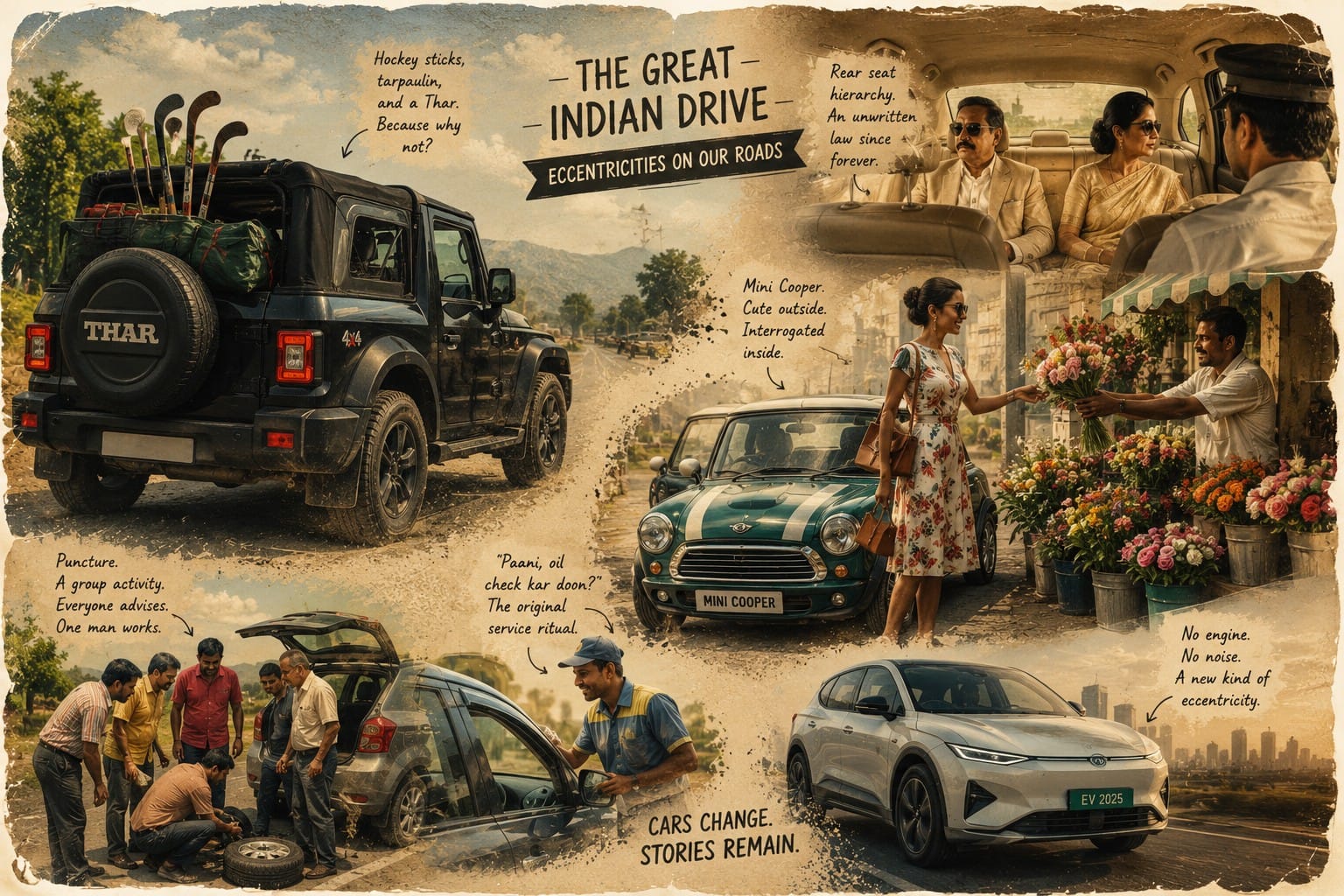
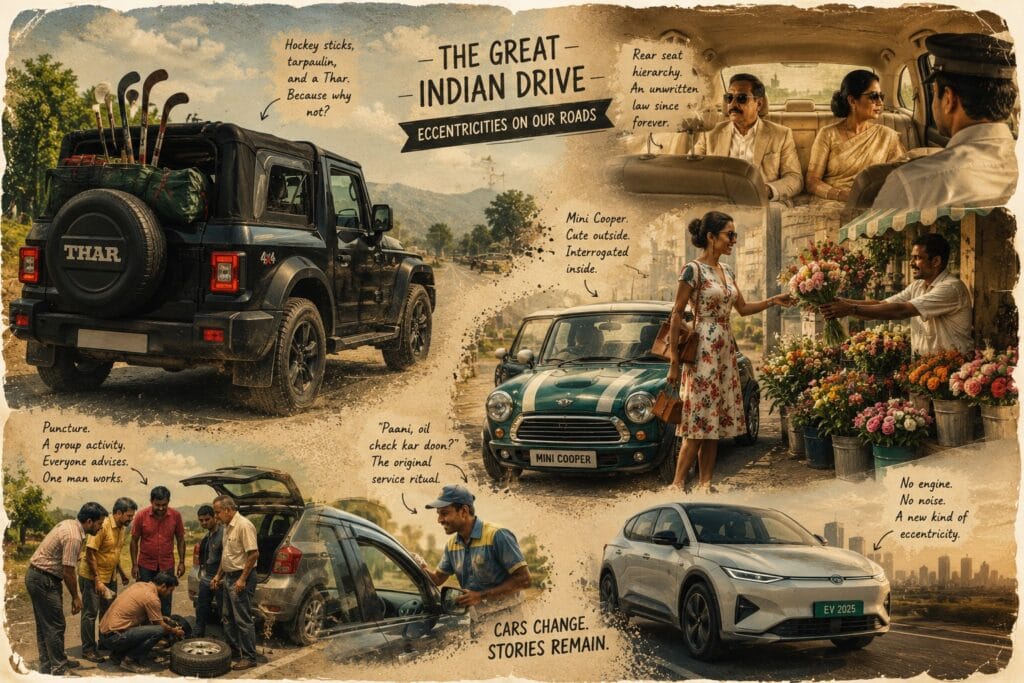
Big tyres, upright stance, enough swagger to make the traffic light feel like a minor inconvenience. You could almost imagine hockey sticks under a tarpaulin at the back and, after Animal, perhaps a blood-stained gandasa tucked away somewhere for cinematic effect. Sunny Paaji di gaddi had clearly been reborn. The Jaat never really died. He merely upgraded.
The Thar was an animal, a beast, and half its attraction was probably that it made even a trip to buy vegetables feel mildly insurgent.
As it moved ahead, I glanced into the rear-view mirror. Suddenly the road behind looked very crowded. There was the Scorpio, the original बिच्छू, sitting high and proud with a real sting long before every second car wanted to call itself an SUV. There was the Fortuner, turning bulk into status. Somewhere further back sat the Safari, Sierra, Santro, the early Honda City with that peculiar space-age shape, the Contessa with its endless bonnet, the Nano dreaming of putting everyone on four wheels and, behind all of them, the little Maruti 800 probably wondering how the roads had become so complicated.
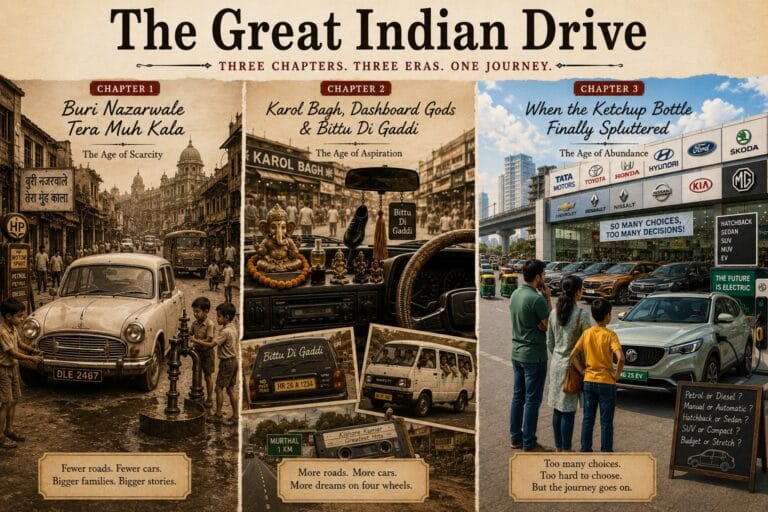
For years, buying a car in India had been remarkably uncomplicated. There simply weren’t enough choices to make a mistake. You looked at your budget, looked at the few cars available, consulted that one uncle who claimed to know everything about automobiles and bought one. The next ten years were then spent defending the decision as though family honour depended on it.
Then the ketchup bottle spluttered.
For decades we had been patiently thumping the bottom, waiting for something to emerge. When it finally did, everything came out together. Suddenly there were Japanese cars, Korean cars, European cars, Indian cars trying to look European, European cars trying to understand India and another launch every few months promising to fix whatever the previous one had apparently got wrong.
Everyone developed an opinion. Petrol or diesel? Manual or automatic? Hatchback or sedan? Someone’s cousin had driven the new Honda. A neighbour swore by Hyundai. One office colleague insisted Toyota could run forever if you just changed the oil on time. Another had read one magazine review and was now an authority on suspension, resale value and engine refinement. The person with the strongest opinion was often the one who had driven the car the least.
The showroom salesman discovered a weapon more powerful than horsepower: the EMI. Nobody told you what the car cost anymore. They told you how little extra per month the better model would be. “Sir, thoda sa stretch kar lo.” That sentence probably moved more Indians up the automotive ladder than some of the finest advertising campaigns ever did.
There had been occasional attempts at glamour even before the ketchup bottle really spluttered. Hindustan Motors, the same people who had given us the Ambassador, produced the Contessa. The feel was great and the car was huge—just huge. That endless bonnet, long body and growl gave it an importance completely different from the cheerful little Maruti. It looked like something a businessman, politician or Bollywood villain should emerge from while somebody hurried forward to open the door. Standard Motors briefly tried something similar with the Standard 2000—long, low and handsome—but it faded away almost as quickly as it arrived.
Tata had perhaps the oddest transition to make. We knew Tata as trucks, and suddenly the same company wanted us to believe it understood family cars. The Sierra looked unlike anything else around, the Safari was huge and imposing, the Indica carried the excitement of an Indian company making a proper Indian passenger car and the Indigo stretched the idea further. There was occasionally a faint sense that the people who had spent years designing trucks had simply been moved to another building and told, “Now make this comfortable.” But they persisted, and some of those cars developed personalities unmistakably their own.
Then there were the cars that simply made Indian roads prettier. The early Honda City had a peculiar space-age shape unlike anything we had grown up seeing. It looked low, sleek and futuristic, as though somebody had quietly imported tomorrow and put Indian number plates on it. The Santro went in the opposite direction—cute, upright and sturdy. Its tall-boy shape looked slightly odd for about a week and completely normal thereafter.
The Nano was perhaps the strangest collision between engineering and Indian psychology. A one-lakh-rupee family car was an astonishing idea. The engineers solved the affordability problem beautifully and then crashed straight into aspiration. Indians wanted an affordable car. They just didn’t particularly want to tell the neighbours they had bought the cheapest car in India. The poor Nano deserved better.
Luxury meanwhile continued to live in another financial galaxy. Beemers, Mercs and Audis glided past occasionally like celebrities making guest appearances. We admired them, pointed them out and moved on. They were reassuringly expensive and somebody else’s problem.
One car I always felt India missed was the Beetle. Those engorged eyes, rounded body and slightly goofy expression—we went bananas over it whenever we saw one abroad or in a film. It eventually arrived here too, but far too late and too expensively to become part of our roads. What a pity. The Beetle had personality before personality became a marketing department.
The Mini Cooper faced a peculiarly Indian problem. Why spend serious money on a tiny car that looked perfect for buying flowers from the market when, with a little stretching, you could get yourself into a Merc or Beemer with all the bells and whistles? Try explaining to Bhatia Aunty that your little Mini cost as much as the neighbour’s luxury sedan. Even Monica would cook a snook at it. Cute was fine. At that price, status also had to occupy some road space.
The Scorpio changed the mood completely. Even the name worked. Scorpio. बिच्छू. The bichhoo had a real sting. It sat high, looked aggressive and seemed equally comfortable outside a farmhouse, wedding tent, government office or barging through Delhi traffic. It wasn’t trying particularly hard to be European or Japanese. It looked perfectly happy being itself.
The Fortuner took bulk and converted it into social status. Then came the Thar and macho was no longer implied; it was written all over the thing. Which brought me back to the beast disappearing ahead in traffic. Sunny Paaji di gaddi had returned, only with better suspension and a much larger EMI.
Somewhere along the way, India collectively decided that every pothole demanded the ground clearance required for an African safari. Cars grew taller, grilles became larger and advertisements suggested that taking the children to school involved crossing three rivers and climbing a mountain pass. Most of these magnificent beasts spent their lives negotiating office basements and supermarket parking lots, but that never stopped us imagining ourselves as explorers.
We carried some wonderfully durable theories about safety too. One was that a long bonnet was reassuring on the hills. The logic sounded reasonable enough: if you hit something, there was plenty of metal in front that had to crumple and sacrifice itself before anything reached the windscreen and eventually you. Whether anybody had statistically checked this was irrelevant. It felt right. Perhaps that is why cars like the Innova always felt so reassuring on a long drive—big, planted and built as though they intended to bring everyone back home.
Another Indian eccentricity had been around much longer: the hierarchy of the rear seat. The senior, elder, boss, guest or lady was rarely directed to the seat immediately behind the driver. Somehow the other rear seat had acquired higher social status. Nobody had written this rule down, yet everybody seemed to know it. Chauffeur-driven India had developed its own seating protocol without ever issuing a circular.
Features meanwhile multiplied at absurd speed. Airbags, which once hadn’t even entered our heads, became numbers to compare. Cameras, sensors, touchscreens, automatic climate control and assorted buttons appeared everywhere. The cassette player travelled through CDs and USB drives before the entire dashboard turned into a television screen.
Then came the sunroof, a feature I still don’t entirely understand in a country blessed with this much sun. Eventually I realised the glass wasn’t the attraction. Standing through it was. Teenagers popped their heads out, hair flew everywhere and suddenly everybody was auditioning for Rang De Basanti. Secretly, I always wanted to do it too—preferably somewhere in the mountains, hair in the wind and safety temporarily consigned to the bins.
Even our relationship with the bonnet changed. Once, whenever a car stopped, everybody opened it whether they understood engines or not. Someone checked the radiator, somebody tugged at a wire and an uncle stared thoughtfully at the battery until another uncle arrived with an entirely different diagnosis. Open the bonnet of a modern car and there are plastic covers, electronics and a fairly strong suggestion that you should shut it again and call the service centre.
Then, almost without drama, the engine itself became quieter. Electric cars arrived. No choke, no anxious listening for a strange rattle, no petrol-pump attendant asking “Paani, oil check kar doon?” before wiping the windscreen with a cloth that somehow spread the dirt more efficiently than removing it.
Even the puncture, that great Indian roadside conference, started disappearing. Nobody really knew how to change a tyre, yet everybody knew exactly how it should be done. One man questioned the jack, another argued about the wheel nuts and the poor owner knelt on the road doing all the work while the advisory committee stood around with folded hands. Eventually the stepney went on and everyone walked away convinced his advice had saved the expedition.
Somewhere during this journey, buying a car quietly stopped being an occasion. Half the neighbourhood no longer emerged to inspect the newest arrival. Cars became safer, faster, quieter, smarter and vastly easier to own.
Every now and then, though, an old Ambassador, Premier Padmini or Maruti 800 still wanders past.
I don’t find myself looking at the car.
I’m looking for the family inside.