
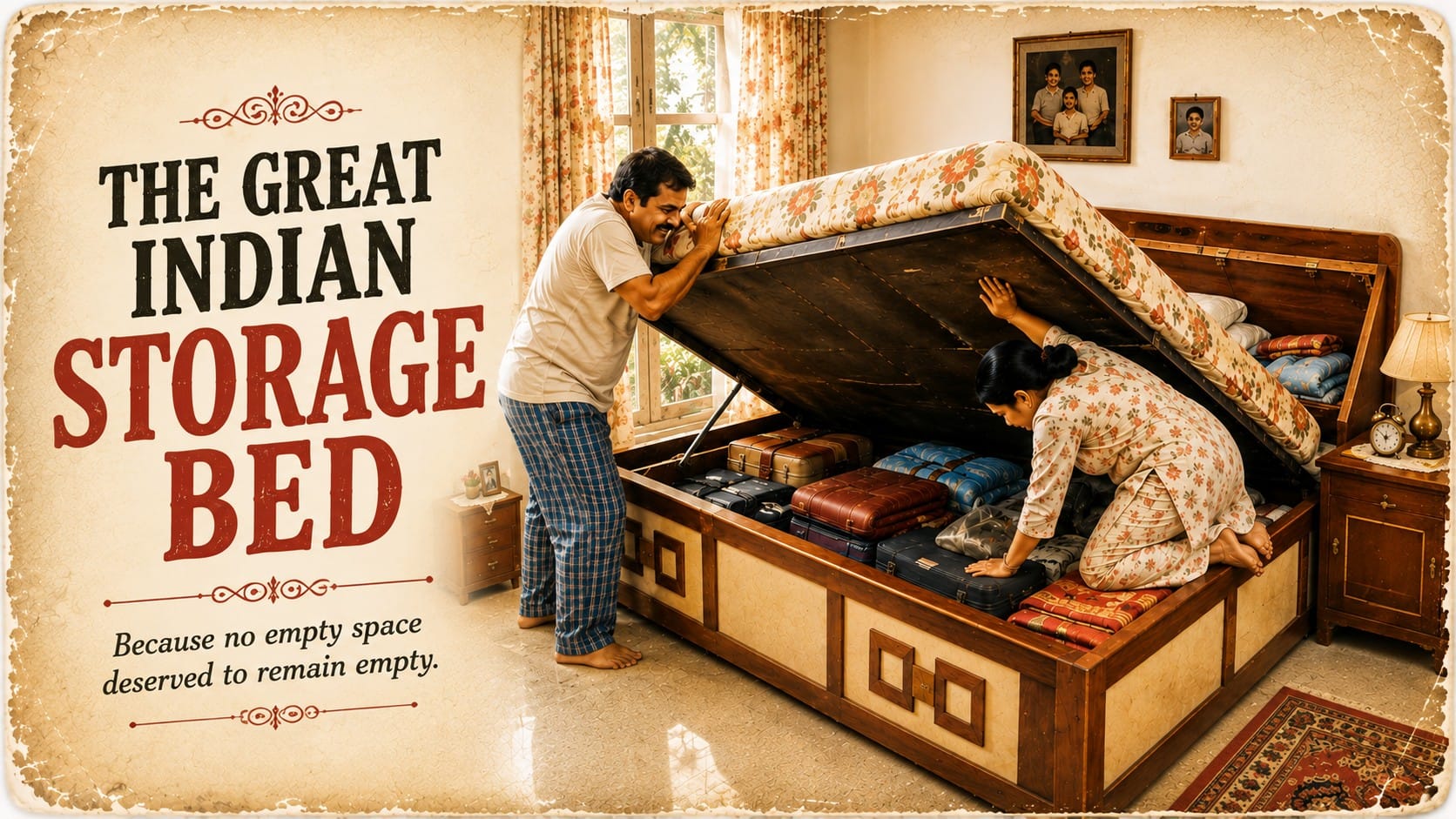
The Indian middle class has never been comfortable with unused space. If a corner remained empty for too long, somebody would eventually decide it could be put to better use. The loft acquired trunks, the top of the Godrej almirah acquired suitcases, the space below it became home to shoes, and then someone had the bright idea of creating a large storage compartment beneath the mattress of a perfectly ordinary double bed. Sleeping was no longer enough. The bed also had to become a cupboard.
The storage bed almost always entered the house with the wedding. Those were the days when marriages didn’t merely unite two people; they furnished an entire household. There seemed to be an unwritten rule that everything had to come as a set—a sofa set, a double bed set, a dining set, a tea set and, if the budget permitted, a pressure cooker, mixer grinder and enough stainless steel utensils to feed an unexpected wedding procession. The Godrej almirah stood proudly in one corner while the storage bed occupied the other. Looking back, I sometimes wonder whether families spent more time discussing furniture than discussing the couple.
The beds themselves followed predictable fashions. If the budget was generous, there was polished teak. Otherwise came the laminated plywood versions from Panchkuian Road or Kirti Nagar, trying very hard to resemble real wood. They looked perfectly respectable then, although through today’s eyes they seem to belong to another civilisation. The matching side tables were compulsory. Nobody really questioned why every bed required two identical little cupboards standing guard on either side. They came because they belonged to the set. The dressing table matched the bed, the wardrobe matched the dressing table and somehow the entire room looked complete.
The bedsheets had their own unmistakable personality. This was long before lifestyle stores convinced us that bedrooms should resemble Scandinavian catalogues. Ours came in loud floral prints, oversized geometric patterns and those familiar NTC-style designs that seemed to exist in every Indian home. Nobody worried whether the bedsheet matched the curtains or the wall colour. It only had to survive years of washing and still look respectable when guests arrived.
The real adventure, however, began only when someone announced, “Let’s look inside the bed.”
That single sentence immediately became everybody’s assignment.
Unlike today’s lightweight foam mattresses, those old cotton mattresses seemed to have absorbed the weight of every afternoon nap, every winter quilt and every family worry. Lifting one wasn’t a one-person job. Two reasonably fit adults were required, followed by a discussion on where exactly the mattress should be parked while the operation continued. Only then could the heavy wooden platform be raised, revealing the vast storage space underneath.
One person held the wooden lid while the other disappeared headfirst into the cavern below in search of a razai, old suitcases, winter clothes, wedding albums or something that somebody distinctly remembered putting there several years earlier. The arrangement demanded extraordinary trust. It always reminded me of the man at the Bangkok zoo who places his head inside the open mouth of a crocodile, hoping the crocodile continues to honour the arrangement. Here too, one partner trusted the other not to let the heavy wooden plank come crashing down.
Unfortunately, the person holding the lid was usually just as fascinated by the discoveries taking place below. Every few minutes came another excited announcement.
“Look… here’s the old photo album.”
“I had forgotten we still had this blanket.”
“Wasn’t this suitcase lost?”
The holder instinctively leaned forward for a better look, momentarily forgetting that gravity had been waiting patiently for exactly this moment. Looking back, it is remarkable how many Indian marriages survived these expeditions without serious injury.
If the storage underneath was manageable, the compartment behind the headboard was an altogether different challenge. Its depth matched the width of the bed, ensuring that whatever you wanted would always roll to the farthest corner. Retrieving it involved lying half across the mattress, stretching your arm to anatomical limits and blindly fishing around until your fingers located the curled-up pillow, blanket or shawl you were looking for. By the time you retrieved it, your shoulder had usually registered its formal protest.
And what exactly occupied all this carefully designed storage?
Not things we needed every day.
Those lived outside.
The storage bed became home to things that could never quite be thrown away. Extra quilts. Wedding gifts that nobody found a use for but nobody had the heart to discard. Old curtains from the previous house. Suitcases. School projects. Decorative cushions. Empty gift boxes because they were “too good” to throw away. Plastic flowers. Photo albums. Mysterious newspaper-wrapped packets that nobody had opened in years because opening them would only create one more decision.
Modern storage beds have hydraulic lifts. You raise the mattress with one finger and the mechanism quietly does the rest. Efficient, elegant and entirely free of drama.
Our generation had no hydraulics.
We had teamwork.
Opening a storage bed was never an individual activity. Someone lifted the mattress, someone held the plank, someone searched, someone supervised and before long another member of the family would appear from nowhere and say, “Since you’ve opened it anyway, see if my old sweater is also inside.”
That was the thing about Indian homes. Nothing was ever opened for just one purpose.
Looking back, I don’t think the storage bed was really designed to store quilts and suitcases. It quietly stored something far more Indian—the belief that no empty space should remain empty and no reasonably good object should ever be thrown away.
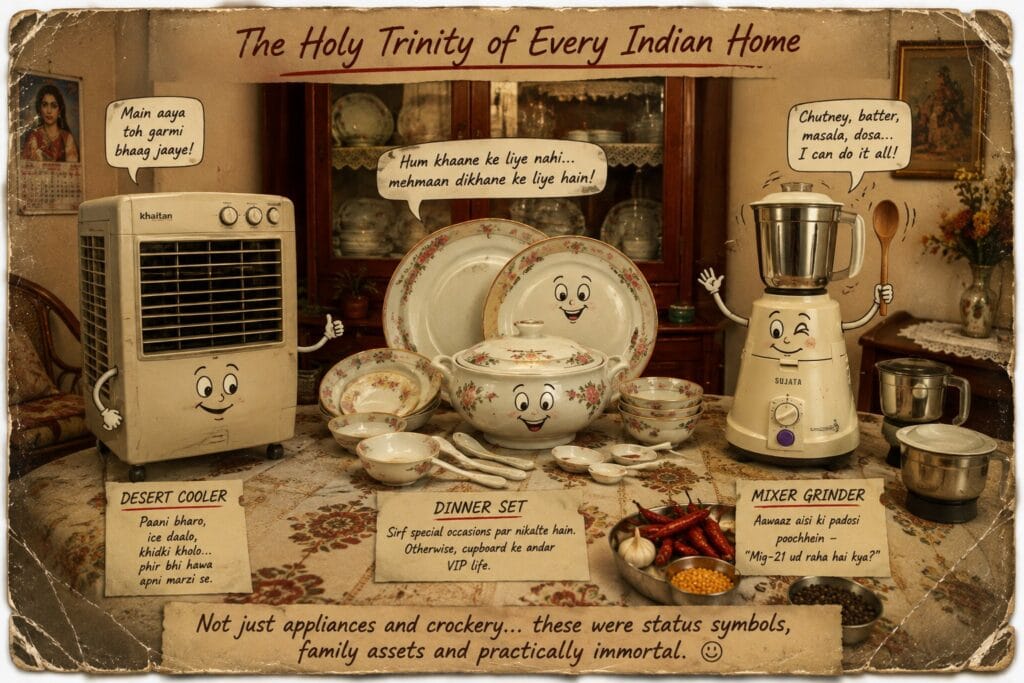
And now that I’ve opened this particular cupboard of memories, I realise there are many more waiting patiently in line. The wedding dinner set that was too precious to be used except when the Head of a State dropped in. The desert cooler that announced the arrival of summer long before the weather department did. The mixer grinder that sounded like a MiG-21 taking off. They all deserve their turn.
After all, every Indian home came fully furnished with stories.
If you enjoyed this story, stay around. We’re only just opening the cupboards of memory. Coming soon: the wedding dinner set that was never used, the desert cooler that defined Indian summers, the mixer grinder that woke up the neighbourhood, and other middle-class legends that quietly shaped our homes.
Before you go, if you like the above post, you would like the below :






What lovely articles.
Enjoying reading each one of them