
Long before air conditioners became affordable and began appearing on every second wall, Indian homes had developed their own elaborate systems for surviving summer. Heavy curtains were soaked in water and hung over doors and windows, hoping that whatever breeze entered the house would pick up some coolness on the way. Roofs and terraces were sprayed with water in the evening, ceiling fans worked continuously, and hand-held fans were always around because the rotating one above could not necessarily be trusted to handle a north Indian summer on its own.
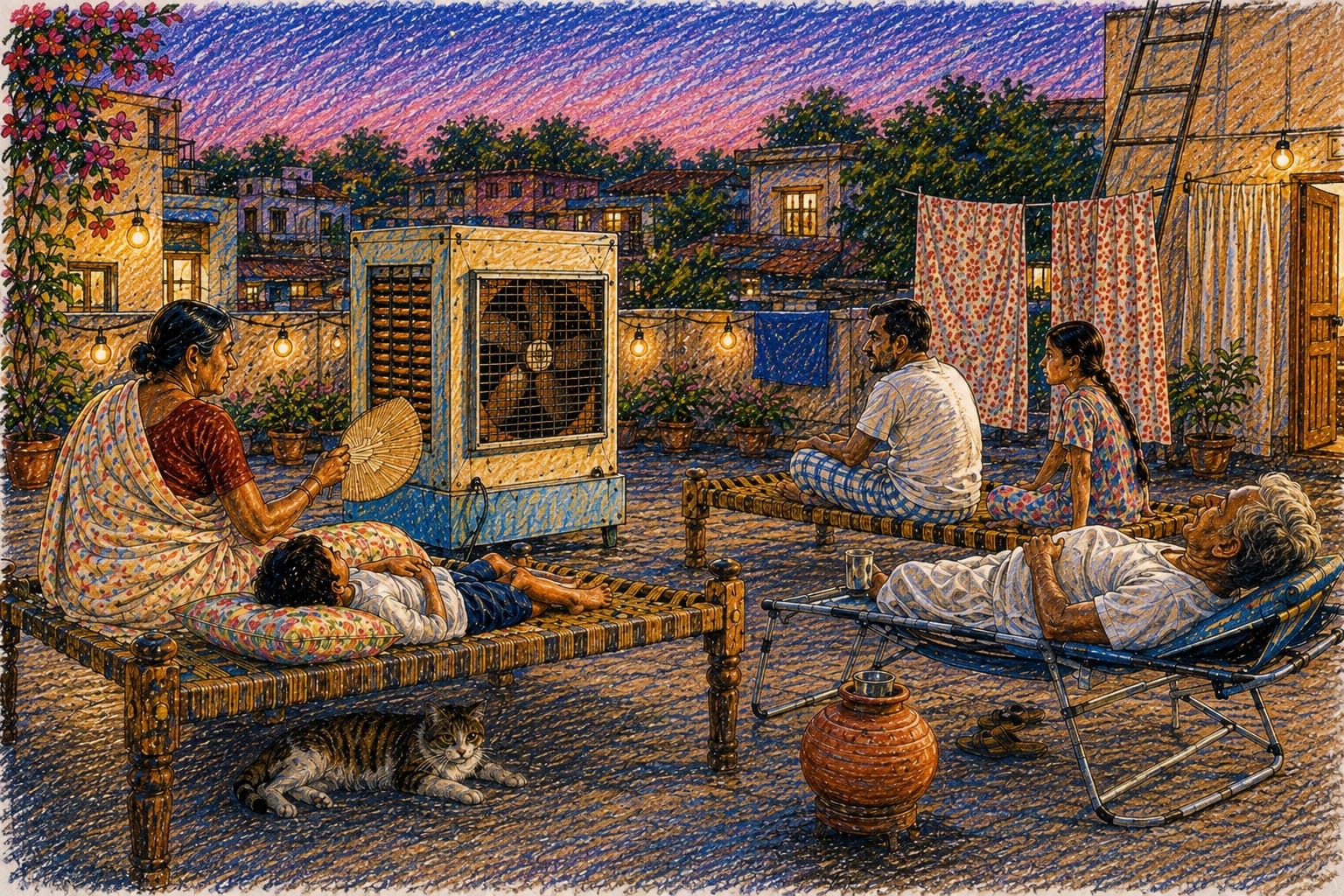
Night brought its own seasonal migration. In government colonies, ground-floor families simply pulled their charpoys outside and slept in the open, while those living upstairs had the more cumbersome ritual of lugging them onto the terrace every evening. These were proper charpoys with four solid payas, unlike the folding beds that arrived later with shiny plastic-looking strips stretched tightly across a metal frame. Those looked wonderfully modern then, although seen today they have roughly the elegance of emergency hospital furniture.
The surahi travelled with the charpoy because sleeping on the terrace was one thing, surviving the night without water was another. It sat beside the bed, sometimes wrapped in a damp cloth, keeping the water naturally cool. The surahi also had a fairly predictable life cycle. At some point, usually while being carried up or down the staircase, it would slip, shatter and release an impressive stream of water across several steps. The unfortunate carrier would first be admonished for carelessness and then ordered to wipe the stairs before somebody slipped and broke something considerably more expensive than an earthen pitcher.
Terrace sleeping was completely communal. Cats slept comfortably under the charpoys, conversations floated from one cot to another, somebody discussed the electricity bill, somebody complained about the water supply and somebody repeatedly told the children to stop whispering and go to sleep. Sleeping under the stars sounds romantic now. At the time, nobody was looking at constellations; we were simply trying to get some ventilation.
The occasional summer rain shower could turn this peaceful arrangement into chaos. Bedsheets and pillows had to be picked up and rushed indoors before they became completely soaked because drying them again depended entirely on sunlight, patience and a clothesline. Then came the small but significant problem of the charpoy itself. It could be midnight, everyone half asleep, and suddenly nobody appeared to own this particular responsibility. People vanished downstairs or slipped indoors with remarkable efficiency and, in the ensuing confusion, it was generally the eldest available person who got caught dragging the charpoys to safety while muttering about the uselessness of the entire family.
There was also invariably one stubborn family member who refused to participate in any of this. Despite the rain, he would simply pull the bedsheet over his head and continue sleeping while getting progressively drenched. That was his wet dream. He was usually the same fellow who, on perfectly dry mornings, refused to wake up until the sun had come out in full glory and converted the terrace into a tandoor.
And then, almost magically, desert coolers arrived. They were clunky tin boxes, somewhere between an appliance and a metal cupboard, with a huge fan in front and three sides covered with khus. Thin tin panels with rows of louvers allowed air to enter, while wires, screws and bits of metal held the whole thing together without any unnecessary concern for finish, symmetry or human safety. Inside sat a shallow pool of water, a small pump and a fan powerful enough to announce itself to the neighbourhood.
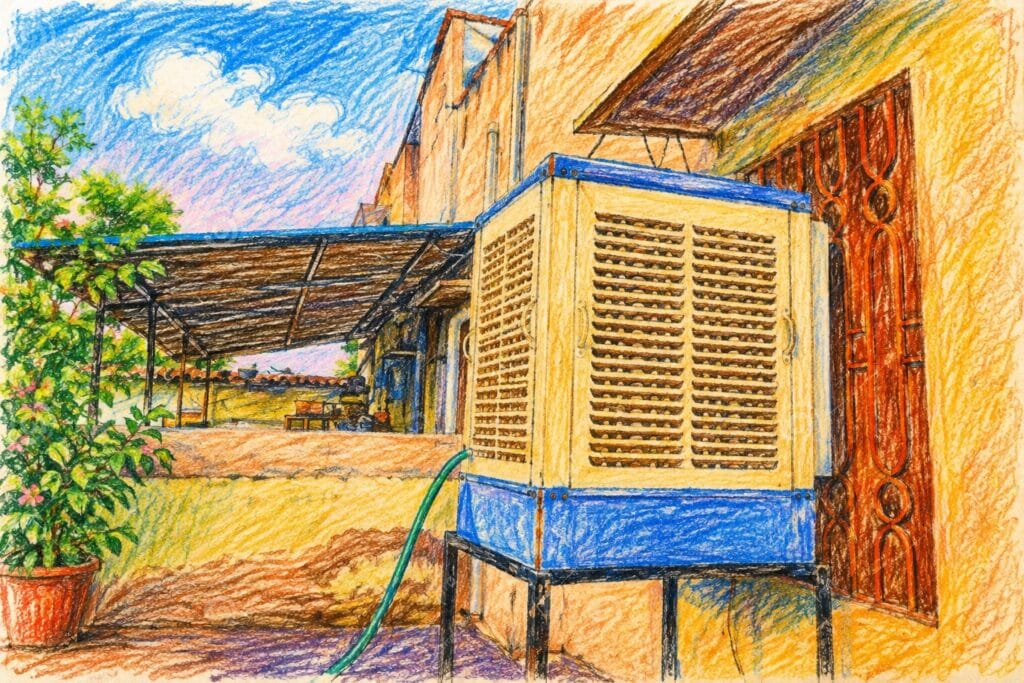
The pump lifted water and spread it over the khus sheets, the fan pulled hot air through them and what came out from the other side felt miraculous. It was essentially the old wet-curtain idea, except somebody had automated it and put it inside a tin box. The breeze carried that wonderful earthy smell of wet khus and on a savage May afternoon an ordinary room could suddenly feel almost luxurious.
Naturally, the miracle had its own engineering challenges. Ground-floor families had it relatively easy because the cooler could be fitted directly into a window on iron supports outside, with the fan facing into the room. Once installed, however, it effectively became part of the building. Removing the entire contraption every winter was too much effort, so most families simply covered it with thick cloth, plastic or whatever else could be tied around it. Unfortunately, winter air still found its way through the louvers, khus and tiny gaps in the metal body, which meant the machine that had saved you in May could turn the same room into an Eskimo training camp by December.
Upper-floor families and those unwilling to undertake a small civil engineering project often bought coolers on wheels and placed them inside the room. It was easier but never quite as effective because a desert cooler really wanted hot, dry air from outside. Put one inside a closed bedroom and after a while the room could begin to resemble a mildly tropical ecosystem.
Then there was the water, which the cooler consumed relentlessly. The civilised method was to remove one of the side panels and pour it in patiently with a mug. The more popular method was to arrive with a full bucket, lift the entire thing with misplaced confidence and try to empty it into the cooler without flooding half the room. Removing the side panel was itself an adventure because these tin sheets were not designed around modern ideas such as ergonomics or consumer safety. The edges were sharp, the wires unpredictable and the panel rarely came out without resistance. Many people cut their hands while opening the cooler, adjusting the khus or putting everything back together, after which came Dettol, a small bandage and an angry declaration that the cooler had been terribly designed. A few days later, the same ritual was repeated exactly as before.
Water filling soon became a project worthy of an engineer. Nobody enjoyed carrying heavy buckets from the bathroom to coolers sitting in different rooms, so a long flexible pipe was bought, one end attached to the bathroom tap through some ingenious arrangement and the other sent on a winding journey through the house, negotiating doors, furniture and human traffic until it finally reached the cooler. It worked surprisingly well, except that the bathroom door had to remain ajar and the bathroom itself effectively went out of service while the operation was underway.
The cooler, to be fair, had its own primitive piece of automation. Inside was a black hollow sphere floating on the water and connected to the inlet. As the level rose, the sphere was supposed to rise with it and eventually shut off the incoming supply. It was quite clever, provided the pipe was actually connected to the inlet. Many households considered this excessive precision and simply pushed the flexible pipe through the front grille, thereby bypassing the entire black-bobbing-sphere technology and returning control to human beings.
Since municipal water itself often came at fixed timings, cooler filling had to be synchronised with the water supply. Somebody would be deputed to watch the rising level while simultaneously studying, reading a book or watching cricket, and at the appropriate moment he was expected to shout across the house for someone to shut the tap. The system worked reasonably well provided everyone remained alert and there was no gripping last over on television.
When teamwork failed, the water would rise beyond the intended level and suddenly the whole household would spring into action. The filling exercise would reverse into a water-removal exercise involving buckets, mugs, wet floors and accusations about how nobody was focused, nobody listened and everybody else was careless. By the time peace returned, the cooler would be full, the bathroom available again and half the family mildly offended with the other half.
Some families went one step further and called the plumber to create a permanent water connection to the cooler. This was viewed as great technological progress until someone realised that water pipes could hardly be allowed to criss-cross bedrooms and drawing rooms like a miniature irrigation project. So the innovation remained impressive but somewhat limited in practical application.
Opening the cooler, however, was not always about maintenance. With the fan switched off, it was great fun to remove one of the louvred side panels and put your head inside. The interior was dark, damp and surprisingly cold, almost like entering a tiny cave in the middle of summer. Wet khus surrounded you, droplets clung to the metal and for a few seconds the blazing heat outside seemed very far away. Naturally, an adult would eventually discover the expedition and order you to remove your head before you cut yourself, damaged the pump or somehow managed to get trapped inside a desert cooler, but until then it was probably the coolest place in the house.
The cave was not always unoccupied. A lizard or some unfortunate insect occasionally found its way inside and was usually discovered either drowned in the water below or clinging desperately to one of the wet khus sheets. Such discoveries immediately brought the household around the cooler. Nobody particularly wanted to remove the intruder, but everybody wanted to watch while the bravest available person was handed a broom, stick or pair of tongs. For a few minutes, the desert cooler stopped being an appliance and became live entertainment.
Standing water created another problem because after a few days the pleasant smell of wet khus could begin to resemble a neglected pond. Families responded creatively by pouring perfume, eau de cologne and assorted fragrant liquids into the tank in the hope that the cooler would release air suitable for a drawing room rather than something from a damp warehouse.
The pump too had moods of its own. It could work perfectly one afternoon and refuse all cooperation the next. The fan would roar, the khus would remain dry and the air coming out would be almost as hot as the air going in. Somebody would open the side panel, tap the pump, shake a wire and confidently announce that the motor had become jammed. Eventually the neighbourhood electrician would arrive, inspect the machine with great seriousness and restore it with a combination of pliers, insulation tape and authority. For the next few days, everybody treated the pump gently, almost as if it had recently recovered from a serious illness.
Children, meanwhile, discovered that the cooler was not merely an appliance but also an entertainment system. You could put your face near the fan and shout into it, producing a wonderfully vibrating voice, and entire conversations could be conducted this way until some irritated adult threatened to switch the cooler off. More adventurous experiments involving pencils and the front grille generally needed to be attempted only once.
Despite all this, the desert cooler was revolutionary. It was noisy, damp, temperamental, faintly dangerous and occasionally smelled peculiar, but when that first blast of cool air touched your face in peak summer, every complaint disappeared. Chairs moved closer, mattresses moved closer and children moved closer until the patch directly in front of the cooler became the most valuable real estate in the house.
Then came the air conditioner. For a long time, a proper branded AC remained expensive enough for ownership itself to indicate that a household had crossed a certain financial threshold. Fedders Lloyd, Blue Star and Voltas were familiar names, but the middle class, as always, discovered a workaround. The friendly neighbourhood electrician began assembling air conditioners locally from compressors, cooling coils, cabinets and assorted parts, producing machines that looked vaguely like air conditioners and sounded like small industrial units. There was no meaningful brand identity; reliability depended largely on the confidence with which the electrician said, “Sir, bilkul imported quality hai.”

Those machines cooled the room, consumed heroic quantities of electricity and occasionally released water from unexpected places, but they represented a major step forward. For the first time, summer could be fought without khus sheets, water buckets or plumbing adventures.
By the turn of the century, LG, Samsung and several other brands changed the market. Air conditioners became cleaner, quieter and progressively more affordable, remote controls appeared, temperatures could actually be selected and financing made the purchase easier. Compressors slowly began colonising the outside walls of middle-class homes and Indian summers were never quite the same again.
The wet curtains disappeared, charpoys stopped travelling to terraces and the surahi gradually gave way to the refrigerator. The desert cooler survived, but increasingly in verandas, rented homes and places where the air conditioner had not yet completely conquered. We undoubtedly gained comfort; we slept better, worked better and no longer woke because somebody on the neighbouring terrace had started an argument at midnight.
But somewhere during that journey, summer itself changed. What had once been a noisy, uncomfortable and strangely communal season slowly moved behind closed doors.
Summer became private.
Before you go…
If this brought back memories of summers when the desert cooler was practically a family member, you may also enjoy the below posts:
Different objects. Same Indian household. And somehow, the same chaos.






One Comment